Hanging gutter: the edge that cuts, the hand off the rail
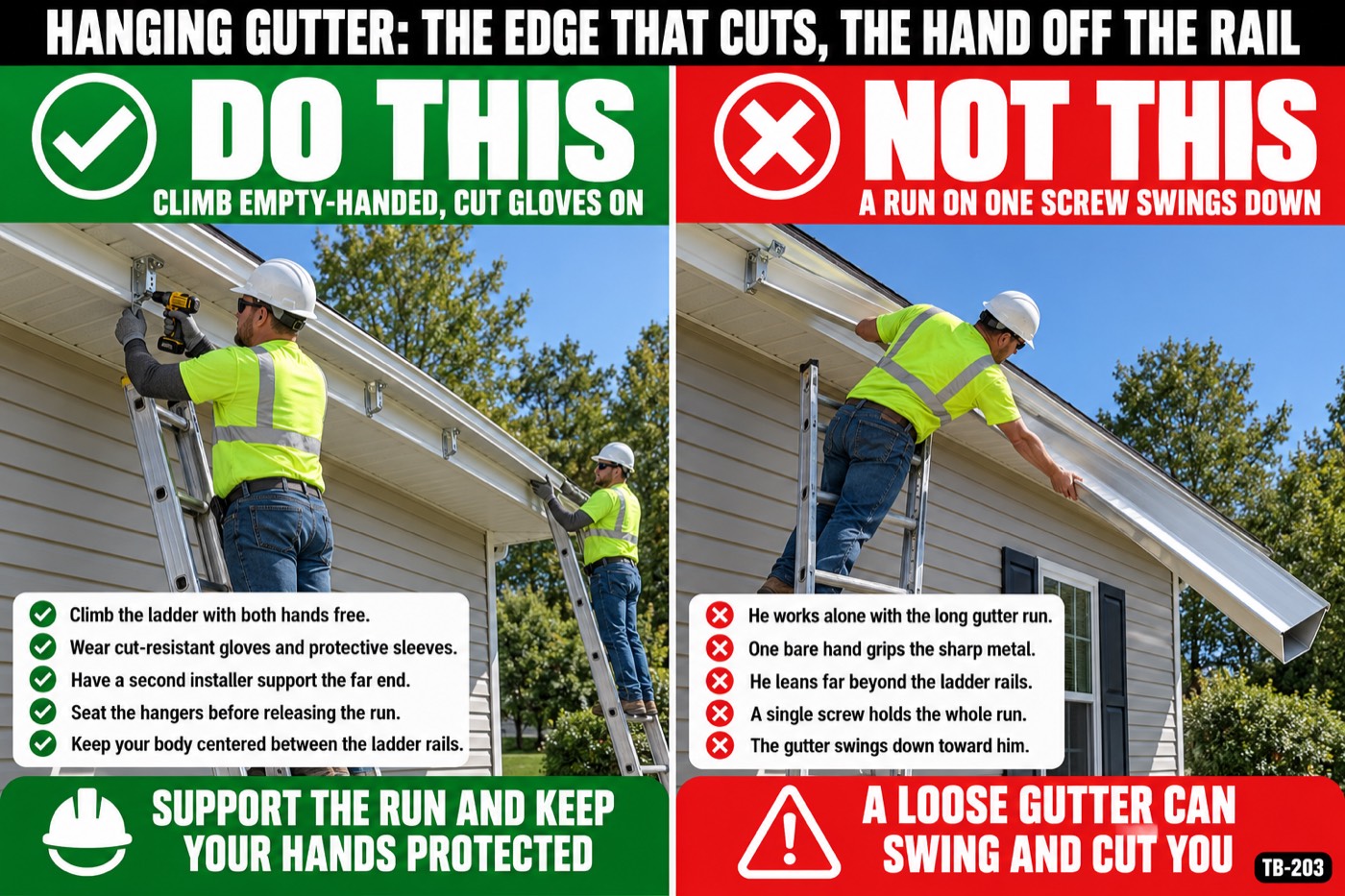
A freshly cut end of aluminum gutter is sharper than most of the knives on this crew. And the rule says you do not carry anything up a ladder that can make you lose your balance.
The points
- Gutter work gets people two ways: the cut edge takes skin off a forearm, and the person on the ladder leans out with a 40-foot run in one hand and no hand for the rail.
- Cut-resistant gloves and sleeves for anyone handling gutter, downspout or miter. The crimped end of a downspout and the cut end of a run are both razor edges.
- Never move a ladder with gutter or a downspout in your hand. Set the material down, move the ladder, climb, then the ground person hands it up.
- A long run goes up with two people on two ladders, or with the ground person lifting the far end on a pole. Your belt buckle stays between the rails; the run comes to you, you do not reach for it.
- Hangers go in every 24 to 36 inches as you go, screws seated, before anyone lets go of the run. A gutter held by one screw at 20 feet swings down like a scythe.
Why it goes wrong
Aluminum gutter is 0.027 or 0.032 inch thick, and a shear cut leaves a clean, thin edge with a burr. It is the same geometry as a box cutter blade. Sliding a hand along a run, catching a miter, or a downspout section that slips through your grip while you are looking up puts the cut on the tendon side of the wrist or the inside of the forearm, and those bleed hard.
The ladder rule says an employee shall not carry any object or load that could cause the employee to lose balance and fall. A 10-foot downspout is light, but it is 10 feet long and it swings. Coming down a ladder with it is worse than going up, because you are looking at your feet and the far end catches the gutter or a branch.
The ladder move is the fall. The pattern is a person with a run in one hand walking the ladder sideways along the fascia with the other. The foot skids, the run hits the ground, and they go with it. Material down first, then the ladder, every hanger, every time, even the last four feet.
Two people on a run over 20 feet. A run resting on your shoulder while you drive a screw puts your center of gravity outside the rail. A ground person with a gutter pole or a second ladder holds the run while you seat hangers. If the ground person has to step away, the run goes back down.
Hidden hangers and screws hold gutter, not the first two screws and gravity. Space hangers about 24 inches in snow and ice country and 36 inches where it does not freeze. The first hanger goes in at the high end, then the run is leveled to the chalk line, then the rest. A run that lets go over the front steps hits whoever is walking out the door.
Downspouts get set from the bottom, straps screwed as you climb, and the top elbow last. A ladder standoff keeps the rails off the downspout and off the new gutter. The old gutter coming down is the same edge and the same weight, plus 20 years of wet leaves and a wasp nest.
Questions for the crew
- How long are the runs going up today, and who is on the ground for each one?
- Where do we set the ladder for the run over the front door, and where does the family come in and out?
- Who has cut gloves on right now?
To close
Today the ladder moves with empty hands, and no run is let go of until at least three hangers are seated.
To hold this talk with your crew
1
Read it aloud. Five minutes, before the work starts.
2
Ask the questions. A crew that talks is a crew that remembers.
3
Have them sign on their own phones, and the record is sealed.