Cutting Hardie: shears make chips, saws make silica
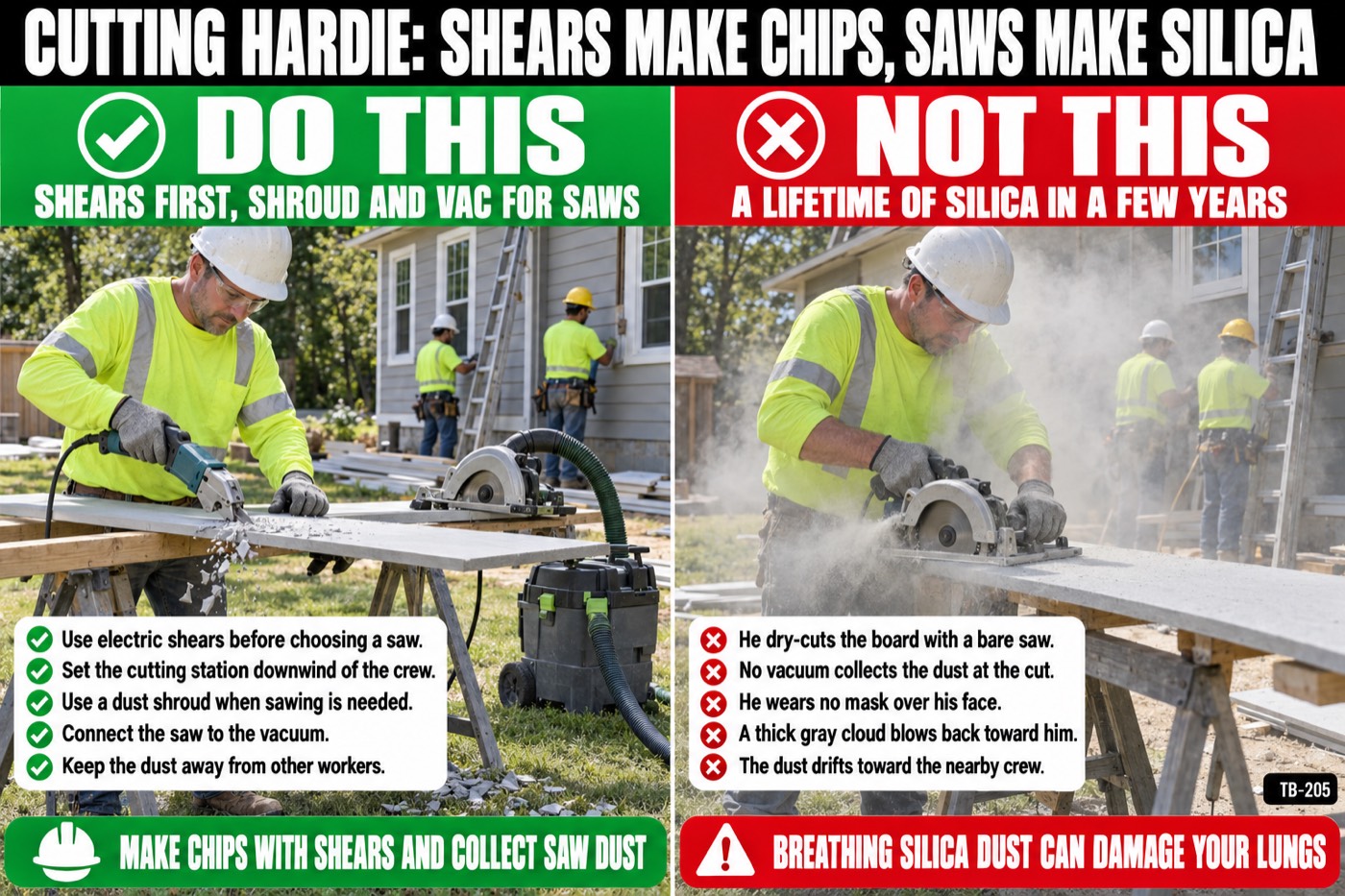
Fiber cement board is roughly half sand by weight. Run a dry saw through it and the cloud you see is crystalline silica going into lungs, and lungs do not clean it back out.
The points
- Silicosis is scar tissue in the lungs, it is permanent, and by the time you are short of breath on the stairs it is too late to fix. A siding crew can breathe a lifetime's worth in a few years of dry cutting.
- The limit is 50 micrograms per cubic meter over a shift. A dry circular saw cut on fiber cement puts out many times that at the operator's face.
- Shears first. Electric or pneumatic fiber cement shears cut the board with no dust at all, and they are the tool for straight cuts and most of the day.
- When you need a saw, it is a fiber cement blade on a saw with a dust collection shroud and a vacuum with a 99 percent filter, cutting outdoors. That is the setup the rule lists as needing no respirator.
- A regular saw and a regular blade with no vacuum is not on the list. Nobody makes that cut today, and the cutting station is downwind of the crew, not next to the ladder.
Why it goes wrong
Respirable silica is dust smaller than 4 microns, too small to see and small enough to get past the nose and throat into the air sacs. There it causes scarring that keeps spreading after exposure stops. Silicosis, lung cancer and kidney disease are the outcomes, and none reverse. The rule sets an action level of 25 micrograms and a permissible limit of 50 micrograms per cubic meter, averaged over 8 hours.
Table 1 in the silica rule lists the tools and the controls that count as compliance without air sampling. For fiber cement board 8 inches or less, cutting outdoors with a saw equipped with a commercially available dust collection system and a filter of 99 percent or better efficiency, no respirator is required at any duration. Take the vacuum off, cut indoors, or use a saw that does not fit the entry, and you are off the table and the employer owes an exposure assessment and probably respirators.
The dust collection saw only works if the vacuum runs, the hose is on, and the filter is not clogged. A bag full of cement dust drops the airflow and the shroud starts leaking. Empty it into a bag, not into the wind, and check the hose is attached before the first cut, every setup.
Shears, a score-and-snap knife, and a guillotine cutter make no respirable dust. For lap siding that is most of the cuts on the wall. Saws are for notches around outlets and rake cuts, and even those can be done with a jigsaw and a shroud. Fewer saw cuts is the cheapest control there is.
Downwind and away. The dust from a saw cut goes where the wind takes it, which is onto the helper on the ladder 10 feet away, the homeowner's open window, and the kids' sandbox. Set the station on the downwind side of the house, away from doors and windows, and keep other trades out of it.
Wash hands and face before you eat, and change the dusty shirt before you get in the truck. Silica on your clothes goes home, into the cab, and onto the kid you pick up. The rule also requires medical exams for anyone who has to wear a respirator 30 or more days a year, so if you are in a mask that often, the employer owes you a lung test.
Questions for the crew
- What are we cutting fiber cement with today, and is the vacuum on the saw actually running?
- Where is the cutting station, and which way is the wind?
- How many of the cuts today could be shears instead of a saw?
To close
No dry saw cut on fiber cement today without a shroud and a running vacuum, and shears for every straight cut.
To hold this talk with your crew
1
Read it aloud. Five minutes, before the work starts.
2
Ask the questions. A crew that talks is a crew that remembers.
3
Have them sign on their own phones, and the record is sealed.