Extension springs: the cable that stops it flying
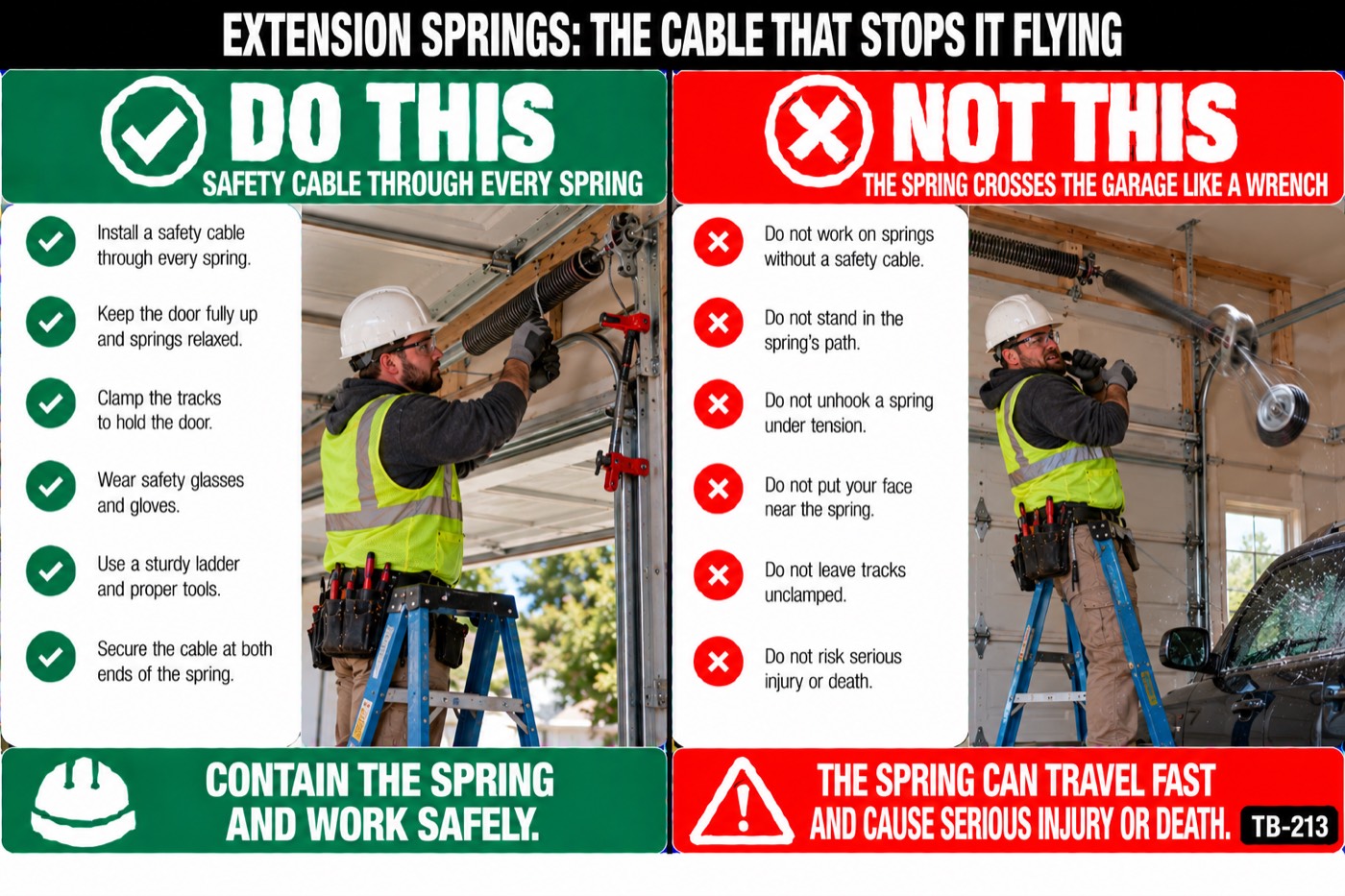
An extension spring on a 7-foot door is stretched to about 42 inches and pulling about 100 pounds with the door closed. When it breaks with nothing through it, the spring and the pulley cross the garage like a thrown wrench.
The points
- An extension spring that snaps under load whips its loose end and the pulley through whatever is in the way: a windshield, drywall, a face. Without a safety cable the pieces have gone 20 feet.
- The safety cable runs through the middle of the spring, from the rear track hanger to the front track bracket, with the slack out, so a broken spring stays on the wire.
- Springs carry the load with the door down. To work on the spring, run the door all the way up, clamp both tracks under the bottom rollers, and then the spring is slack.
- Pulleys: the sheave, the bolt and the fork. A cracked or wobbling pulley is a broken pulley one cycle away, and fingers stay out of it while the door moves.
- Springs are replaced in matched pairs by the color code. Mixing ratings racks the door and overloads the stronger spring until it lets go.
Why it goes wrong
An extension spring is a coil of steel wire stretched to roughly double its resting length, and every inch of stretch is stored energy. When a coil breaks, the loose end recoils at the speed of a slingshot, and the pulley and its bolt ride the end. The safety cable does not stop the spring breaking; it keeps the broken halves on a wire instead of in the air.
The cable is 1/8-inch aircraft cable run through the inside of the spring, not alongside it, anchored to the rear hanger and to the track bracket at the front. Older installations often have none, and adding a pair takes ten minutes. Door and spring makers call for them; there is no OSHA section on them, so it comes under the training duty in 1926.21(b)(2): you know what the cable is for and you do not leave a door without it.
Load only comes off when the door is fully open, because the spring is at its shortest with the door up. Vise grips on both tracks below the bottom rollers hold it there. Never unhook a stretched spring by prying the hook with a screwdriver, and never stand in line with the spring's length while it is under tension.
The pulley at the spring end travels with the door; the pulley on the front track bracket is fixed. Look at the sheave for cracks and at the bolt for wear, and spin it by hand. A pulley that seizes lets the cable saw through it in a few dozen cycles, and a cracked sheave lets the cable jump the groove and slam the door down on one side.
The common mistake is replacing only the broken spring. The other spring has the same cycles on it and a different rating from the new one, so the door pulls crooked and the old spring goes within weeks. Weigh the door with the springs unhooked, and put a matched pair on it.
Questions for the crew
- Does this door have safety cables through both springs, and are they anchored at both ends?
- Where is the door going to be when we touch these springs, and what is holding it there?
- Who is standing in line with the spring while we cycle it?
To close
Every extension-spring door we leave today has a cable through both springs, and nobody unhooks a spring with the door down.
To hold this talk with your crew
1
Read it aloud. Five minutes, before the work starts.
2
Ask the questions. A crew that talks is a crew that remembers.
3
Have them sign on their own phones, and the record is sealed.