Lift cables: the drum, the snap and the racked door
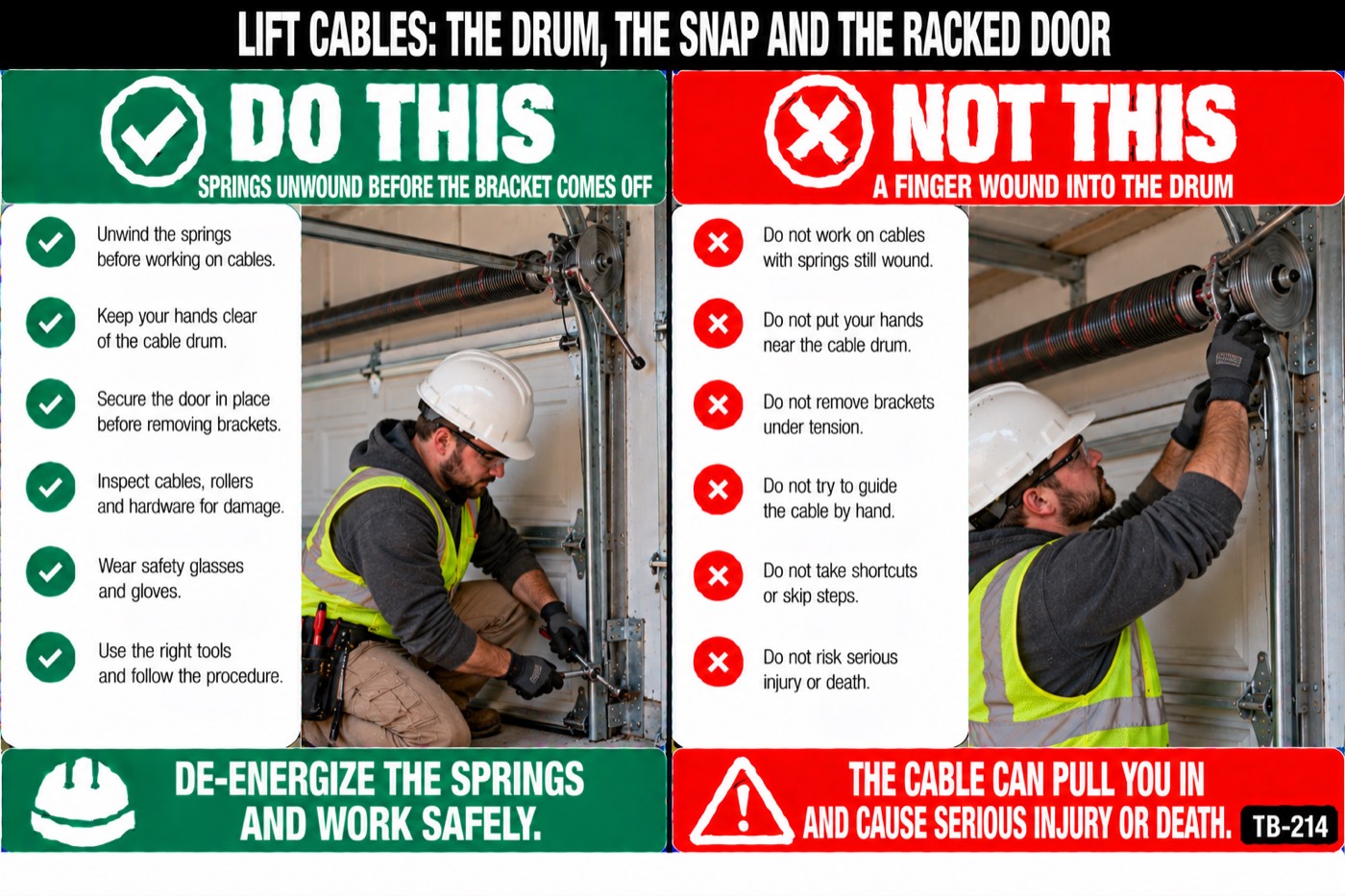
A 1/8-inch lift cable breaks at around 1,700 pounds and carries half the door every cycle. When it is down to a few good strands at the bottom bracket you cannot see it from the floor, and it lets go on the way up with the drum spinning.
The points
- When one cable snaps, that side drops, the door cocks in the tracks and jams, and the other cable and spring take the whole load. People have been hit by the falling side and lost fingers at the drum.
- The cables carry the spring's full pull whenever the door is down. Tension comes off by unwinding the springs, never by pulling on a cable or unbolting the bottom bracket.
- Hands off the drum. A cable winding onto a drum with a wound spring on the shaft pulls a finger in and around it; you seat the cable in the drum's slot and let the tension take it up.
- Look at the cable at the bottom bracket and at the drum: broken strands, rust, a kink or a flat spot means both cables get replaced, not one.
- The bottom bracket is under load. Nobody takes the bolts out of a bottom bracket with the springs wound, and the red warning tag on it is there for that reason.
Why it goes wrong
The bottom bracket is where technicians and homeowners get hurt. The cable anchors to it and the spring pulls up on it through the cable, so with the springs wound the bracket is holding about half the door's weight. Take the bolts out and the bracket swings up with the cable and hits whatever is above it. Manufacturers put a warning label on the bracket; read it as an order.
Cables wear at the bottom loop, where water and salt off the car sit in the strands, and at the drum where the cable bends over the groove every cycle. Broken wires stick out and go through a glove, so handle cable with leather gloves and look before you grab. Rust, a kink, or a cable that has been flattened by riding out of its groove is a cable that is already failing.
A racked door is a door that is now out of square by 2 or 3 inches, with rollers pulling out of the track on the low side. The homeowner's first move is to run the opener to straighten it, which pulls the top section and pops rollers. Ours is to unplug the opener, clamp the door where it sits, and take the springs down before anything else.
The drums are what keep the door level: both cables wound the same number of wraps, both sitting in the grooves, both at the same tension before the set screws go in. A cable that jumps its groove piles up on the drum, shortens that side, and the door climbs crooked. Vise grips on the shaft hold the drums while you set the cables, so your hand does not.
Use the right cable: 7x19 galvanized aircraft cable, 1/8 inch on most residential doors, 3/32 on the light ones, 5/32 or 3/16 on commercial. Hardware-store cable of unknown grade has no rating you can trust. The rule that covers cable work is the employer's duty in 1926.20(b): equipment that is not safe does not stay in service, and the person who touches it has been trained on it.
Questions for the crew
- What does the cable look like at the bottom bracket on this door, right now, before we start?
- If a cable let go while we were cycling the door, which way does the door go and who is standing there?
- Who is holding the shaft while the cables go onto the drums?
To close
Nobody unbolts a bottom bracket or puts a hand on a drum today with the springs wound.
To hold this talk with your crew
1
Read it aloud. Five minutes, before the work starts.
2
Ask the questions. A crew that talks is a crew that remembers.
3
Have them sign on their own phones, and the record is sealed.