Openers: the 2x4 test and the door that did not reverse
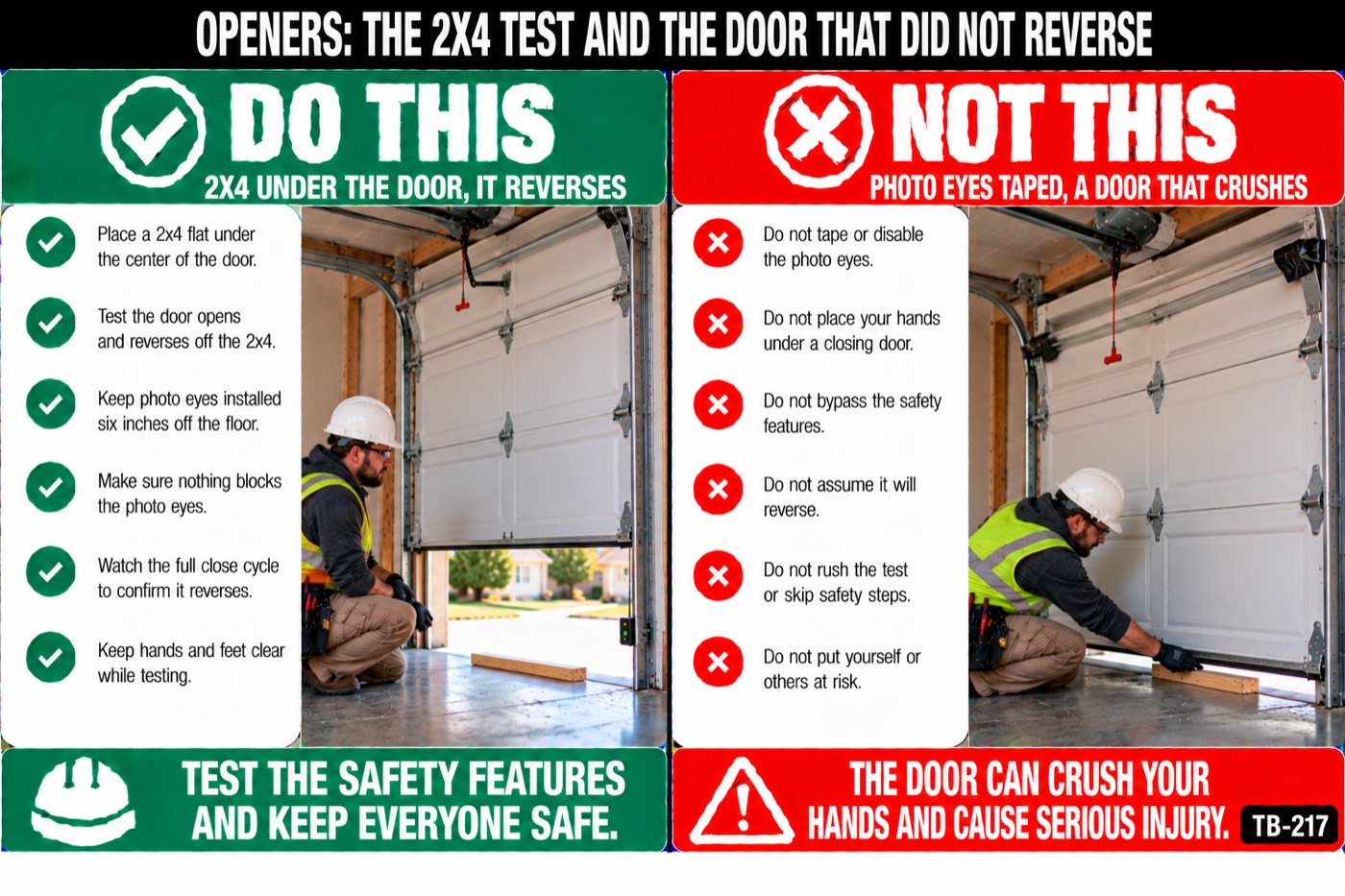
Lay a 2x4 flat under the center of the door, 1-1/2 inches high, and run it down. The door has to reverse off it within 2 seconds. That is the whole standard in one test, and a good share of the doors you touch fail it.
The points
- Openers have crushed children and adults against the garage floor. That is why 16 CFR 1211 exists: every residential opener made since 1993 has to reverse on contact and has to have a second safety, almost always photo eyes or an edge sensor.
- Photo eyes go no higher than 6 inches off the floor, on both sides, aimed at each other. Photo eyes taped to the header so the door will close are a disabled safety, and you do not leave a door that way.
- The 2x4 test on every door you install or service: 2x4 flat under the center, run it down, reverse within 2 seconds, or you adjust and test again.
- Force is not a fix for a heavy door. If you have to crank the force up to make it close, the springs are wrong and the door is now a press.
- The manual release lets go of the trolley, not the door's weight. With good springs the door stays; with a broken spring it drops. Know which before you pull the cord.
Why it goes wrong
The federal rule in 16 CFR 1211 came out of children pinned under doors in the 1980s. Section 1211.7 requires the opener itself to reverse on contact with an obstruction within 2 seconds, and 1211.6 and 1211.8 require a second means as well: photo eyes, a sensing edge, or a wall button you must hold down to close the door. Both have to work; one is not a substitute for the other.
Photo eyes are the second means on almost every residential door. They mount on the tracks no more than 6 inches above the floor so a child lying down breaks the beam. The common bypass is to unscrew them and tape them together at the header, or wire the terminals together, so the door closes when the eyes were misaligned. That door has no secondary protection and it is the door in the news story.
The contact test uses a 2x4 laid flat at the center of the opening. The door comes down, touches the board, and reverses within 2 seconds. If it stalls on the board, pushes it, or stops and stays, the down force is set too high or the door is out of balance, and the door does not get handed back until it passes.
Force settings exist to overcome friction on a balanced door, not to lift or push a door the springs are not carrying. Pull the release, lift the door halfway by hand and let go: a balanced door stays. A door that drops or climbs needs spring work, and no force setting on the opener makes that door safe.
The release is for getting the door open with the power out. It disengages the trolley from the door arm and nothing else. On a door with a broken spring, the trolley is the only thing holding 300 pounds up, and pulling the cord with the door up is how people end up under it. Look at the spring first, every time.
Tell the customer, in words, that the 2x4 test is a monthly test and show them how. Reversal is checked every time you leave a door, and it goes on the ticket. Newer openers learn the force themselves, and older ones have two dials; either way the board on the floor is the proof.
Questions for the crew
- Where are the photo eyes on this door right now, and are they where the standard puts them?
- Has this door had the 2x4 test today, and who watched it?
- If we had to pull the release on this door, what is holding the door up?
To close
No door leaves our hands today until it has reversed off a 2x4 and both photo eyes are at the floor and working.
To hold this talk with your crew
1
Read it aloud. Five minutes, before the work starts.
2
Ask the questions. A crew that talks is a crew that remembers.
3
Have them sign on their own phones, and the record is sealed.