Rolling steel: the barrel, the tension and the drop test
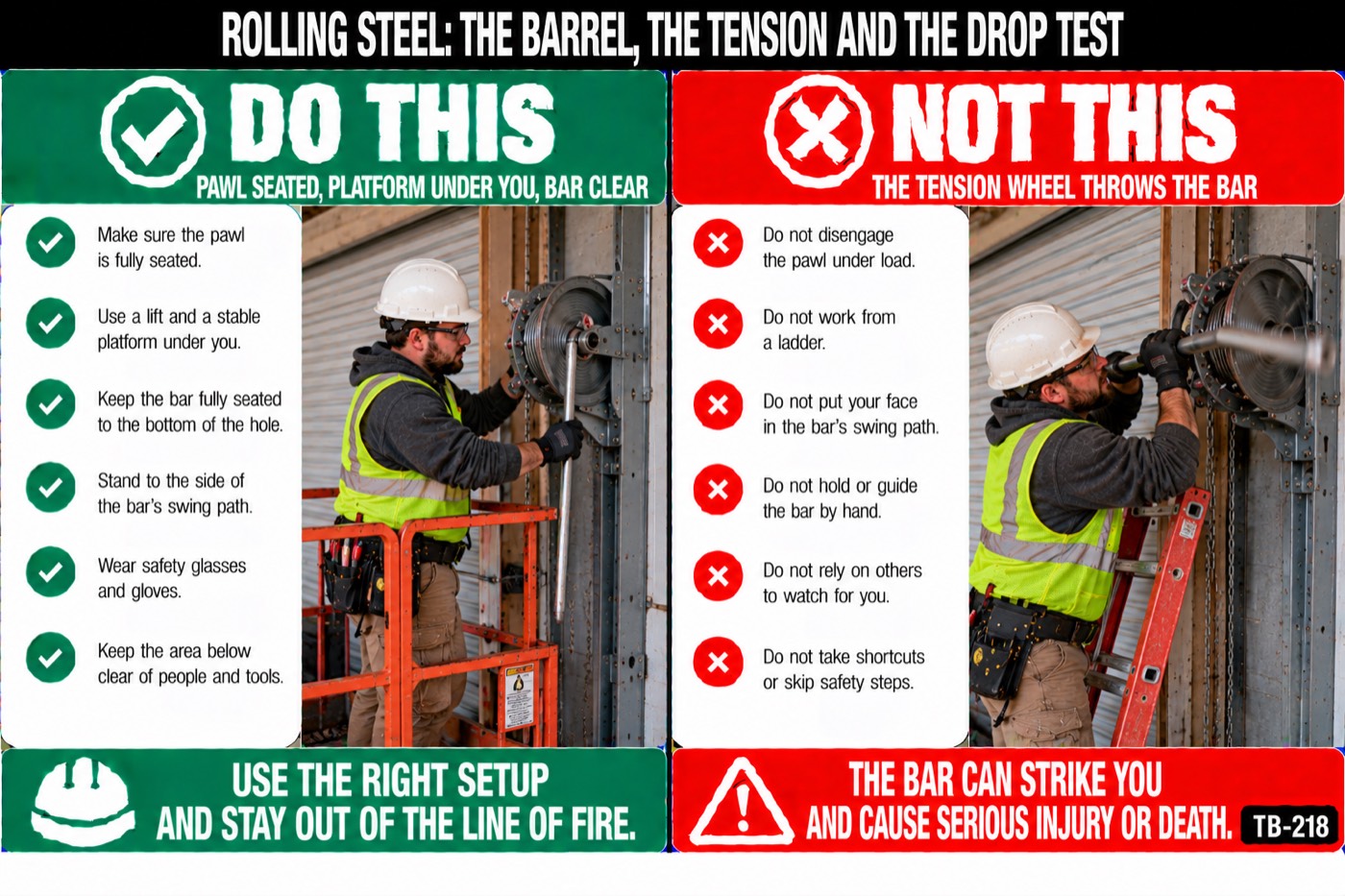
The curtain on a 12-by-12 rolling steel door weighs about 700 pounds, and the springs holding it are inside a pipe you cannot see into. The tension is set with a bar in a wheel, and a pawl on that wheel is the only thing between you and the bar.
The points
- A rolling steel counterbalance that lets go spins the tension wheel and throws the bar; bars have broken arms and jaws. A curtain that comes off the barrel is 700 pounds of steel slats coming down on whoever is on the ladder under it.
- Tension is adjusted at the tension wheel only, with the pawl engaged, the right bar seated to the bottom of the hole, and you standing to the side on a platform, never on a ladder against the guides.
- The curtain goes onto or off the barrel with the barrel supported and the door where the manufacturer's sheet says, and the area under the opening is clear the whole time.
- Fire doors close on a fusible link that melts at 165 °F, and the drop test proves the door comes down on its own at a controlled speed. NFPA 80 wants that test once a year, done with nobody under the door and reset by someone trained on that governor.
- Commercial doors run 12 to 24 feet tall and everything that matters is at the top. A lift or a scaffold, not a ladder against the guide.
Why it goes wrong
Inside the barrel are one or more torsion springs anchored to a fixed shaft, and the tension wheel on the end of the barrel is how the winding gets into them. A steel bar in the wheel, one hole at a time, with the ratchet pawl catching each step. If the pawl is not seated, or a hand lifts it at the wrong time, the wheel takes the bar around in a blur. Manufacturers print the number of turns for the door on the tag; that number and the position of the door when you set it are not guesses.
A rolling steel curtain is 22-gauge or heavier slats, about 4 to 5 pounds per square foot, so a 12-by-12 door is roughly 700 pounds and a 20-by-20 is about a ton. The slats are hinged to each other and nothing else, so a curtain that leaves the barrel does not fall as a sheet; it unrolls, and every slat edge is a blade. Nobody stands in the opening while the curtain is off the guides.
Winding bars for rolling doors are longer and heavier than sectional bars, and the wheel is at the top of the door, 12 feet or more up. You work it from a scissor lift or a scaffold deck with rails, standing to the side of the wheel's arc. A ladder leaned on the guide is a ladder leaned on a piece of sheet metal, and the bar's swing knocks you off it.
Fire doors are held open by a cable run through fusible links rated at 165 °F. When a link melts, the door drops under its own weight, and the governor limits the speed so the door does not destroy itself or whoever is under it. The drop test releases the door on purpose to prove all of that works. It is a test with a known result and a known danger, so the opening is taped off and the reset is done by the person who knows the governor and the tension.
NFPA 80 requires the drop test annually, with a written record, and requires the door to be reset by trained people; local fire inspectors ask for the paper. A fire door that was wired open, painted shut, or had its governor removed because it closed too slowly is a door that will not be there when the building burns.
The OSHA rule that governs all of this is the employer's duty under 1926.20(b): the tension work, the curtain, and the drop test are jobs for people trained on them, with equipment that has been checked. The written procedure is the manufacturer's sheet and DASMA's rolling door technical data sheets, and they are in the truck for a reason.
Questions for the crew
- What does this curtain weigh, and what is holding it while we work on the barrel?
- Who is on the tension wheel today, and where does everyone else stand while the bar is in it?
- Is this a fire door, and when was it last drop tested and by whom?
To close
Nobody puts a bar in the tension wheel today without the pawl seated, a platform under him, and the bar's swing clear.
To hold this talk with your crew
1
Read it aloud. Five minutes, before the work starts.
2
Ask the questions. A crew that talks is a crew that remembers.
3
Have them sign on their own phones, and the record is sealed.