The opener circuit: unplug it before you touch the door
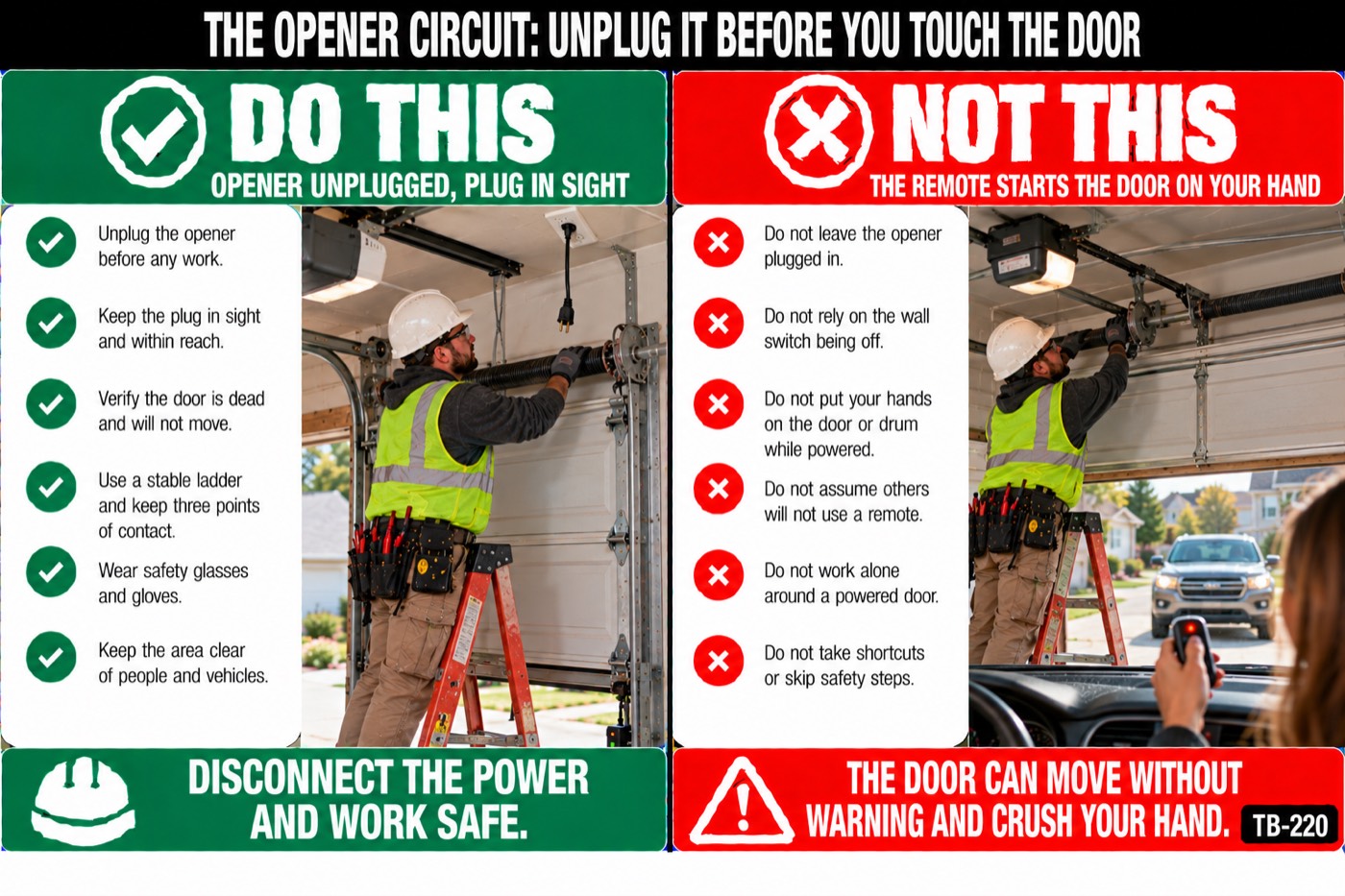
The opener outlet in the ceiling is on the same 15-amp circuit as half the garage, and the remote clipped to the visor in the customer's car can start the door while your hand is in the drum.
The points
- Someone presses the remote from the driveway and the trolley pulls a hand into the drum, or the drill through the header finds the line feeding the outlet. Both have happened to people doing exactly what you are about to do.
- Before you touch the door, the springs or the track, unplug the opener at the ceiling and keep the plug where you can see it. On commercial, open the disconnect, lock it, and the key stays in your pocket.
- The three-button station, open, close, stop, is not a lockout. Neither is the wall console, the keypad or the remote. Only the plug in your hand or the locked disconnect is.
- Before you drill into a header or a jamb, find out what is behind it: the feed to the outlet, the lighting circuit, the panel on the other side of the wall. If you cannot see it, it is live.
- No opener cord run across the ceiling on hooks, no extension cord as permanent wiring, and the photo eye wires never land on the 120-volt side.
Why it goes wrong
1926.416(a)(1) says nobody works where they can contact a live circuit unless it is de-energized and grounded or guarded, and (a)(3) says the employer finds out where the live circuits are before work starts. For a residential opener that means the plug is out; for a commercial operator on 208 or 460 volts three-phase it means the disconnect at the operator is open and locked, and a tag on it names the circuit being worked on, as 1926.417 requires.
A residential opener runs on a 120-volt, 15-amp ceiling outlet. Everything on the door side of the opener is a machine that starts on a radio signal from a remote you did not collect, a keypad on the jamb, a phone app, or a car with a built-in button. The only thing that makes that machine safe to put a hand in is the plug out of the outlet, and the plug stays where the person on the ladder can see it.
Commercial operators have a three-button station and often a disconnect on the wall nearby. The stop button opens the control circuit, not the power circuit; a stuck contactor or a fault in the board runs the motor anyway. Lockout at the disconnect with your own lock, test the station to prove it is dead, and then go to the shaft.
Headers and jambs carry wiring: the opener outlet's feed drops through the header in a lot of garages, the exterior light is on the jamb, and in a shop the panel may be on the back of the same wall. A cordless drill through a live conductor puts 120 volts on the chuck and on you. Look at both sides of the wall, follow the conduit, and use a detector where you cannot see.
The common mistake is the test cycle with a technician still on the ladder: someone plugs the opener back in to check the limit while a hand is still at the drum or the operator. The rule is one voice: the person who unplugged it plugs it in, and only after hearing 'clear' from the ladder.
Questions for the crew
- Where is the plug or the disconnect on this door, and who is holding the plug or the key?
- What remotes, keypads and apps can start this door, and where are they right now?
- What is behind the header and the jamb where we are going to drill?
To close
Nobody's hand goes on this door today until the opener is unplugged or the disconnect is locked, and nobody plugs it back in without hearing 'clear'.
To hold this talk with your crew
1
Read it aloud. Five minutes, before the work starts.
2
Ask the questions. A crew that talks is a crew that remembers.
3
Have them sign on their own phones, and the record is sealed.