Gate operators: UL 325 zones and the gate off its track
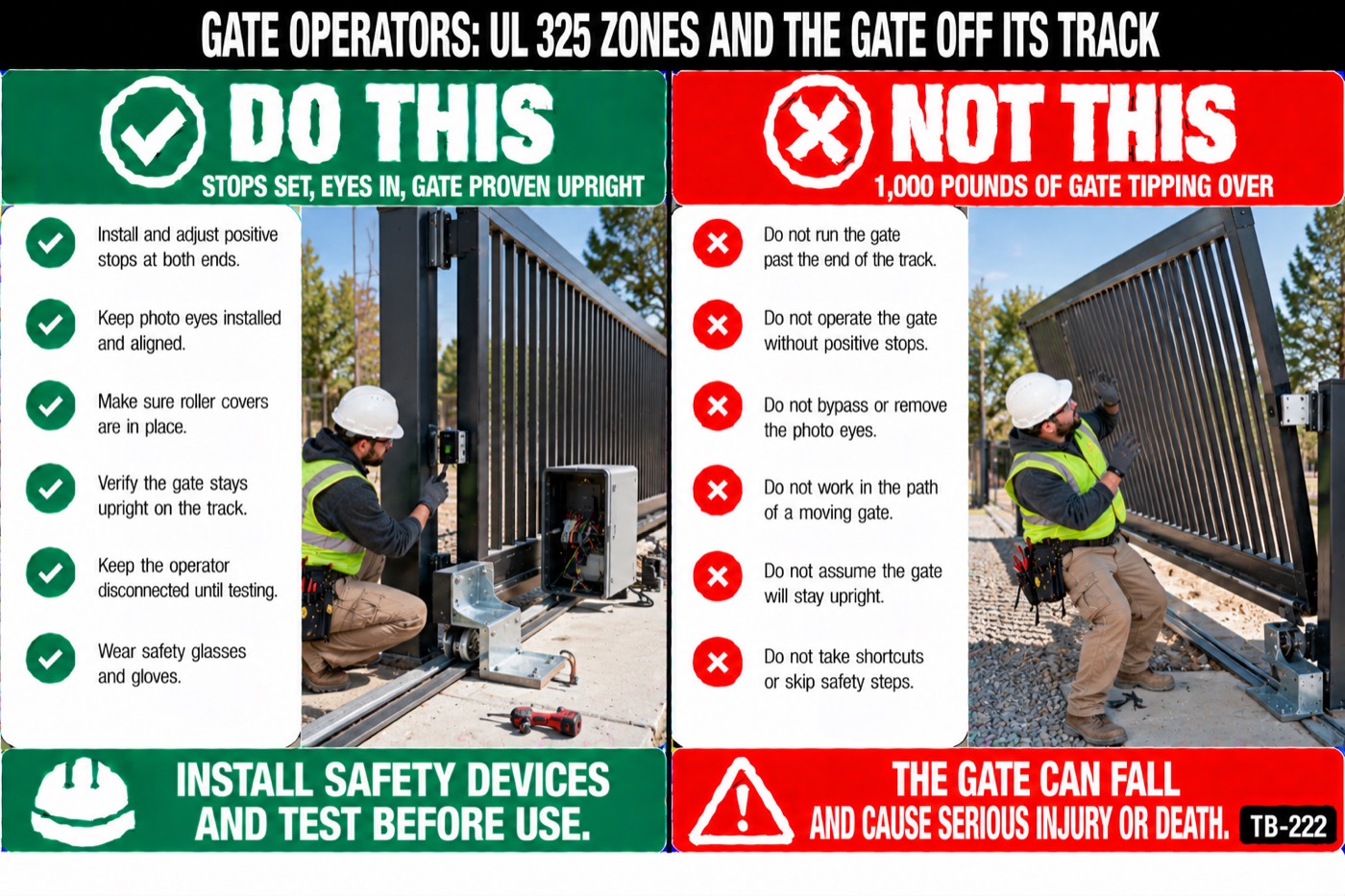
A slide gate weighs 500 to 1,500 pounds and moves at about a foot a second. The places where it meets a post, a roller or the ground have names in ASTM F2200 because those are the places it kills.
The points
- Gates have crushed people against posts, pulled hands into rollers and chain sprockets, and fallen over on installers when they came off the track. The gate that closes on a child is its own talk; this one is about the crew on the install.
- UL 325 requires two independent means of entrapment protection on every automatic vehicular gate: the operator's built-in reversal plus photo eyes or sensing edges at every entrapment zone. Both go in, or the operator does not get wired.
- ASTM F2200 puts the numbers on the gate itself: no openings over 2-1/4 inches in the gate panel or between the gate and the posts where it can pinch, covers on the exposed rollers, and positive stops at both ends of travel.
- A slide gate off its track is 1,000 pounds tipping over. F2200 requires the gate to stay upright if it leaves the track, and the stops keep it from running off the end. Both get checked before power goes on.
- Counterweight and lift gates hang a second load over the same space. Nobody works under the weight, and the cables and pulleys get the same look a door's lift cables get.
Why it goes wrong
UL 325 is the safety standard for the operator, and it names the entrapment zones on a slide gate: between the gate and the post as it closes, between the gate and the post or column as it opens, at the rollers and the guide posts, and under the gate if the ground rises. Each zone that is within reach gets a non-contact sensor (photo eye) or a contact sensor (sensing edge) in addition to the operator's inherent reversal, and the operator has to reverse within 2 seconds when either trips.
ASTM F2200 is the construction standard for the gate the operator moves. The 2-1/4-inch figure is the gap a child's hand or head can go through; it applies to picket spacing and to the gaps between the gate and adjacent fixed objects within the reach zone. Exposed rollers get covers so fingers cannot ride into them. Positive stops at both ends of travel keep a gate from leaving its track when the limits fail or when someone shoves it by hand.
Gates come off the track during installation more than at any other time: the track is set, the gate is rolled on before the stops are in, and it rolls off the end or a grade change on the driveway takes it. A 1,000-pound gate leaning past vertical is not something two people push back. F2200 requires the gate be designed so it cannot fall over more than 45 degrees if it leaves the track, and the crew treats every gate as a wall that is about to tip until the stops and the guides are in.
Pinch and crush zones are where the installer's hands are during setup: aligning the gate to the post, setting the roller height, fitting the chain. With power off and the operator disengaged, the gate is moved by hand and it still weighs what it weighs; a slope on the driveway moves it on its own. Chock it, or clamp it to the track, before hands go between it and anything fixed.
Counterweighted and vertical-lift gates carry a weight that equals the gate on cables over sheaves. The counterweight travels opposite the gate, so the space under it is a crush zone every cycle and a fall zone if a cable fails. Cables, sheaves and the anchor pins are inspected the same as door lift cables, and the weight is blocked before anyone is under it.
Nothing in OSHA names a gate operator; the employer's duty in 1926.20(b) governs the crew, and UL 325 and ASTM F2200 govern the product. Warning signs on both sides of the gate, a separate pedestrian gate so nobody walks through the vehicle opening, and the operator's manual on site are all part of the install, and a gate without them is not finished.
Questions for the crew
- Where are the entrapment zones on this gate, and what sensor is going at each one?
- What is keeping this gate from running off the end of the track or tipping over before the stops go in?
- Is there a counterweight or a lift on this job, and what is under it?
To close
No operator gets power today until both entrapment protections are in, the stops are set, and the gate has been proven to stay on its track.
To hold this talk with your crew
1
Read it aloud. Five minutes, before the work starts.
2
Ask the questions. A crew that talks is a crew that remembers.
3
Have them sign on their own phones, and the record is sealed.