Walking steel: 15 feet, and connectors up to 30
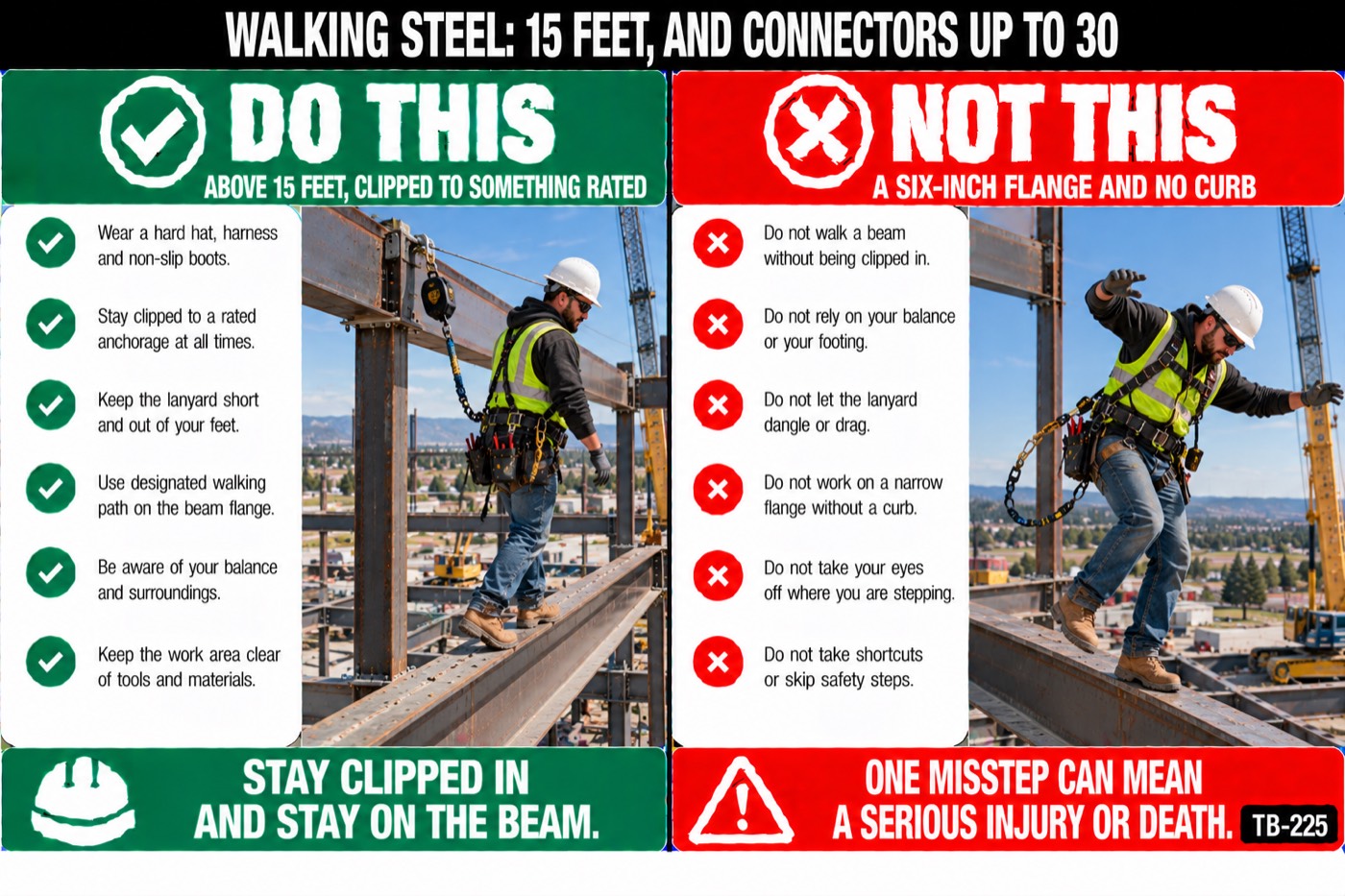
A fall from 15 feet puts you on the ground at about 21 miles an hour. From 30 feet it is 30. A 6-inch flange is a sidewalk with no curb on either side.
The points
- Ironworkers die of falls more than anything else, and most of them fall from a beam or a deck edge they had walked a hundred times. Steel does not care how long you have been doing this.
- The trigger in steel erection is 15 feet, not 6. Above 15 feet over a lower level you are tied off, behind a rail, or over a net. That includes the perimeter, the deck edge, and every opening that is not covered.
- Connectors between 15 and 30 feet wear a harness with the lanyard or retractable on it and have somewhere to tie, and they decide when to clip. Above 30 feet or two stories, whichever comes first, the connector ties off like everyone else.
- Decking crews work a controlled decking zone between 15 and 30 feet: marked with control lines, no bigger than 90 feet by 90 feet from the leading edge, no more than 3,000 square feet of unsecured deck, and only the trained deckers inside it.
- The tie-off point has to hold 5,000 pounds or be engineered. A beam clamp on the top flange, a choker on the column, or the perimeter cable. A tag line and a bolt bucket handle are not anchors.
Why it goes wrong
Walking a beam is balance work, and the things that take balance are ordinary: a bolt on the flange, ice, oil from the crane, a gust, a tag line that snaps tight. The fall rules in Subpart R are written for this trade because a rail cannot go on a beam that is not connected yet. The trade-off is 15 feet instead of 6, and the connector exception, and both come with conditions.
The 15-foot line is measured from the walking surface to the lower level, and the lower level is whatever you would land on. On a second floor with a slab below, that is one story. On a mezzanine over a pit, it is the pit floor. Do not measure to the deck that is not installed yet.
A 6-foot shock-absorbing lanyard anchored at your feet needs about 18 feet of clearance: 6 feet of lanyard, 3.5 feet of deceleration, 6 feet of body below the D-ring, and margin. At 15 feet it does not arrest you, it slows you down before you hit. Anchor overhead where you can, or use a self-retracting lanyard with a short arrest distance, and know the number for the gear you are wearing.
The connector exception exists because a connector tied to a beam that is still on the hook is tied to the load. Between 15 and 30 feet the rule says the connector has the equipment on, has a place to tie, and makes the call. It does not say the connector never ties. When the piece is bolted and the crane is off it, there is no reason left to be unhooked.
The controlled decking zone is not an exemption from fall protection for the deck crew. It is a defined area where the leading edge is moving faster than a rail can follow. It has a boundary marked with control lines, a size limit, a square-footage limit on loose sheets, and only leading-edge trained deckers inside. Anyone else on that deck is outside the lines or tied off.
Anchors: a choker around a column, a beam clamp rated for the flange width, a horizontal lifeline installed to its manufacturer's instructions with the right sag and end anchors. A retractable on the D-ring, anchored above, is the cleanest thing a person on a beam can wear. Two lanyards let you move past a column without ever being off.
Questions for the crew
- Where is the lower level for each place we are working today, and which of those are over 15 feet?
- Who is connecting, and where are they tying once the piece is bolted?
- If we are decking, where are the control lines and who is allowed inside them?
To close
Today nobody is above 15 feet on this steel without a rail, a net, or a hook that is clipped to something rated.
To hold this talk with your crew
1
Read it aloud. Five minutes, before the work starts.
2
Ask the questions. A crew that talks is a crew that remembers.
3
Have them sign on their own phones, and the record is sealed.