Metal deck: the sheet that was not screwed down
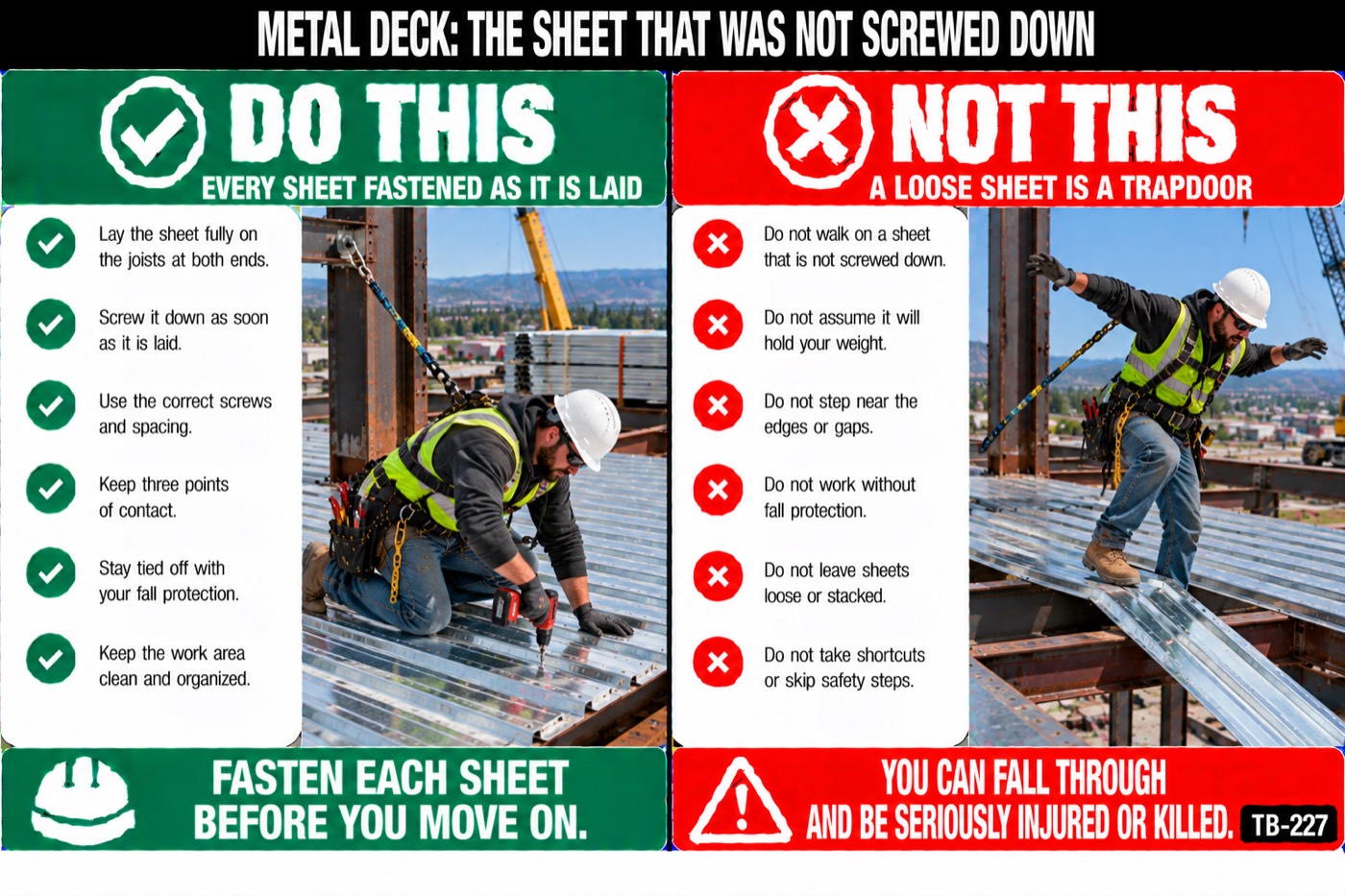
A 3-foot by 20-foot sheet of deck weighs about 140 pounds and has the wind area of a garage door. Lying loose on the joists it is a trapdoor. Standing up in a gust it is a blade.
The points
- Deckers fall through, not off. A sheet laid across the joists and not fastened slides when a boot hits it at the wrong angle, and the decker goes down the gap with the sheet on top. The other way to die is a sheet that the wind takes, into you or into the crew below.
- Every sheet is laid tight and fastened as soon as it is placed, and it sits fully on the framing at both ends before anyone steps on it. The only place loose deck is allowed is inside a controlled decking zone, and even there it is fastened by the end of the shift.
- Holes and openings get decked over. Where they cannot be, the cover holds twice the load that will ever be on it, is secured so wind or a boot cannot move it, and is painted or marked HOLE or COVER. Nobody cuts a deck opening until the thing going in it is there to fill it.
- Bundles land on the framing over a beam or a girder, not mid-span on the joists, and never on unsecured deck. The banding is not a lifting sling unless it says so. Cut the bands with the bundle where it will be used, and only as many as you are laying now.
- The deck edge is a fall edge. The last sheet out is the leading edge, and the sheet hanging past the last joist is a diving board. Over 15 feet, you are tied off or behind the control line.
Why it goes wrong
A composite deck sheet is 20 or 22 gauge, about a thirty-second of an inch of steel. It carries a person when both ends are on a joist and the side lap is nested. It carries nobody when one end is short of the joist, or the sheet is sitting on top of the side lap of the next one and rocking. The first step onto every sheet is the step you look at.
Fastening as you go means screws or puddle welds at the supports and the side laps before the next sheet is laid, not at the end of the row. A run of six loose sheets is 18 feet of floor that can slide. Wind on unfastened deck is what turns a Friday afternoon into a search of the parking lot for the sheets and a hospital for the laborer they hit.
The hole rule has three parts. Frame the opening with the members turned down so the deck runs continuous over it. Deck over every hole you can. Where the hole has to be open, a shaft or a stairwell, protect it with a rail or a cover and mark the cover. A sheet of deck laid over a hole with nothing holding it is not a cover, it is the trap that is easiest to fall into, because it looks like floor.
A bundle often weighs 2 tons or more, depending on the gauge, the profile and the sheet length. Landed mid-span on bar joists, that is a point load the joist was never checked for, and joists have folded under bundles. Land the bundle over a girder or at a column, and spread it if it has to sit on joists. Never land a bundle on deck that is not fastened.
Wind: a sheet standing on edge in 25 miles an hour of wind has about 100 pounds of force on it. That is enough to take it out of two people's hands and put it over the edge. When the wind picks up, the loose sheets get fastened or restacked and banded, and the crew comes off the leading edge. There is no deck job that has to finish in a gust.
End of shift: every sheet placed is fastened, or the loose ones are secured against displacement. Every hole is covered and marked. Every bundle that is opened is rebanded or weighted. The night crew, the wind, and the drywall stocker who wanders up here at six tomorrow morning all get the same floor.
Questions for the crew
- Which openings are on this level, and what is covering each one right now?
- Where are the bundles landing today, and is that over a girder or mid-span?
- What is the wind doing, and at what point do we stop laying and start fastening?
To close
Today every sheet is fastened before the next one goes down, and every hole is covered and marked before we leave the level.
To hold this talk with your crew
1
Read it aloud. Five minutes, before the work starts.
2
Ask the questions. A crew that talks is a crew that remembers.
3
Have them sign on their own phones, and the record is sealed.