Shakeout: the beam that rolls off the bundle
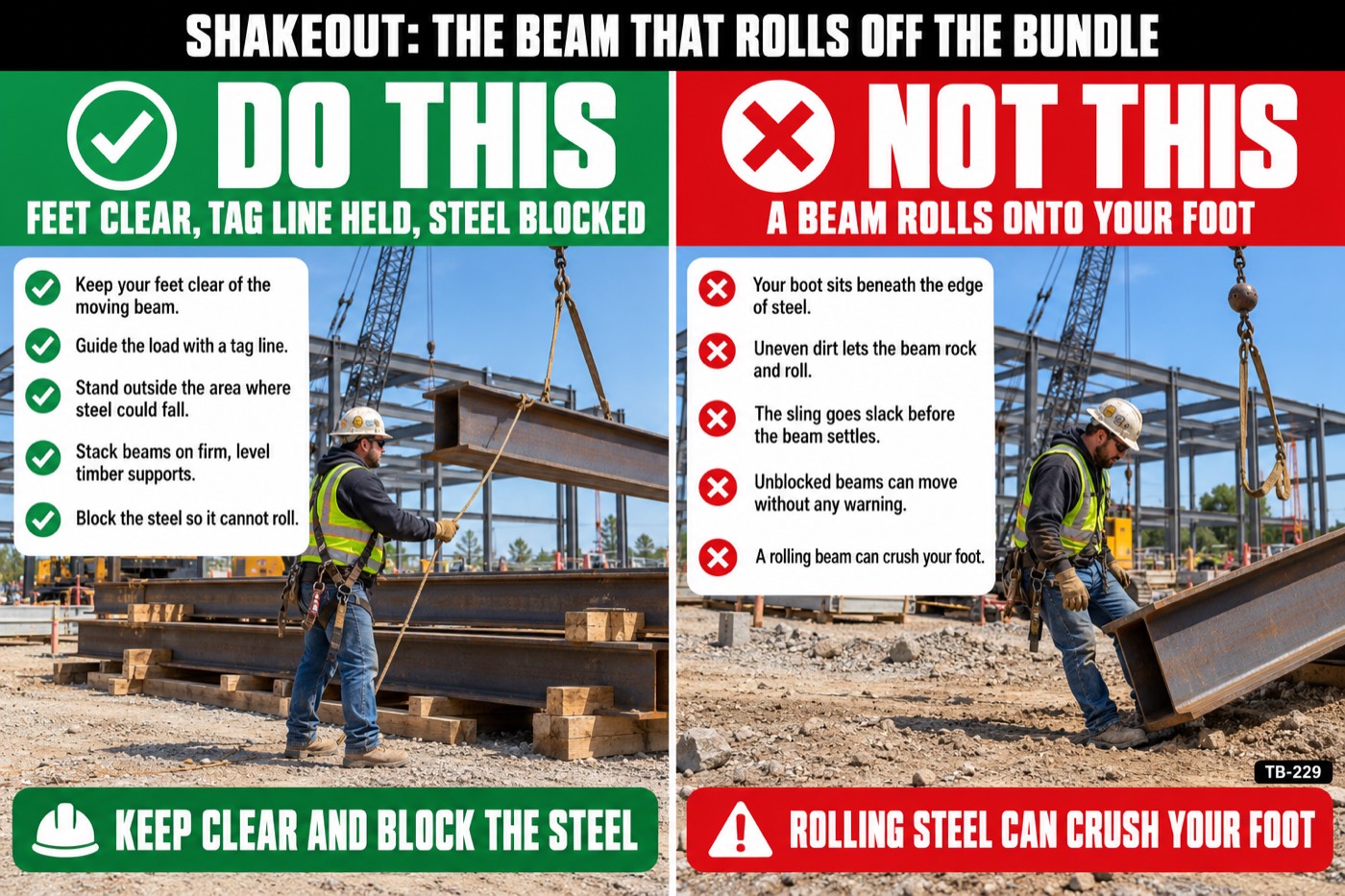
A 30-foot W16 beam weighs about 1,100 pounds. When the crane takes the top piece off a bundle, the ones underneath were being held in place by it, and now they are not.
The points
- Shakeout is where feet get crushed and hands get pinned. A beam lifted off a stack lets the ones under it settle, a piece that lands on dunnage rocks, a beam set on its flange on uneven ground rolls, and every one of those is a foot or a shin between the steel and the ground.
- Routes for every load are planned so nobody is under it, and the only people allowed under a suspended piece are the connector taking it and the one hooking or unhooking. A qualified rigger rigs every piece, with latched hooks, so the piece cannot come out of the hook or slide in the choker.
- Feet stay out from under the load and out from between the load and anything solid. Land it, let the crane set it down fully, and step in only when the slings are slack and it has stopped moving.
- A tag line on every piece long enough to control it from the ground, held, never wrapped around a hand or a wrist, and dropped if the piece takes off. You steer the beam with the line, you do not stop it.
- Stacked steel sits on dunnage, flat, blocked so it cannot roll, and not so high that the top piece is over your head. Multiple lifts are five pieces at most, each on its own hook, 7 feet apart, rigged at the center of gravity.
Why it goes wrong
A bundle on the ground is held together by the bands and by the weight of what is on top. Cut the bands and lift the top beam and the pieces under it move: a channel rolls onto its flange, a beam that was leaning on the top piece drops flat. That is one to four inches of steel moving with 500 to 2,000 pounds behind it, and it lands on whatever is next to it. Nobody's feet are next to the bundle when a piece comes off.
Choker slings on a beam are the rigging of this trade, and the failure is the choker that slides toward the light end when the beam is not level. The rigger picks the center of gravity, cinches the choker with the eye down, and the crane lifts an inch and holds while everyone looks. If it tips, back down and move the sling. A beam that swings level on the first inch stays level all the way up.
Under the load: the rule allows the connector and the hooker under a suspended piece because there is no other way to set steel. It allows nobody else. Routes for the crane are planned before the pick so the piece flies over the open bay, not over the bolt-up crew or the deck crew. The controlling contractor keeps other trades out from under the erection.
Landing a piece on a deck or a floor: the deck is fastened, the load sits over a beam not mid-span, and the piece is blocked so it cannot roll or slide before the slings come off. A wide-flange set on its flange on a slope rolls when the sling goes slack. A piece set on its web on a deck edge tips over the edge. Dunnage under it, chocks beside it, then unhook.
Tag lines: a 20-foot piece of rope on a beam lets the ground person turn it and keep it off the column. Wrapped around a wrist, it takes the person up with the piece or pulls the arm out of the shoulder when the crane swings. Held in the hand, it is dropped the instant the piece moves faster than you can walk. In wind the line is what keeps the beam from becoming a 1,000-pound pendulum, and the pick waits if the line cannot hold it.
Multiple lift rigging, the Christmas tree, is five beams at most, each on its own rigging attached at its center of gravity, spaced at least 7 feet apart on the line, and the rigging assembly rated for what is on it. The bottom piece comes off first, and the connectors on the beams below the load are under a hanging stack. It is a qualified rigger's pick and a connector's job, not something to do because the truck is waiting.
Questions for the crew
- Who is the qualified rigger today, and who is hooking and unhooking at the ground?
- What is the crane's route from the trailer to the set, and who is under it?
- Where is the shakeout area, and what is the dunnage and blocking down there?
To close
Today nobody's boots are under a load or between steel and the ground, and every piece is blocked before the slings come off.
To hold this talk with your crew
1
Read it aloud. Five minutes, before the work starts.
2
Ask the questions. A crew that talks is a crew that remembers.
3
Have them sign on their own phones, and the record is sealed.