Chainsaw work and the kickback zone
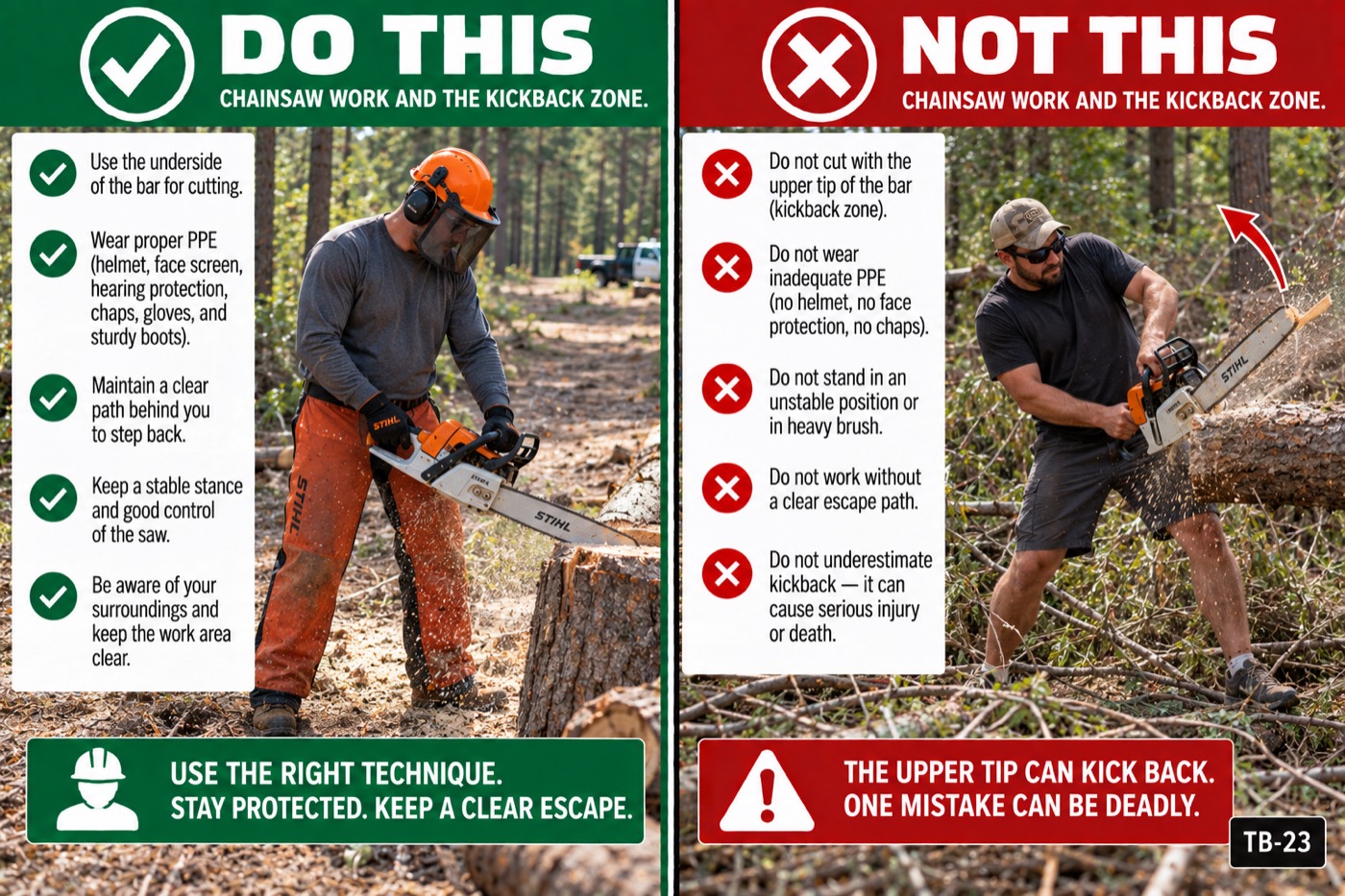
The tip of that bar has a zone on it about the size of your hand. Touch anything with it and the saw comes back at your face.
The points
- Kickback happens when the upper tip of the bar touches something. The saw comes back at your head faster than you can react.
- Keep both hands on the saw, thumb wrapped around the front handle, and the chain brake working.
- Chaps, boots, gloves, eye and face protection, hearing protection, and a hard hat for overhead work.
- Plan two escape routes at forty-five degrees back from the fall direction, and clear them before you cut.
- Never cut above shoulder height, and never cut alone.
Why it goes wrong
A chainsaw chain moves fast enough that by the time you feel the cut, the saw has passed through several inches of tissue. Chaps work by pulling loose fibers into the sprocket and stalling the chain, and they work well, but only if you're wearing them.
Spring poles, barber chairs, and widow-makers are what kill experienced sawyers. A tree under tension does something violent and unpredictable when you release it. Read the lean and the tension before the bar touches wood.
Kickback comes from the upper quadrant of the bar nose. When the chain there catches, the bar is driven up and back along an arc that ends at the operator's head and neck, and it happens far faster than any reaction. Nothing about grip strength stops it once started, which is why the chain brake and the thumb wrapped fully around the front handle exist - they change what the saw can do rather than how fast you respond.
Cutting above shoulder height puts the bar in the worst possible place: near your head, with poor control, and with the kickback arc pointed straight at your face. It also puts the weight of the saw where your arms cannot hold it steady for long.
Escape routes at forty-five degrees back from the fall direction are planned and physically cleared before the cut, because the ground you have to move over is exactly the ground you will not be looking at. Two of them, because a tree does not always go where it was supposed to.
Never cutting alone is about what happens after. A chainsaw injury is a bleeding emergency measured in minutes, and there is no version of it you self-treat while alone in the brush.
Questions for the crew
- What's the lean on the tree we're taking, and where's the tension?
- Where are your escape routes, and are they actually clear?
- Is anyone here cutting without chaps, and why?
To close
Clear your escape routes before the bar touches wood. Both of them.
To hold this talk with your crew
1
Read it aloud. Five minutes, before the work starts.
2
Ask the questions. A crew that talks is a crew that remembers.
3
Have them sign on their own phones, and the record is sealed.