Setting stairs: everyone uses it the minute it is in
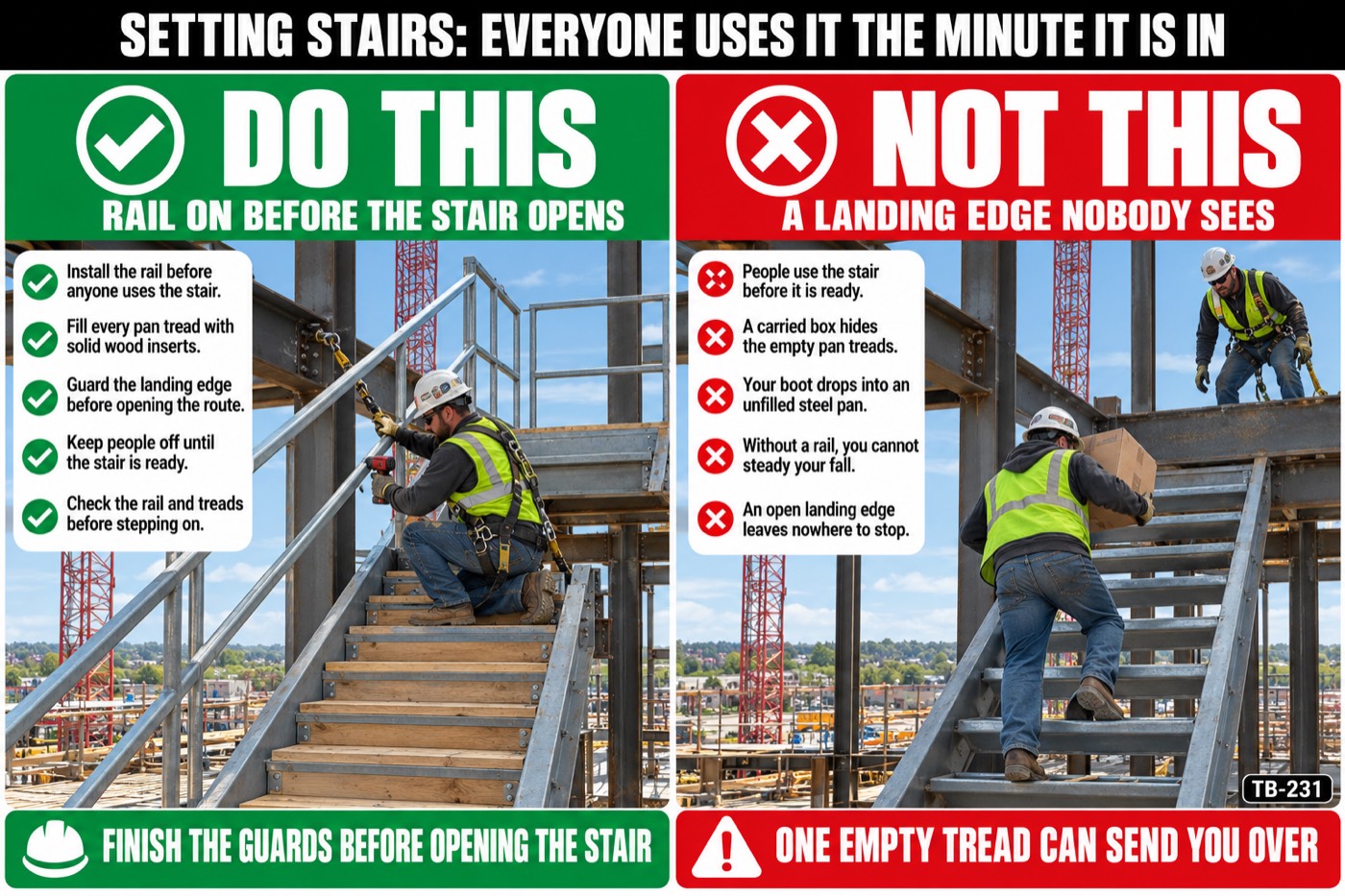
The stair you set at ten this morning is the stair the electrician walks up at ten-thirty. If the rail is still on the truck, the first person up finds out where the edge of the landing is.
The points
- A stair without its rail has an open side on the flight and an open edge at the landing, and on the second floor the landing edge is a full-story drop. People fall off stairs going down with a load in their hands, and the landing edge is the one they do not see because they are looking at the treads.
- The rail goes in with the stair, the same day, before the stair is opened to the job. If the permanent rail is not on site, a temporary stair rail goes on at 36 inches that holds 200 pounds, and the landing edge gets a guardrail the same day.
- Pan stairs are not walked on until the pans are filled with concrete or a solid temporary tread to the top of the pan. Skeleton stairs get full secured temporary treads and landings. A pan with nothing in it is a 6-inch step you did not expect.
- Any stair with four or more risers or more than 30 inches of rise gets a stair rail on every open side and a handrail. Landings are at least 30 inches deep and 22 wide, every 12 feet of rise.
- The stair is set and bolted, plumb and to elevation, the same rules as a beam: two bolts wrench-tight at every connection before the hook comes off, and the stringers landed on the framing that is meant to carry them.
Why it goes wrong
Steel stairs go in early because the building needs a way up that is not a ladder, and the erector is the crew that can set a 1,500-pound flight. From that moment the stair belongs to every trade on the job. The fall on stairs is not dramatic: a boot slips off a bare pan, or a person turning at the landing with a sheet of drywall steps where the rail will be. A fall of 30 inches onto concrete with your hands full is enough to break a hip.
The rule on temporary service is simple. Pan stairs, foot traffic prohibited until the pans are filled with concrete or fitted with wood or solid material to the top edge of each pan. Skeleton stairs, the same until secured temporary treads and landings cover the whole tread and landing area. A pan stair with an empty pan is a stair with a 6-inch pocket on every step, and the person who does not know it walks it in the dark.
Stair rails: required on any stair with four or more risers or more than 30 inches of rise, on every unprotected side. Height 36 inches from the top of the rail to the tread nose, able to take 200 pounds within 2 inches of the top edge. The permanent rail is usually a separate piece, sometimes on a separate delivery and sometimes another contractor's scope, and the gap between the stair going in and the rail going in is the gap where the fall happens.
The landing: a stair landing is a walking surface with an open edge, and in steel erection above 15 feet it needs fall protection the same as a beam does. At the second floor, the landing edge is usually over the lobby and the drop is the full story. A guardrail on the landing is 42 inches, a top rail and a mid rail, and it goes in before the stair is opened, whether it is the permanent rail or a clamp-on temporary one.
Setting the stair: a stair is a beam that is not level. The stringers hang from the upper landing and sit on the lower one, and until both ends are bolted the flight can slide down the slope of the stringer. Rig it level or slightly nose-up, land the top end first, bolt it, then the bottom. Two bolts wrench-tight at each end before release, same as any structural member.
Opening the stair: when it is set, bolted, treaded, and railed, the erector tells the controlling contractor it is ready, and until then it is barricaded at the bottom so nobody starts up it. A stair with a barricade and a note is not a hardship for anyone. A stair with no rail and no note is an invitation, and the note takes 30 seconds.
Questions for the crew
- Which stairs go in today, and is the rail for each one on site or coming later?
- Are these pan stairs or skeleton stairs, and what fills the treads before anyone walks them?
- What is on the landing edge at each level, and who is opening the stair to the other trades?
To close
Today no stair opens to the job until its treads are solid, its rail is on, and the landing edge has a guardrail.
To hold this talk with your crew
1
Read it aloud. Five minutes, before the work starts.
2
Ask the questions. A crew that talks is a crew that remembers.
3
Have them sign on their own phones, and the record is sealed.