Above the ceiling: the grid that will not hold you
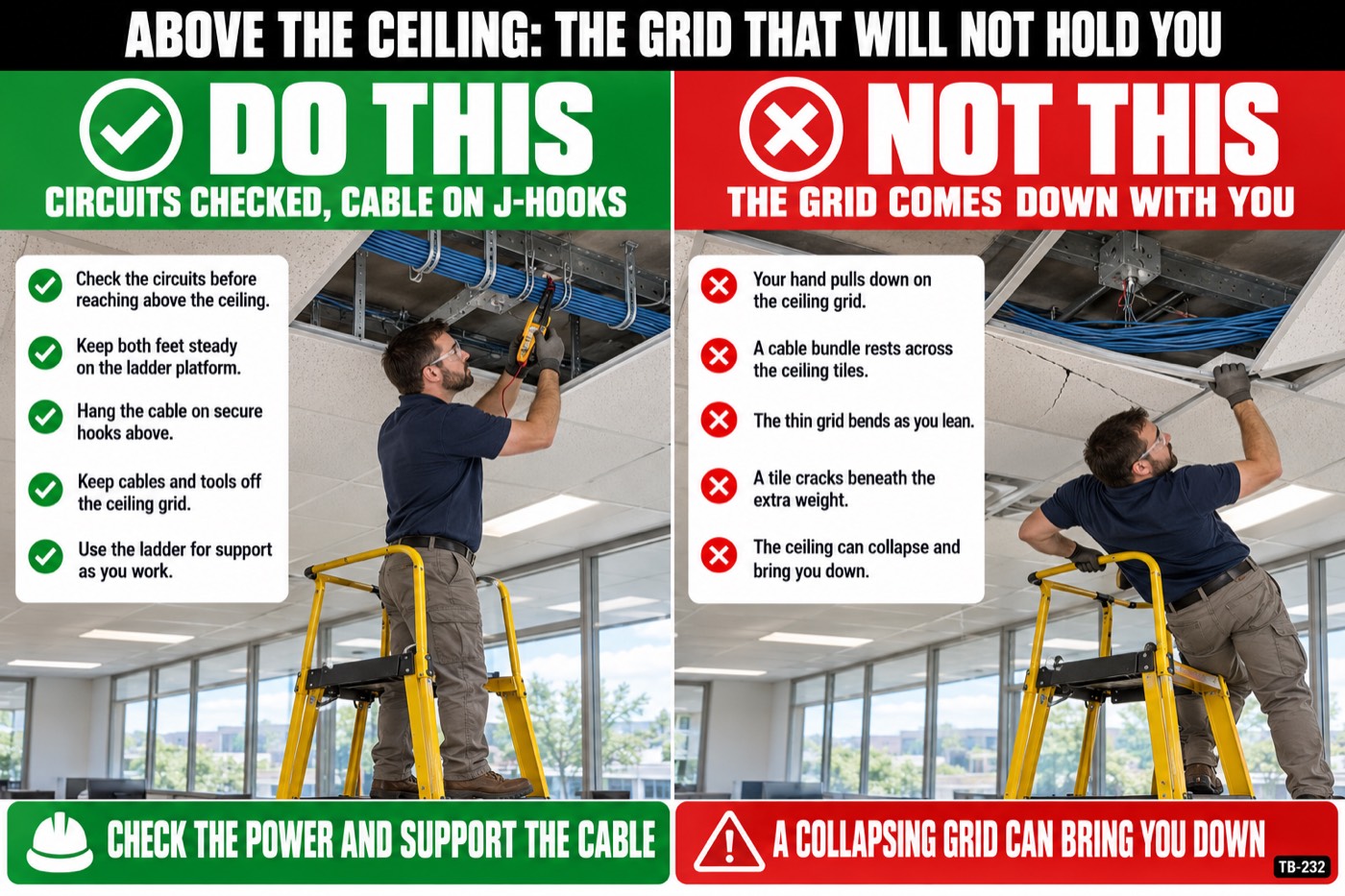
A ceiling grid hangs on 12-gauge wire every four feet and it is built to carry two-pound tiles and a light fixture. The last thing it is built to carry is you.
The points
- Push a tile up and you are working blind. The space above has 277-volt lighting, open junction boxes, a plenum that feeds the whole floor, and a grid that comes down the first time you grab it for balance.
- Before anybody goes up, find out where the live circuits are: the rule says the employer determines that before the work starts, by asking, looking, or testing. Assume the abandoned line is live until a meter says otherwise.
- The grid, the hanger wires, the sprinkler pipe and the conduit are not handholds and not cable supports. Cable goes on J-hooks or its own support, no more than five feet apart, and nothing rests on the tiles.
- In a building from 1980 or earlier, the sprayed fireproofing on the beams and the insulation on the pipes is presumed asbestos until a test says it is not. You do not drill it, scrape it, or drag cable through it; you stop and ask the owner for the survey.
- The plenum is return air for the whole floor. Plenum-rated cable only, and anything you stir up above the ceiling, dust, fibers or droppings, gets breathed by every office on the floor within the hour.
Why it goes wrong
The fall above the ceiling starts on a stepladder. You are on the top step because the ladder was a foot short, your shoulders are through the grid, and when the tile jams you grab a main tee. It bends, the ladder walks, and you come down eight feet head first onto a desk. Get a taller ladder or a platform, and keep both feet below the top step.
Commercial lighting runs at 277 volts, not 120, and the ballasts and whips above the ceiling are a hazard nobody tagged. Abandoned circuits are often still on the breaker. A meter or a non-contact tester in your pocket costs less than a minute, and 1926.416 puts the duty to find live circuits before work on the employer, not on your luck.
Spray-applied fireproofing on structural steel and the wrap on hot water and steam pipes were asbestos in most buildings before 1980, and the rule presumes they are until sampling says otherwise. The exposure limit is 0.1 fiber per cubic centimeter over eight hours, and the fibers you knock loose are invisible. The building owner is required to tell you what the survey found. If nobody can produce a survey, the beam does not get touched.
The electrical code does not allow cable to hang on the ceiling grid, the hanger wires, or other systems' pipes and conduit, and the grid is the reason. Every bundle laid on the tees adds weight the hangers were not sized for, and the tech who adds the last bundle is the one under it when the grid lets go. J-hooks every four to five feet, a sag you can see, and nothing on the sprinkler line.
Sprinkler heads live just below the grid and a ladder rail or a hard hat takes one off. A single head puts out 20 gallons a minute of black water over the office, and it does not stop until somebody finds the valve. Look for the heads before you set the ladder, and know where the riser room is.
If the space above the ceiling is a return air plenum, the air handler pulls everything up there through the building. That is why plenum cable exists, it is made to slow flame spread and give off little smoke, and it is also why fireproofing dust, rodent droppings and fiberglass are a whole-floor problem the moment you disturb them. Wear the dust mask the job calls for, and bag what you pull down instead of letting it fall.
Questions for the crew
- What year was this building built, and has anybody seen the asbestos survey for this floor?
- Where are the lighting circuits and the panels for the area we are working in today, and who checked that the abandoned runs are dead?
- Which ladder are we using in that hallway, and does it put your feet below the top step with your shoulders through the grid?
To close
Nobody pushes a tile today until the survey question is answered and the circuits above that spot have been checked.
To hold this talk with your crew
1
Read it aloud. Five minutes, before the work starts.
2
Ask the questions. A crew that talks is a crew that remembers.
3
Have them sign on their own phones, and the record is sealed.