Fiber: invisible light and the shard you can't find
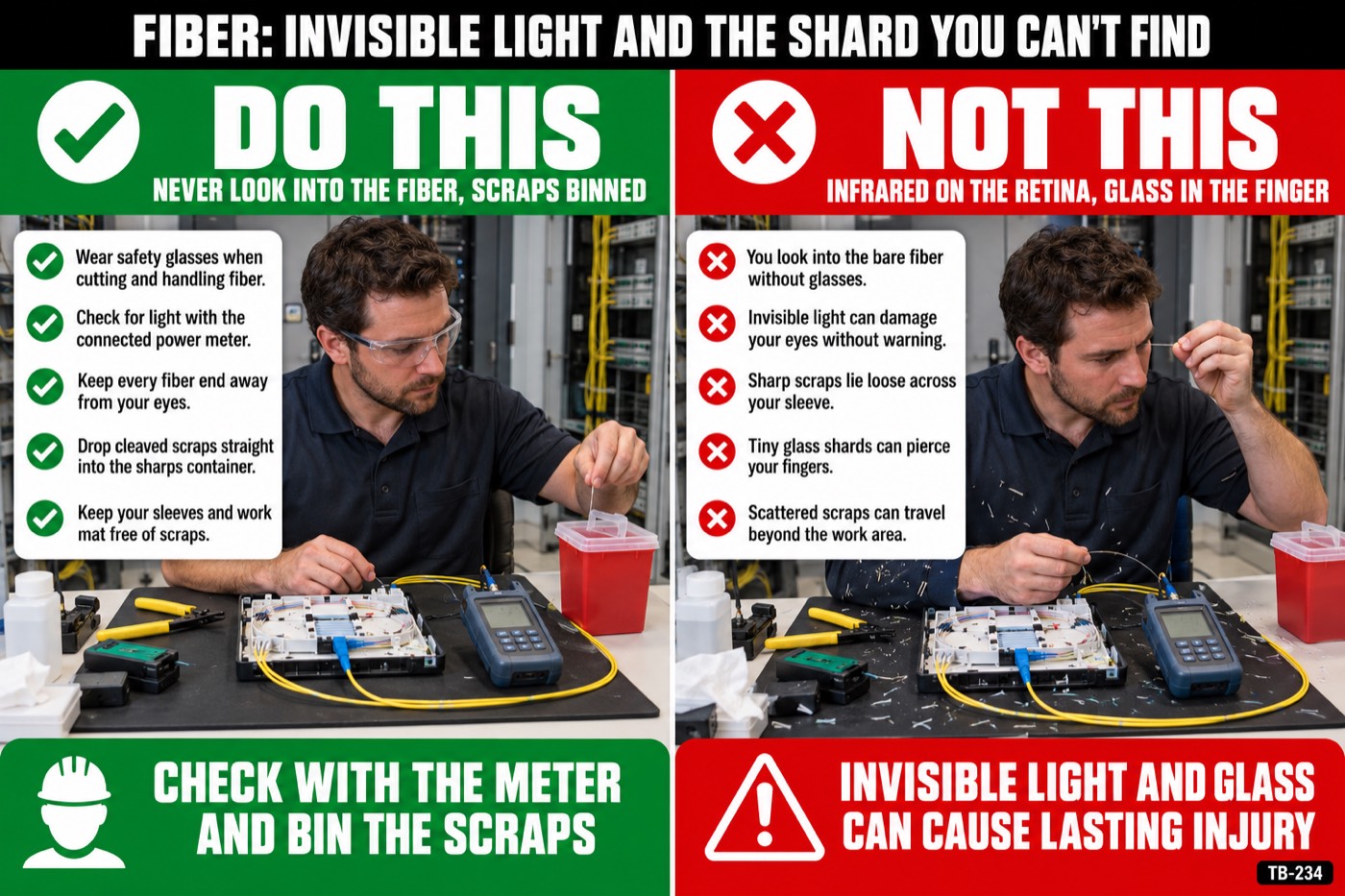
A cleaved fiber end is a glass needle five thousandths of an inch across. It goes into your finger without a mark, it does not dissolve, and it does not show on an X-ray.
The points
- Fiber hurts you two ways: glass slivers you cannot see, in the finger or the eye, and light you cannot see, in the eye. The light from a transmitter or a test source is infrared, so there is no blink and no warning; the burn can be on the retina or the front of the eye, and it can be permanent.
- Never look into the end of a fiber, a connector or a port, live or not, and never point one at anybody. You check for light with a power meter, not your eye; a direct-view scope on a live fiber focuses the beam onto the retina.
- Safety glasses for every strip, cleave and splice; the rule requires eye protection against flying particles, and when a laser source is in use, goggles rated for its wavelength. Do not rub your eye with a glove that has handled fiber.
- Every scrap off the cleaver goes in the sharps container, not on the floor, the mat or your sleeve. No food, no drink, no smoking at the splice point, and wash your hands before you touch your face.
- Cap every unused connector and keep the source off until the patch cord is connected. If the fiber is in a manhole or vault, remember the fusion splicer makes an arc; you test the atmosphere first, like any confined space.
Why it goes wrong
The sliver is 125 microns of glass with a fresh-cleaved end sharper than a scalpel. It enters skin with no sensation, it can work deeper with movement, and once it is under the skin you cannot find it to remove it. That is the reason for the dark mat: you see the scrap on it, you pick it up with tape, and it goes into a container marked for glass. A sliver in the eye is a trip to an eye doctor the same hour, not a rub and a blink.
Telecom light is at 1310 or 1550 nanometers, far outside what the eye can see. An ordinary single-mode transmitter puts out about a milliwatt, which is unlikely to injure you in a glance but is enough that you should not test the rule. Amplified and long-haul systems, and OTDR and high-power test sources, can put out 50 to 200 milliwatts of invisible light from a spot the size of a hair, and that is an eye burn with no pain and no blink to save you. Treat every fiber as lit because you cannot tell.
1926.102(b)(2) says an employee exposed to a laser gets goggles for that wavelength with the optical density the power calls for. In practice the fiber tech's protection is procedure: power meter before eye, video inspection scope instead of a direct-view eyepiece, dust caps on everything unused, and the source switched on only after the far end is connected. The visual fault locator is a red laser you can see; that makes it easier to point at your own eye, not safer.
The cleaver blade is a ceramic or diamond wheel that scores the glass; it also scores fingers. Keep the scrap bin on the cleaver, empty it into the sharps container, and never sweep scraps with your hand. A scrap in a boot, a sleeve or the truck seat is a sliver an hour later in somebody who was not even splicing.
Alcohol for cleaning, gel from loose-tube cables, and the splicer's arc are a set. The fusion splicer arcs at several thousand volts to melt glass; in a manhole with gas that arc is the ignition source. Meter the vault for oxygen, LEL and hydrogen sulfide before anybody or any splicer goes down, and keep the alcohol capped and away from the arc.
Aerial and duct fiber comes with the same lifts, poles and trenches as any other cable, and the fiber does not change those rules. What it adds is the habit: glasses on, mat down, container open, source off, and the end of the fiber pointed at the floor every single time.
Questions for the crew
- Is there a chance any of the fibers we are opening today are live, and what are we using to find out?
- Where is the sharps container going to sit on this job, and who empties it?
- Which test sources are on the truck, what are their output levels, and who is turning them on?
To close
Today no fiber end gets pointed at a face, and every scrap goes in the container before the next cleave.
To hold this talk with your crew
1
Read it aloud. Five minutes, before the work starts.
2
Ask the questions. A crew that talks is a crew that remembers.
3
Have them sign on their own phones, and the record is sealed.