Pole climbing: sound it before you trust it
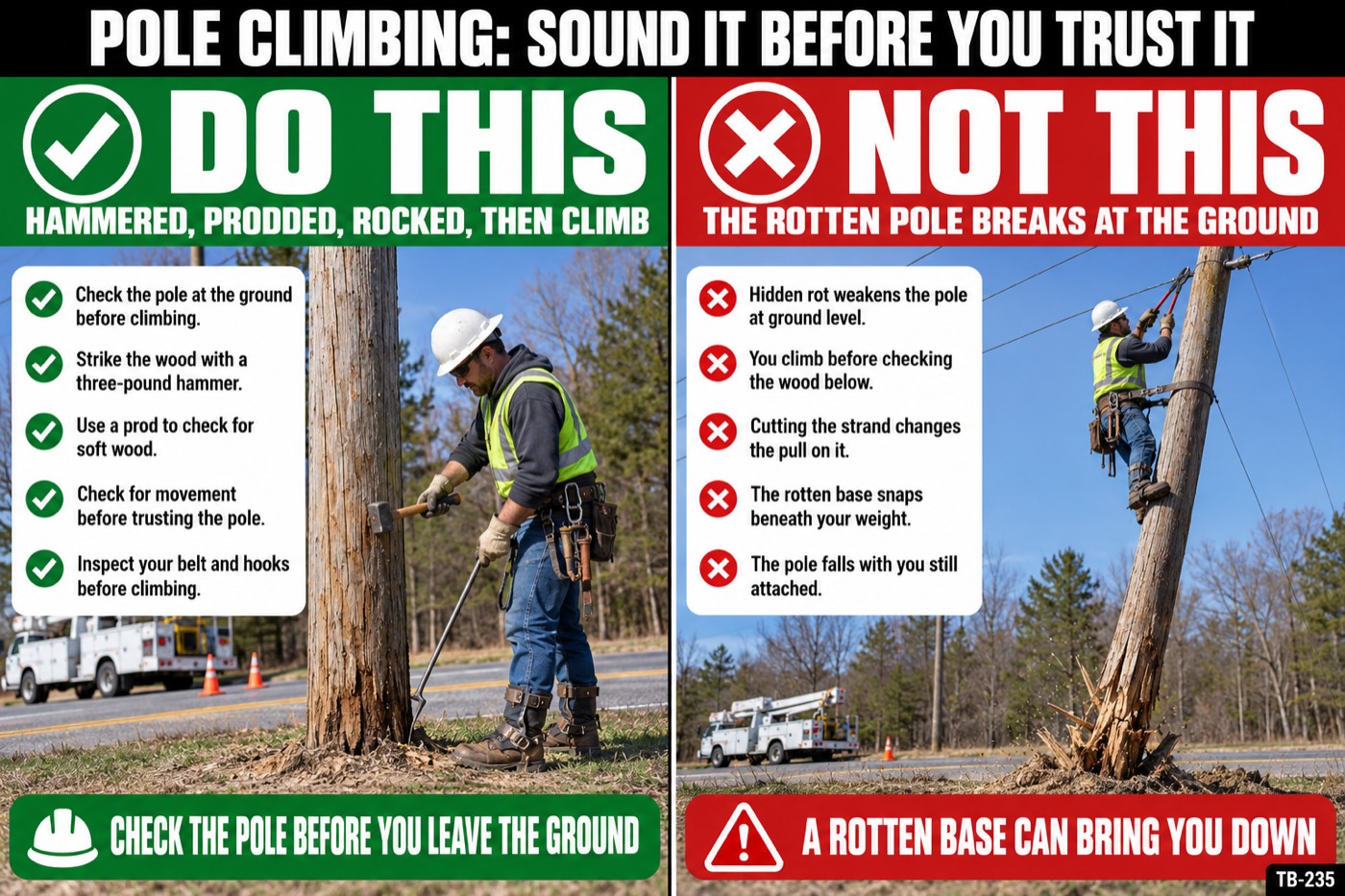
A wood pole rots from the inside at the ground line, where you cannot see it. It stands fine for years, and it breaks the day a climber adds 200 pounds and cuts the strand that was holding it up.
The points
- When the pole goes, you go with it, belted to it, and you land under it. The rule says no pole is climbed until it has been tested: a three-pound hammer from the ground line up to six feet, listening for the dull sound, a prod with a five-inch blade at the ground line, or a rock test.
- A pole that fails the test gets tagged where everybody can see it and is not climbed until it is guyed, braced or the bucket truck is doing the work. Poles with a strand or a drop you are about to cut are the ones to test hardest, because the tension is part of what holds them up.
- Hooks and belt get inspected before every climb: gaffs at least 1¼ inches and sharp, straps and buckles whole, and the positioning strap or fall arrest attached from four feet up. You do not wear climbers in the bucket, on a ladder, or walking rocky ground.
- Power is on top, communications is on the bottom, and you do not climb or work above the lowest power conductor. The 40 inches between the lowest power attachment and the highest comm attachment is the safety zone; it is there so you can work below it, not in it.
- In the bucket, feet on the floor, lanyard on the boom or the basket, brakes set, outriggers on pads, and never belted off to the pole. The boom stays in the comm space; the moment it reaches for the power space you are back in the overhead-lines talk.
Why it goes wrong
The ground line is where moisture, oxygen and fungus meet, and a pole loses strength from the inside out while the shell looks sound. The hammer test works because rotten wood does not ring and does not rebound; the prod test works because a screwdriver goes into rot. 1910.268(n)(3) spells out both, and the rock test: push the pole perpendicular to the line and listen for cracking. A pole that cracks or a prod that sinks means the pole is unsafe, full stop.
Cutting a drop or a strand changes the load on a pole that was leaning on that tension. A pole that stood for a decade in a guyed condition can fold when the guy or the strand is released with a climber on it. Before you cut anything on a pole, ask what is holding the pole up, and if the answer is the wire you are about to cut, brace or guy it first or do the work from the bucket.
A gaff cut-out is the climber's fall: the gaff slides out of the wood and you drop the length of the pole with your chest against it. Dull gaffs, gaffs under 1¼ inches, wet or frozen poles, and climbing too upright all cause cut-outs. The rule wants the climbers inspected daily by a competent person and a cut-out test weekly, and the positioning strap or fall arrest in use above four feet on the pole. Freehanding a pole above the strap is a fall with nothing between you and the ground.
On a joint-use pole the power space and the communications space are separated by design so an unqualified worker never touches a supply conductor. Streetlight brackets, service drops and risers break that design, and a 120/240-volt drop or a streetlight feed can be down in your space or right above your head. 1910.268(n)(12) forbids working above the lowest power conductor except in narrow cases. If the pole in front of you does not match the drawing, the pole wins: treat every conductor you cannot identify as power, and call it in.
The bucket truck is the safer platform and it has its own rules under 1926.453: stand on the floor of the basket, never on the rail or a plank, wear the harness with the lanyard on the boom or basket, and never tie off to the pole, because if the truck moves the pole does not. Brakes set, outriggers on pads, wheel chocks on any slope. Keep the boom, the bucket and the cable clear of the power space by the distance the table gives for the voltage, and if you do not know the voltage, call the utility and stay farther back than ten feet until you do.
Aerial drops from the strand to the house are ladder work, and the ladder against a strand has to be hooked or strapped to it before the first step. The strand is under hundreds of pounds of tension; a cutter into a live strand, a tree limb on it, or a truck under it can move the ladder. At the house end, look for the power service drop, which is usually a few feet above yours and looks a lot like it.
Questions for the crew
- Which poles are we on today, and who is sounding and prodding each one before the first climb?
- On the pole with the streetlight and the service drop, where is the lowest power conductor, and where does that put us?
- Is anything we are cutting today holding a pole up, and what is the plan for that pole?
To close
No pole gets a climber on it today until it has been hammered, prodded and rocked, and the result said out loud.
To hold this talk with your crew
1
Read it aloud. Five minutes, before the work starts.
2
Ask the questions. A crew that talks is a crew that remembers.
3
Have them sign on their own phones, and the record is sealed.