Pulling cable: the rope that lets go at 1,500 pounds
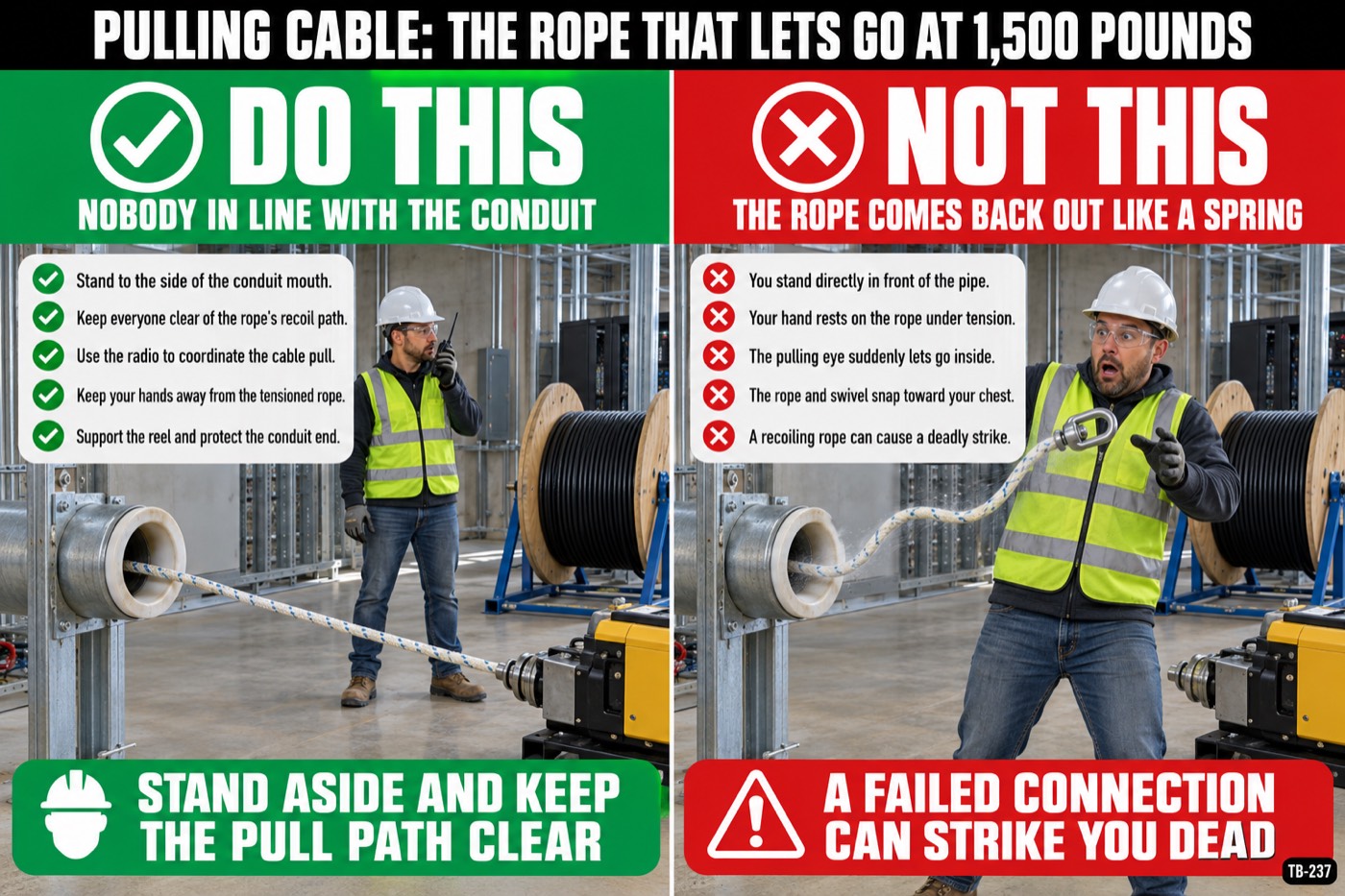
A pull rope at 1,500 pounds is a spring 300 feet long. When the pulling eye lets go, the rope and the swivel come back out of the conduit faster than you can turn your head, at whoever is standing in line with it.
The points
- Cable pulls hurt people three ways: the rope or the cable snaps back and hits somebody in line with the conduit, a hand goes into the winch capstan or the sheave, and a steel fish tape goes into a panel that is still on. The last one is an arc flash in your face, not a shock.
- Nothing gets fished or pulled into a panel, cabinet or box that is energized. The rule says circuits you are working around are deenergized, rendered inoperative and tagged at every point they can be turned back on; if the customer cannot turn it off, a nonconductive fish tape and a qualified person, or the work waits.
- Nobody stands in line with the conduit at either end while the rope is under tension, and nobody's hand goes on the rope, the capstan, or the cable within three feet of the sheave. The winch operator can see the winch; the feed end talks to the winch on the radio, and one word stops everything.
- Know the cable's rated pulling tension before you start: 25 pounds for a four-pair data cable, and the fiber's number is on the spec sheet. Past that the cable is damaged even if it comes through, and past the rope's rating the rope is the projectile.
- The conduit end has a bushing, the reel is on a stand that cannot roll, and lubricant goes on before the pull, not after it binds. Feeding overhead from a ladder is two hands on the cable and none on the ladder; put the reel on the floor and feed from a platform or the floor.
Why it goes wrong
Tension in a pull is a spring, and everything on the pulling end, the rope, the swivel, the pulling grip, the winch mount, stores it. When one of them fails the energy leaves through the weakest point toward the conduit mouth. The winch operator is behind the winch and usually safe; the person at the far end looking to see if the cable is coming is not. Nobody looks down a conduit under tension, and the winch is anchored to something that will hold three times the expected pull.
Capstan winches take fingers. The rope wraps the drum three or four times and your hand is what holds tail tension, so the natural move when it slips is to grab closer. Three feet is the rule for hands from the capstan; a glove, a sleeve, or a ring in the wraps goes around the drum with the arm attached. Never wrap the rope around a hand or a wrist, and the winch has a stop within reach of the operator that does not require letting go of the tail.
The fish tape into a live panel is the low-voltage trade's arc flash. A steel tape or a metal pull string bridges a 480-volt bus and the arc is several thousand degrees at arm's length, and the burns are on your hands and face. 1926.417 requires the circuit deenergized, rendered inoperative and tagged wherever it can be re-energized, and the existing lockout talk covers the how. Where the panel cannot be off, as in a data room, you do not fish into it; a qualified electrician lands your conduit and you pull from the other side.
Communication cable does not share a raceway with power, and the reason is the cable in your hand. The separation rules exist so the pull string you are fishing never meets a power conductor, and a low-voltage box that turns out to contain 120 volts is a box somebody wired wrong. Test the box before you put a hand or a tape in it, no matter what the label says.
Rated pulling tension is where the cable stops being a cable: 25 pounds-force for four-pair copper is not much, and a hand pull on a bundle of twelve can exceed it in a bind. Fiber is rated for its strength member, commonly a few hundred pounds for outside plant and much less for indoor, and exceeding it breaks glass you cannot see. Conduit fill of 40 percent, lubricant, a bushing on every end, and a pull that stops the moment it binds instead of adding another wrap on the winch.
The conduit mouth pinches. A hand guiding the cable into the end of a conduit goes in with it, and a burr on a cut conduit strips the jacket and skin. The cable coming out at speed on the far end whips; the person catching it stands to the side with the cable coming past, not toward. Reels go on a stand or jack, chocked; a 300-pound reel rolling across a floor takes an ankle.
Questions for the crew
- Where does our conduit land today, and is anything in that panel or box still on?
- Who is on the winch and who is at the feed end, and what is the stop word on the radio?
- What is the rated tension on the cable we are pulling today, and how will we know when we have reached it?
To close
Before the winch turns today, both ends are on the radio and nobody is standing in line with either conduit mouth.
To hold this talk with your crew
1
Read it aloud. Five minutes, before the work starts.
2
Ask the questions. A crew that talks is a crew that remembers.
3
Have them sign on their own phones, and the record is sealed.