The load chart: capacity at radius, minus the block
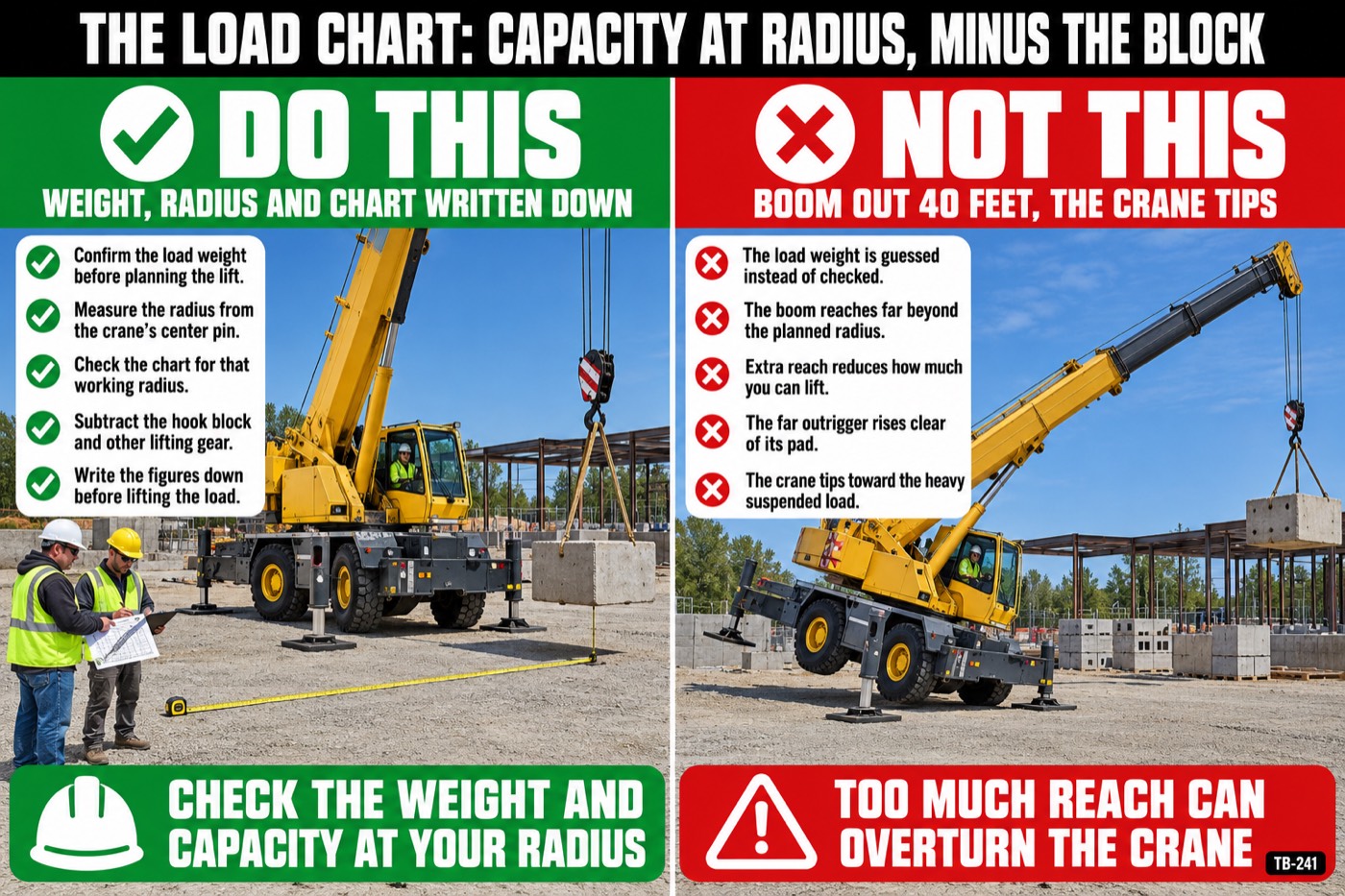
The 30 on the door of a 30-ton crane is what it lifts at a few feet of radius with the boom nearly straight up. Boom out 40 feet and the same crane may be good for 4,000 pounds.
The points
- Exceed the chart and one of two things happens: below the bold line the crane tips over, above it the boom folds. Either way the load comes down on whoever is near it, and the operator does not get a second try.
- Capacity is read at radius, the distance from the center of rotation to the hook, not from the boom length. The load drifts out, the radius grows, the number on the chart drops.
- The chart number is gross. You subtract the block, the ball, the slings, the shackles, the spreader bar and any jib stowed on the boom. A 400 pound block and 200 pounds of rigging are part of the load.
- The operator has to know the weight, from the shipping papers, the drawing or the scale, or by lifting it and reading the indicator. If a test lift shows the load is over 75 percent of the chart at the longest radius of the lift, the lift stops until the weight is verified from a recognized source or a calculation. Many outfits also make that a critical lift with a written plan.
- The lift plan has a name on it. Whoever signs as lift director owns the weight, the radius, the configuration, the ground and the rigging, and the operator can refuse any lift the chart does not cover.
Why it goes wrong
A load chart is a table for one configuration: this counterweight, these outriggers at this extension, this boom length, main boom or jib, over the side or over the rear. Change any of those and you are on a different page. Under 29 CFR 1926.1417 the equipment is never operated over rated capacity, the operator cannot be required to, and the chart has to be in the cab.
Radius is the killer variable. On a telescopic boom, extending at the same angle pushes the load out; lowering the boom at the same length also pushes it out. Both drop the capacity. Boom deflection adds to it: under load the boom bends, and the hook ends up a foot or two further out than the angle indicator says.
Deductions are simple arithmetic that gets skipped. Say the chart reads 6,200 pounds at 40 feet. Take off the 450 pound block, a 90 pound shackle set, two 60 pound slings and a 300 pound spreader. You have 5,240 pounds for the load itself. If the load is a 5,000 pound rooftop unit with 300 pounds of packaging and a wet pallet, you are already over.
The 75 percent line is where the margin gets thin. The operator has to verify the weight, and if the load will be over 75 percent of the rated capacity at the longest radius, verifying means a recognized source or a calculation, not a guess. A test lift with the indicator only tells you it is over 75 percent. It does not clear the lift. Most outfits also make anything over 75 percent a critical lift: written plan, rigging sketch, ground check, names and signatures.
The lift plan is not paperwork for the office. It is the two minutes where somebody writes down the weight, the radius at pick and at set, the chart number for that configuration, the deductions and the net capacity left. If that last number is smaller than the load, the plan just saved the crane.
The common mistake on small jobs is the unknown weight. A pallet of block, a used generator, a rooftop unit with the curb, a steel beam somebody eyeballed. The operator lifts it a few inches, the load indicator reads, and if it reads near the chart the load goes back down and the crew re-plans. That is not a failure. That is the system working.
Questions for the crew
- What is the heaviest pick today, what does it actually weigh, and where did that number come from?
- What is the radius at the set, not the pick, and what does the chart say there after the block and rigging come off?
- Who is signing the lift plan on this one, and is anything over 75 percent?
To close
Every pick today has a weight, a radius and a chart number written down before the hook goes on.
To hold this talk with your crew
1
Read it aloud. Five minutes, before the work starts.
2
Ask the questions. A crew that talks is a crew that remembers.
3
Have them sign on their own phones, and the record is sealed.