Signals: one signal person, and stop from anyone
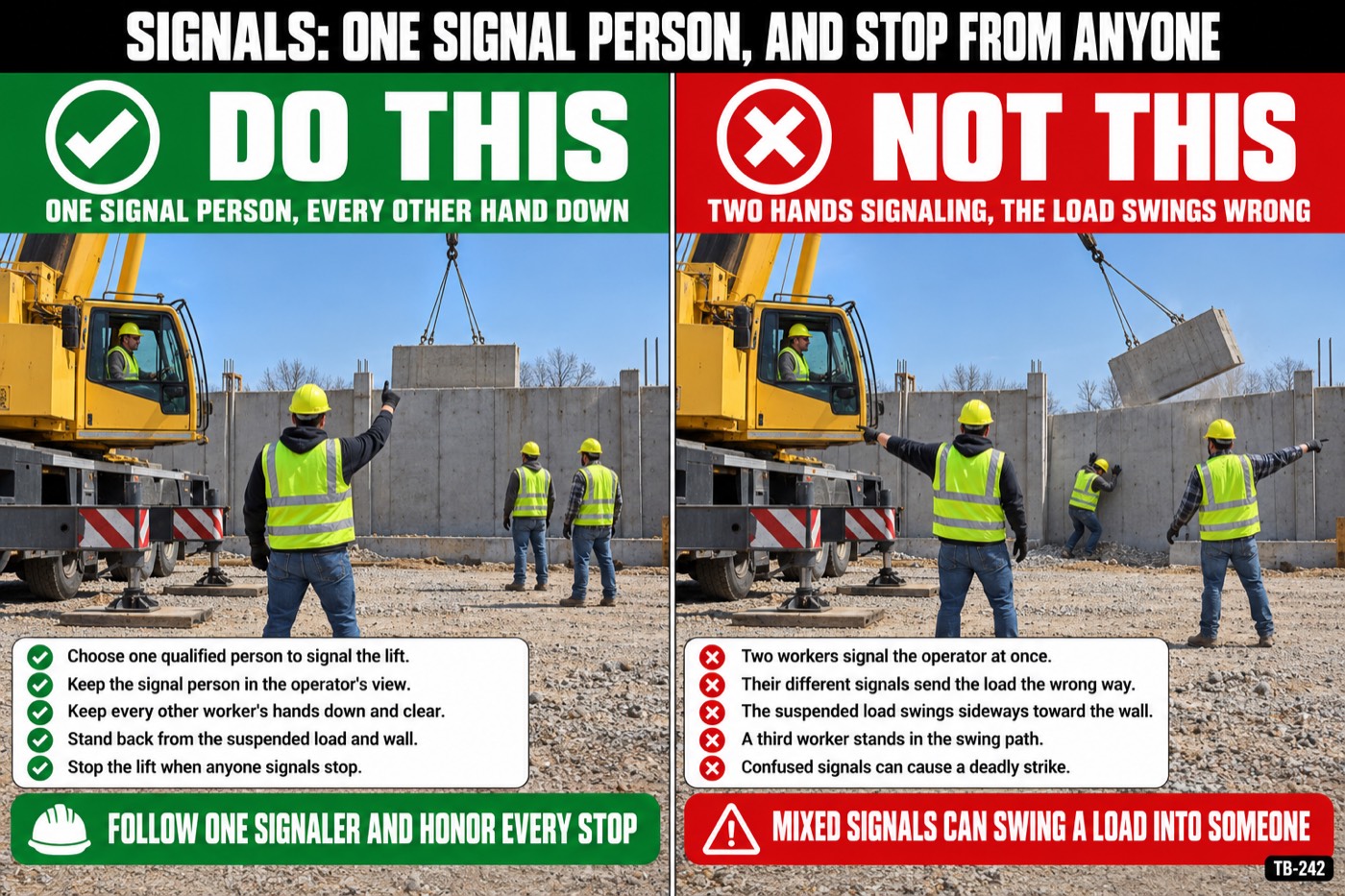
A crane operator with the load behind a wall sees nothing but the boom tip. The only thing between that load and a person is a hand he can see or a voice on a radio.
The points
- Two people giving signals is how a load gets swung into a worker. The operator follows the wrong hand for a second and the load moves 10 feet.
- Any time the operator cannot see the load, the landing area or the path, there is a signal person, and there is only ever one at a time. The operator knows who it is before the lift, and everyone else keeps their hands down.
- Hand signals are the Standard Method in Appendix A, not the ones your last crew used. The signal person is qualified and has a card or a letter on site that says so, for hand and for radio.
- Radio: dedicated channel, hands free for the operator, tested before the lift, and every command gives the function, the direction, the distance and then the stop. Lose the radio and the load stops where it is.
- Stop is the signal anybody gives. If you see something wrong, both arms out, or say stop on the radio, and the operator obeys it no matter who gave it.
Why it goes wrong
The operator is blind more often than the crew thinks. A telescopic boom cab sits low and the boom itself blocks part of the view; a load going onto a roof or into a stairwell is out of sight for the whole set. That is why 29 CFR 1926.1419 requires a signal person when the point of operation is not in full view of the operator, when the equipment is traveling and the view is obstructed, or when site conditions call for it.
A single signal person is the rule because the operator processes exactly one command at a time. Two people signaling produce contradictions, and the operator cannot tell who is right. The exception is the stop: anyone who sees a hazard can give a stop or emergency stop, and the operator has to obey it. Everything else comes from the designated signal person only.
Voice signals have three parts in order: function and direction, distance or speed, and then function stop. Boom down, slow, five feet. Boom down, stop. It sounds stiff until the day the radio breaks up and the operator only catches the last word. The operator asks if unsure; the signal person watches the load, not the operator.
Radios fail in ordinary ways: a dead battery, a channel shared with the landscaping crew next door, a signal person who turns to talk to somebody else with the mic keyed. The rule is that if communication is interrupted, operations stop until it is back. The load does not keep going on the last command.
Direction is from the operator's seat. Swing left means the operator's left, not the signal person's. A signal person standing facing the cab has to translate, and that is why the card and the practical test exist. A signal person who is not qualified to the Standard Method is not a signal person under the rule, and the employer has to be able to show the documentation on the site.
The common mistake is the helper who waves the load in because the signal person walked off to open a gate. If the signal person has to leave, the load stops and hangs, or another qualified signal person takes over and the operator is told who that is. Nobody just steps in.
Questions for the crew
- Who is the signal person on each pick today, and does the operator know their name and where they will be standing?
- Are we on hand signals or radio, and has the radio been tested with the operator this morning?
- If you saw a sling slipping while the load was moving, what exactly would you do and who would you say it to?
To close
Before every pick today the operator says out loud who the signal person is, and nobody else raises a hand except to stop it.
To hold this talk with your crew
1
Read it aloud. Five minutes, before the work starts.
2
Ask the questions. A crew that talks is a crew that remembers.
3
Have them sign on their own phones, and the record is sealed.