Power lines: Table A and the boom that touches
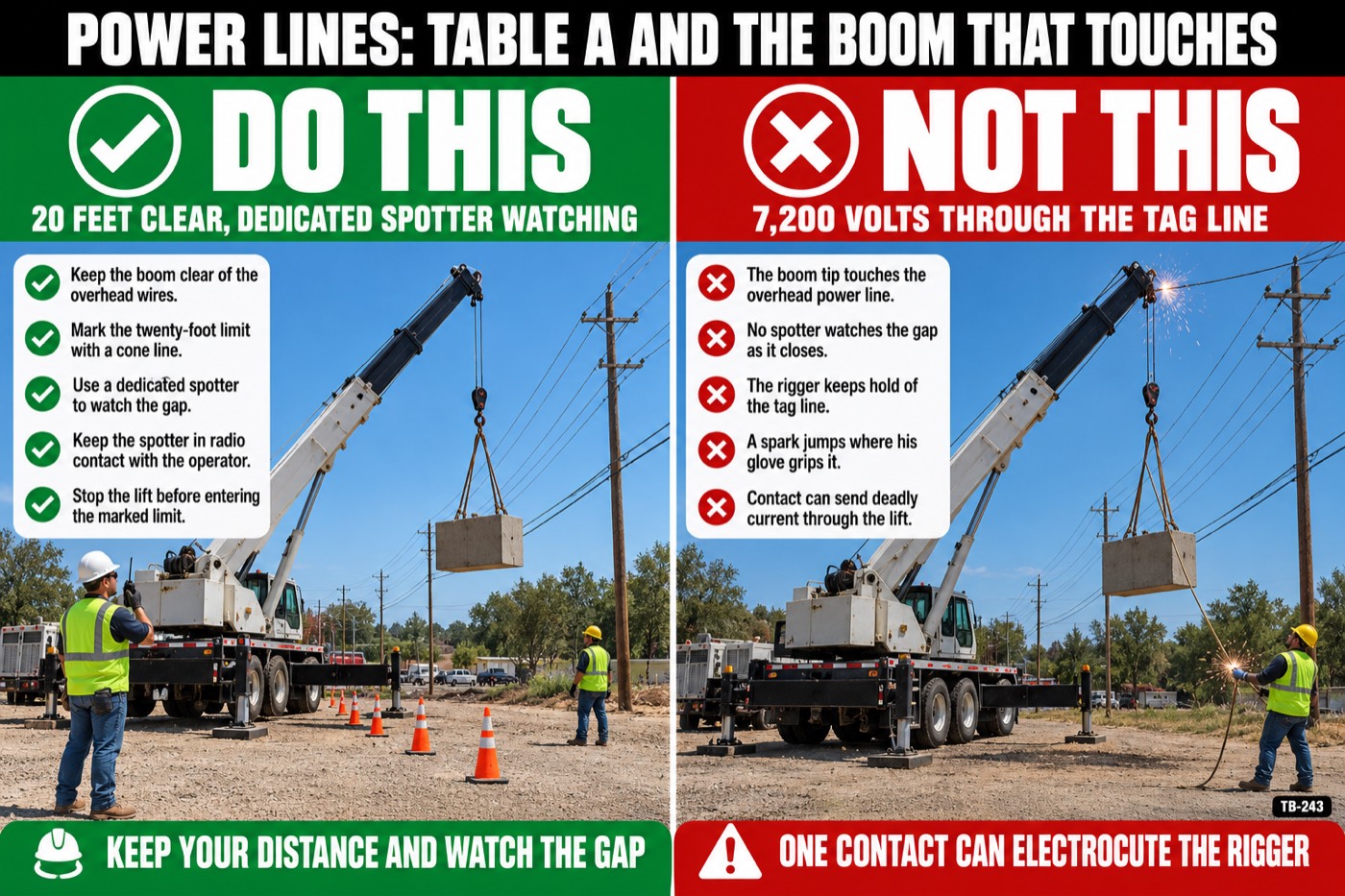
A distribution line on a wood pole runs about 7,200 volts to ground. When a boom touches it, the truck, the outriggers, the load and the tag line are all at 7,200 volts, and the dirt for 30 feet around the crane is a voltage gradient that kills.
The points
- Boom touches a line and the person who dies is usually not the operator. It is the rigger holding the tag line, or the helper who leans on the fender to see what happened.
- Before any boom goes up, somebody checks whether any part of the crane, the load line or the load could get within 20 feet of a power line at full extension in any direction. If it could, the lift changes.
- Three ways to work: the utility de-energizes and grounds the line; or you stay 20 feet clear with a planning meeting, an elevated warning line in the operator's view and a dedicated spotter or a device; or the utility confirms the voltage and you use Table A, 10 feet up to 50 kV, 15 feet up to 200 kV.
- The dedicated spotter does nothing else. Not rigging, not signaling, not holding a tag line. That person stands where they can judge the distance, has a way to talk to the operator, and calls the stop.
- If the boom touches a line: operator stays in the seat, everybody else stays back and away from the crane and the load. Nobody touches the truck until the utility says the line is dead.
Why it goes wrong
Under 29 CFR 1926.1408 the assessment comes first. You identify the work zone, either the full 360 degrees the boom can reach or a marked smaller area, and ask whether anything could get closer than 20 feet to a line. If not, you work. If yes, you pick a method: de-energize and ground, keep 20 feet, or determine the voltage and use Table A. You cannot read the voltage from the ground, so until the utility tells you, the number is 20, or 50 for a transmission line over 350 kV.
Table A is the minimum clearance by voltage: 10 feet up to 50 kV, 15 feet over 50 to 200 kV, 20 feet over 200 to 350 kV, 25 feet to 500 kV. Most lines on wood poles along a street are under 50 kV, so 10 feet is the floor once the voltage is confirmed. That is the distance from the closest part of the crane, the line, the rigging or the load, not the boom tip.
Working under the 20 foot or Table A option requires encroachment prevention: a planning meeting with the operator and the crew, non-conductive tag lines, an elevated warning line, barricade or line of signs in the operator's view at the clearance distance, and at least one of a proximity alarm, a dedicated spotter, a range control device or limiter, or an insulating link. The dedicated spotter is the common choice on small jobs, and the word dedicated means that is the only job.
The mechanism of death is step and touch potential. When the boom contacts a line the current goes through the crane to the outriggers and into the ground. The ground near the crane is at thousands of volts, dropping off with distance, so a person walking toward it has one foot at a higher voltage than the other and the current crosses the body. A person touching the truck with a foot on the ground takes the full difference. That is why the rigger on the tag line and the helper who runs to the cab are the ones killed.
If contact happens the operator stays in the cab and tries to move the boom clear of the line if that is safe to do. Everyone else stays clear and warns others off. If the operator has to leave because of fire, jump clear with both feet together, land without touching the crane, and shuffle away without lifting a foot. Any wire rope that has touched a line is replaced, not inspected.
The common mistake is the second set-up. The first position was checked and the lift was fine, then the truck moves 30 feet down the lot for the next pick and nobody looks up again. Every new position gets the same question, and so does swinging the boom to stow it at the end of the day.
Questions for the crew
- Where are the lines around this set-up, and could the boom or the load get within 20 feet of any of them at full extension in any direction?
- Who is the dedicated spotter today, and is that all they are doing?
- If the boom hit a line right now with the load in the air, who moves and who does not?
To close
No boom goes up today until the lines have been walked and the 20 feet or the Table A number has been called out to the whole crew.
To hold this talk with your crew
1
Read it aloud. Five minutes, before the work starts.
2
Ask the questions. A crew that talks is a crew that remembers.
3
Have them sign on their own phones, and the record is sealed.