Swing radius: the counterweight and the wall
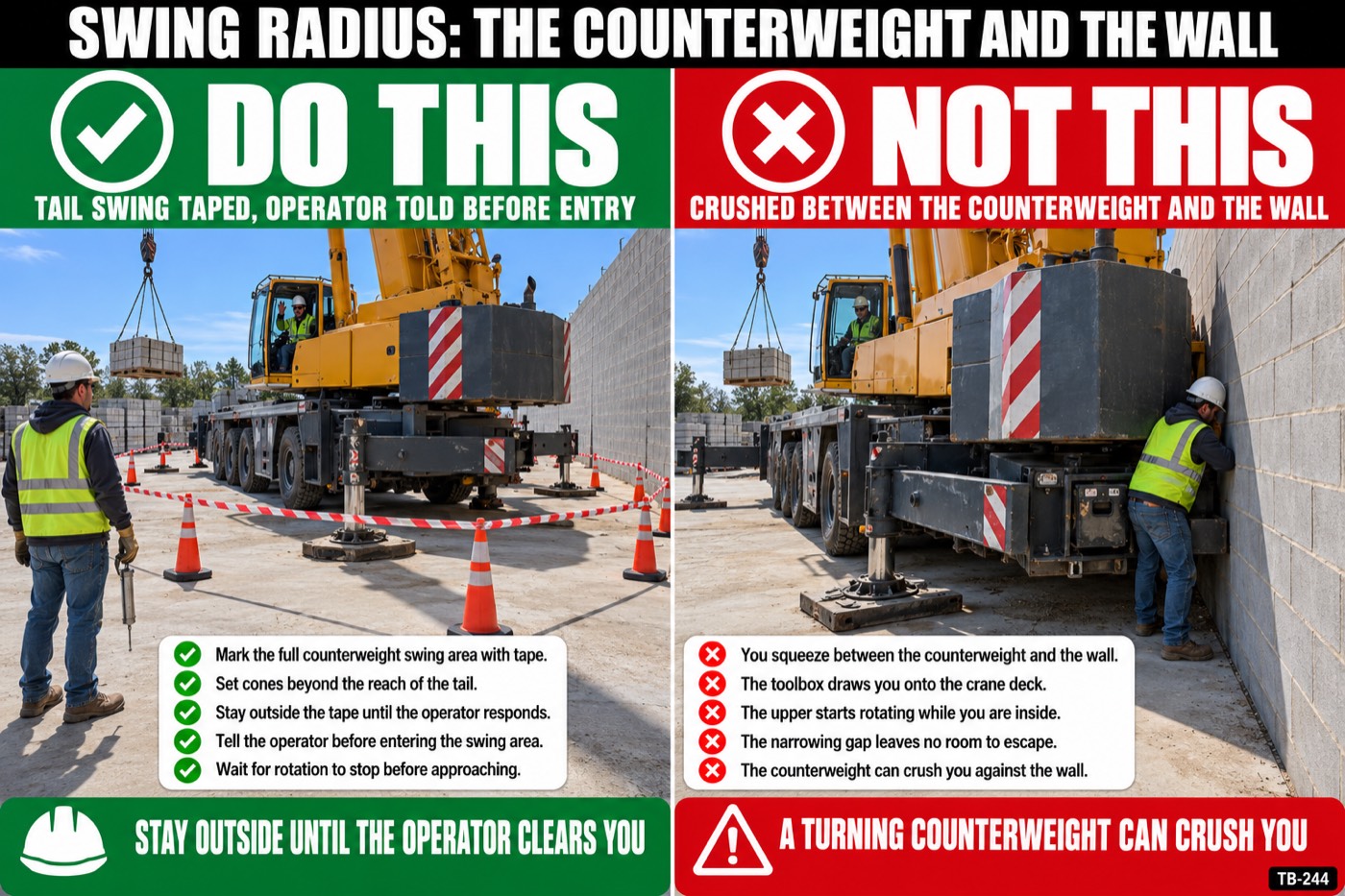
The counterweight on a truck crane swings in a circle nobody watches, because everybody is watching the load. That circle has killed people against walls, trucks and stacks of block.
The points
- A person caught between the counterweight and a wall does not get pushed. They get crushed, chest first, and by the time the operator feels resistance it is over.
- The swing radius of the counterweight and the whole rotating upper is barricaded: control lines, warning lines, railings or tape, and if that cannot be done, signs that say Danger Swing Crush Zone and high-visibility marks on the crane, with the crew told what they mean.
- Set up so the tail swing is not tight against anything. If a wall, a truck or a stack has to be inside the swing path, the gap is a body's width plus room to get out, or nobody is allowed in it.
- Anybody who has to go into the swing area out of the operator's view tells the operator first, and the operator does not swing until told the person is clear. That is a pre-arranged signal, not a shout.
- Grease, the outrigger controls, the toolbox on the deck, the coffee behind the truck. All of those are in the swing. Anything you need from the crane, you get with the operator's hand off the swing lever.
Why it goes wrong
The rotating upper on a truck crane is a few thousand pounds of counterweight plus the cab, and it comes around with the full swing torque of the machine. On many mobile cranes the tail extends several feet past the carrier body, and on a knuckle boom the base and the stabilizer beams do the same. The operator's eye is on the hook. The counterweight is behind him and out of his sight.
Under 29 CFR 1926.1424 the employer has to control the area where the rotating upper could hit or pinch someone. The order of preference is a physical barrier: control lines, warning lines, railings or the like at the edge of the hazard. Only where that is not feasible do signs and markings on the crane substitute, and only if the crew has been trained on what they mean.
The set-up is where this is won or lost. If the crane is parked so the counterweight passes within a foot or two of a wall, a fence, the delivery truck or a pallet stack, you have built a crush point that will be there all day. Moving the truck three feet forward during set-up costs nothing. Getting a body out from between the counterweight and the wall afterward costs everything.
The pre-entry rule is specific: before an employee goes into a part of the hazard area the operator cannot see, the employee or someone acting for them tells the operator, and the operator does not rotate until told by an agreed-on signal that the employee is in a safe spot. A radio call or a hand slap on the cab is fine if that was agreed. Guessing that the operator saw you is not.
The common mistake is the delivery. The materials truck backs up next to the crane so the crew can pick straight off the bed. Now the space between the counterweight and the flatbed is the working area, and the driver walks through it to unstrap. Barricade the tail swing before the truck is spotted, or spot the truck outside the circle.
The other common mistake is the outrigger pad. The operator sends a helper to check a float that is settling, on the side away from the cab, while the load is up. That helper is now inside the swing and out of view. The load stops, the swing brake goes on, and then the float gets checked.
Questions for the crew
- Where does the counterweight go on this set-up, and what is inside that circle right now?
- What have we put up to keep people out of the swing, and does everybody here know what the marks on the crane mean?
- If you had to get to the outrigger controls on the blind side while the operator was working, what would you do first?
To close
Before the first swing today the tail circle is taped or barricaded, and nobody steps inside it without the operator knowing.
To hold this talk with your crew
1
Read it aloud. Five minutes, before the work starts.
2
Ask the questions. A crew that talks is a crew that remembers.
3
Have them sign on their own phones, and the record is sealed.