Boom trucks and knuckle booms: the remote and the tip
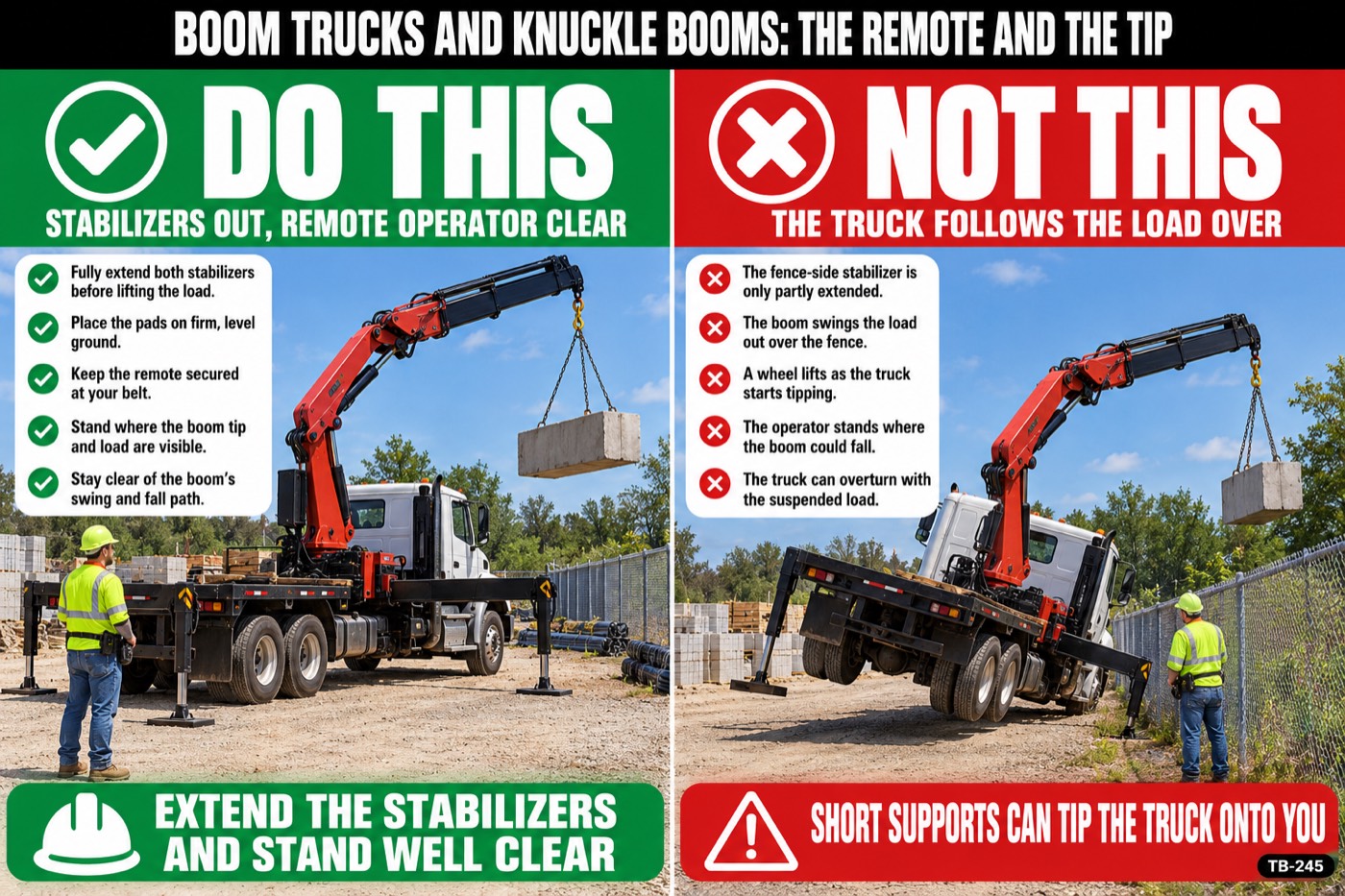
A knuckle boom that lifts 10,000 pounds close in may be good for 1,500 with the boom out 40 feet. The operator standing on the ground with a remote does not feel the truck start to lift a wheel.
The points
- Boom trucks go over sideways, and the operator on a remote is usually standing right where the boom, the load or the truck lands. That is the death on a small crane job: not the load falling, the crane following it.
- Delivering shingles to the ground is one thing. The minute the knuckle boom holds a truss while it is nailed, sets a panel, places steel or lands anything in a sequence, the whole crane rule applies: certified operator, signal person, inspections, power line rules.
- Stabilizers fully out on both sides, on pads, on ground that holds, truck level. Short-jacking the fence side and swinging the load over it is the most common way these tip.
- The remote operator stands where they can see the load and the boom tip, and is never under the load, never between the truck and the wall, and never inside the swing of the boom. The remote goes on the belt, not on the tailgate, and nobody else touches it.
- A shifted load changes the radius. A bundle that slides, a pallet that breaks, one sling shorter than the other, all move the weight out and the truck follows. Stop the lift, set it down, re-rig.
Why it goes wrong
Boom trucks and knuckle booms are cranes under 29 CFR 1926.1400: power-operated equipment that can hoist, lower and horizontally move a suspended load. The scope excludes a knuckle boom that delivers material to a site and unloads it to the ground without sequencing it, or sets sheet goods on a structure with a fork and a working overload device. The exclusion ends the moment the crane holds material in place for a construction activity or handles a prefabricated component or structural steel. Then operator certification, the signal person, inspections and the power line rules all apply.
Stability on a truck crane is a lever. The tipping line runs through the outrigger floats on the load side; the counterweight is the truck. Extend the boom and the moment on the load side climbs while the truck does not get heavier. When the load-side moment passes the moment of the truck's own weight, the far-side wheels and floats lift and the machine comes over. It is quiet until the last second and then it is fast.
The chart on the deck of a knuckle boom is often small and rated for all stabilizers fully extended. Set up with one side in and the capacity over that side is not what the chart says, and many of these machines have nothing to tell you. Overload devices help when they work; they are not a substitute for reading the chart at the radius you are working.
The remote is the trap. Tethered or radio, it lets the operator walk, and walking puts the operator in the fall zone, under the boom tip, or between the truck and the building where the load is going. The operator has to see the load and the boom tip both, stay out from under, and put the load down before doing anything with both hands. A remote left on a tailgate gets a knee on the joystick.
Loads shift on knuckle booms because the rigging is quick. Forks under a pallet that is broken on one side, a bundle picked with one strap, drywall on a cradle at a pitch, a truss with the sling off center so it rolls. Any of those moves the center of gravity, which moves the radius, which cuts the capacity. Rig it to the center, pick it an inch, watch it, then go.
The other death on boom trucks is travel with the boom up, into a power line or an overpass. Boom stowed, locked and stabilizers up before the truck moves, every time, and the driver walks around the truck before getting in. Overhead lines get their own talk; here the rule is simply that nothing on this truck moves with the boom above the cab.
Questions for the crew
- On today's job are we just unloading to the ground, or are we holding, placing or setting something? Which rule are we under?
- Are both sides of the stabilizers fully out, and is the operator's remote position out from under the load and out of the swing?
- What is the furthest reach we need today, and what does the chart give us at that radius?
To close
Today every pick on the boom truck gets set up on fully extended stabilizers, and the remote operator stands where the load cannot land on them.
To hold this talk with your crew
1
Read it aloud. Five minutes, before the work starts.
2
Ask the questions. A crew that talks is a crew that remembers.
3
Have them sign on their own phones, and the record is sealed.