Under the load: never, and the tag line that stops the spin
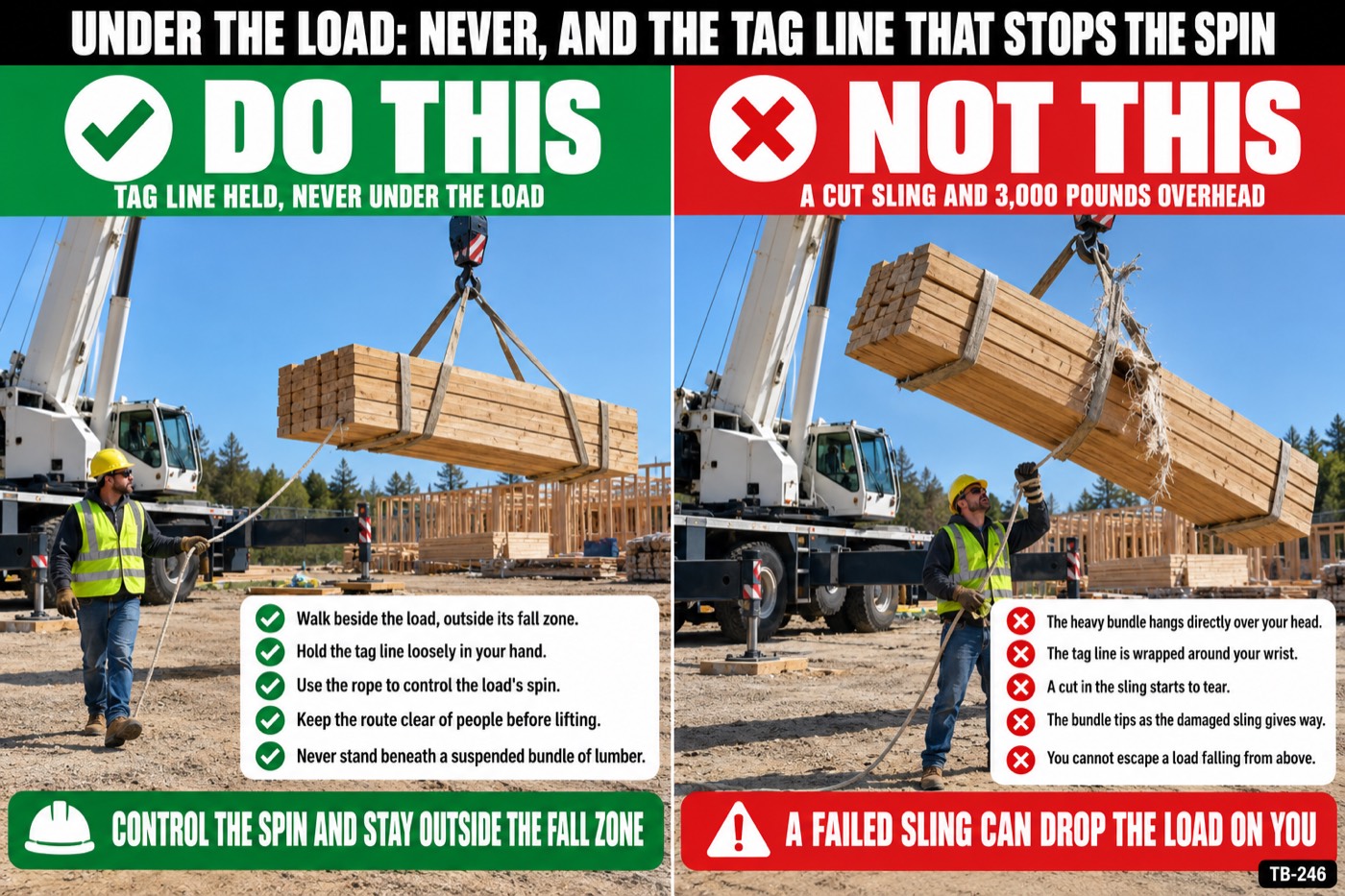
A 3,000 pound bundle of lumber lands on a person from 10 feet up in less than a second. The sling that failed had a small cut in it since last week.
The points
- When a sling, a hook latch or a shackle pin lets go, the load drops straight down and spreads. The fall zone is the ground under it plus wherever it bounces, and the person in it does not have time to step back.
- Nobody is under a suspended load. The only people in the fall zone are the ones hooking, unhooking or making the first connection, and only for as long as that takes.
- Hoisting routes go around people, not over them. The plan says where the load travels, and that path is clear before the pick, including the sidewalk and the neighbor's yard.
- A tag line goes on any load that can spin or swing: long, flat, wide, or anything with sail. It is a rope in your hand, not around it, and you walk with the load from outside the fall zone, never under it.
- Wind moves loads. When the load starts to sail or the operator feels the boom loading sideways, the lift stops, and a competent person decides whether the day's lifts are done.
Why it goes wrong
Under 29 CFR 1926.1425 the fall zone is the area under the load where it is reasonably foreseeable that partially or completely suspended material could fall. While the operator is holding a load, no employee is in that zone except the people connecting or disconnecting it, the ones making the initial attachment to the structure, or the ones on a concrete bucket. Those people are there only while they do that work, the hooks have self-closing latches, and the rigging is done by a qualified rigger.
The physics is short. A load at 10 feet takes about 0.8 seconds to reach the ground. Reaction time for a person watching it is around 0.7 seconds before the first step. The person under a dropping load moves, at best, one stride. That is why the rule is about where you stand before the load fails, not about how fast you can get out.
The tag line does three things: it keeps a long load from rotating into a wall or a person, it keeps a load with sail from swinging out, and it lets you guide a set without putting your hands on it. Rule of the tag line: hold it, never wrap it around a hand or wrist, never tie it to your belt, and if the load starts to take you, let go. A tag line on a load near a power line is non-conductive rope.
The spin is worse than it looks. A 20 foot beam hanging from a single point can rotate under wind or the swing of the boom, and the ends move at a walking pace or better. The person guiding it with a hand on the near end gets hit by the far end coming around. Two tag lines on a long load, one at each end, and both riggers outside the arc.
Wind acts on the load's face. Wind pressure runs about 1 pound per square foot at 20 mph and about 2.3 at 30. A 4 by 12 foot panel is 48 square feet, so 30 mph is over 100 pounds pushing it sideways on the hook, and the tag line holder feels every bit of it. Most crane manufacturers derate or stop between 20 and 30 mph depending on the load, and the operating rule makes the competent person adjust the lift for wind.
The common mistake is landing. The load comes in, the crew crowds under it to guide the last foot, and everybody has a hand on it when the sling relaxes and the load tips. Only the people needed to land it are in the fall zone, hands on the load only when it is inches from set, and feet never under the edge that would drop if it rolled.
Questions for the crew
- Where is the fall zone for the picks today, and where does the load travel? Does it cross anywhere people walk?
- Which loads today spin or catch wind, and who has the tag lines on them?
- What is the wind doing this afternoon, and who calls it when it picks up?
To close
Today nobody stands under a load for any reason, and every long or flat pick goes up with a tag line in somebody's hand and not around it.
To hold this talk with your crew
1
Read it aloud. Five minutes, before the work starts.
2
Ask the questions. A crew that talks is a crew that remembers.
3
Have them sign on their own phones, and the record is sealed.