Walk-around: six broken wires and the anti-two-block
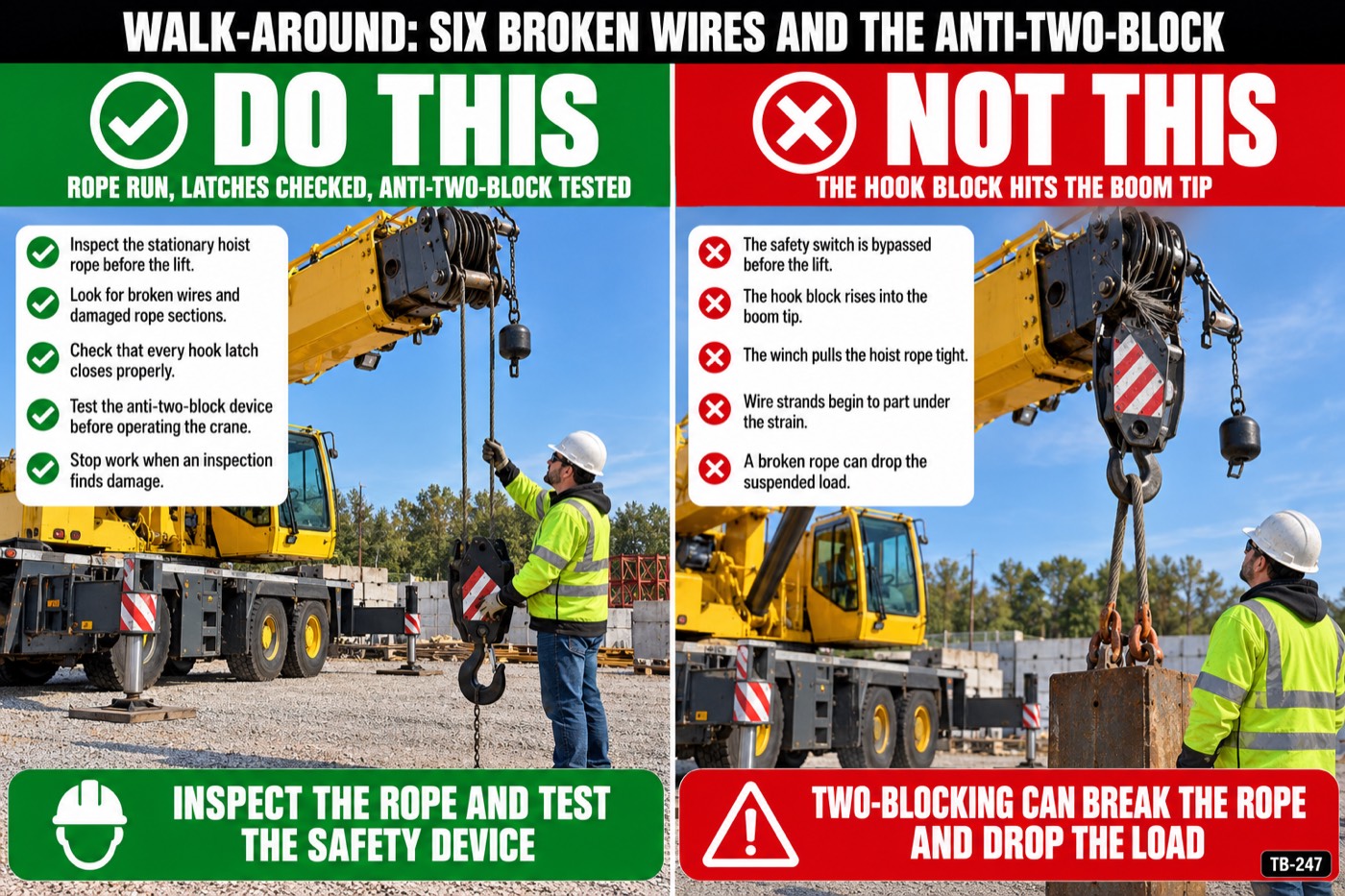
Six broken wires in one lay of the hoist rope, or three in one strand, and that rope comes off the crane today. A lay is about seven times the rope diameter, so on 3/4 inch rope you are looking at a stretch about 5 inches long.
The points
- A hoist rope that parts drops the load from wherever it is. A hook latch that is bent lets the sling walk off the hook on a bounce. A two-block pulls the ball into the boom tip and snaps the rope. Every one of these is found in the walk-around, or found the hard way.
- Before or during every shift a competent person looks at the crane: controls, hydraulic lines and fluid, the rope and its reeving, hooks and latches, tires, ground and level, safety devices and operational aids. Nothing found is used until it is fixed.
- Wire rope: run a gloved hand and your eyes along it. Six broken wires in one lay or three in one strand, 5 percent loss of diameter, kinks, birdcaging, corrosion or heat marks, and it comes off. Rope that touched a power line is scrapped.
- The anti-two-block device stops the block from hitting the boom tip. Test it every shift by booming down slowly with the hook up. If it does not work you can mark the cable and use a spotter for at most 7 days, then it is fixed or the crane sits.
- Monthly inspections are written down and kept, the annual is done by a qualified person and kept for a year, and the operator card is renewed every 5 years and backed by a documented evaluation on this type of crane. None of that is the office's problem; it rides in the truck.
Why it goes wrong
Under 29 CFR 1926.1412 the shift inspection is visual and does not require taking anything apart unless what you see says to. The list is specific: control and drive mechanisms, pressurized lines for leaks, hydraulic fluid level, hooks and latches for deformation, cracks, wear or damage, wire rope reeving, the wire rope itself, electrical apparatus, tires, ground conditions and settling, level position before each shift and after each move, cab windows, and safety devices and operational aids. Ten minutes with the engine warm.
Wire rope fails from the inside out and shows on the outside first as broken wires. The rope wears at the sheaves and the drum and where it sits under load at the same spot day after day. The counts in 1926.1413 are the removal line: six random broken wires in one lay or three in one strand in one lay on running rope, more than two in a lay on a pendant, and 5 percent under nominal diameter. Any of those and a competent person pulls it or cuts the damaged length off; there is no splicing crane rope.
The hook latch is a throwaway part that gets ignored. A latch that does not spring closed, is bent, or has a gap lets a sling eye ride up and off when the load bounces or lands and the sling goes slack. The rule for anyone in the fall zone requires self-closing latches, and the shift inspection says hooks and latches get looked at. Fix it or swap the block.
Two-blocking is the ball or block being hoisted into the boom tip, usually while booming down or extending with the hook held up. The hoist line has nowhere to go and it parts, and whatever is hanging comes down. The anti-two-block device is a Category I operational aid under 1926.1416: if it fails you can work with the cable marked and a spotter watching the tip, but for no more than 7 calendar days unless parts are on order, and then it is out of service.
Documentation is not the point but it is the proof. The monthly inspection is written with items, results, name, signature and date, and kept at least 3 months. The annual is a comprehensive inspection by a qualified person, taken apart as needed, kept for 12 months. The operator's certification comes from an accredited tester or an audited employer program, is good for 5 years, and the employer still has to document an evaluation showing this operator can run this equipment for this work.
The common mistake is the rented or borrowed crane. It arrived on the lowboy, it looks new, and it goes to work. It gets the same shift inspection, and the operator asks where the annual is and looks at the last monthly. A crane idle 3 months or more gets a monthly-level inspection by a qualified person before it lifts anything.
Questions for the crew
- Who did the walk-around on this crane this morning, and what did they find?
- When was the rope last looked at along its whole length, and does anybody know its diameter when it was new?
- Is the annual in the truck, and when does the operator's card run out?
To close
Before the first pick today the operator tests the anti-two-block, runs the rope and the latches, and says out loud what was found.
To hold this talk with your crew
1
Read it aloud. Five minutes, before the work starts.
2
Ask the questions. A crew that talks is a crew that remembers.
3
Have them sign on their own phones, and the record is sealed.