Flagger position: never in the lane, and a way out
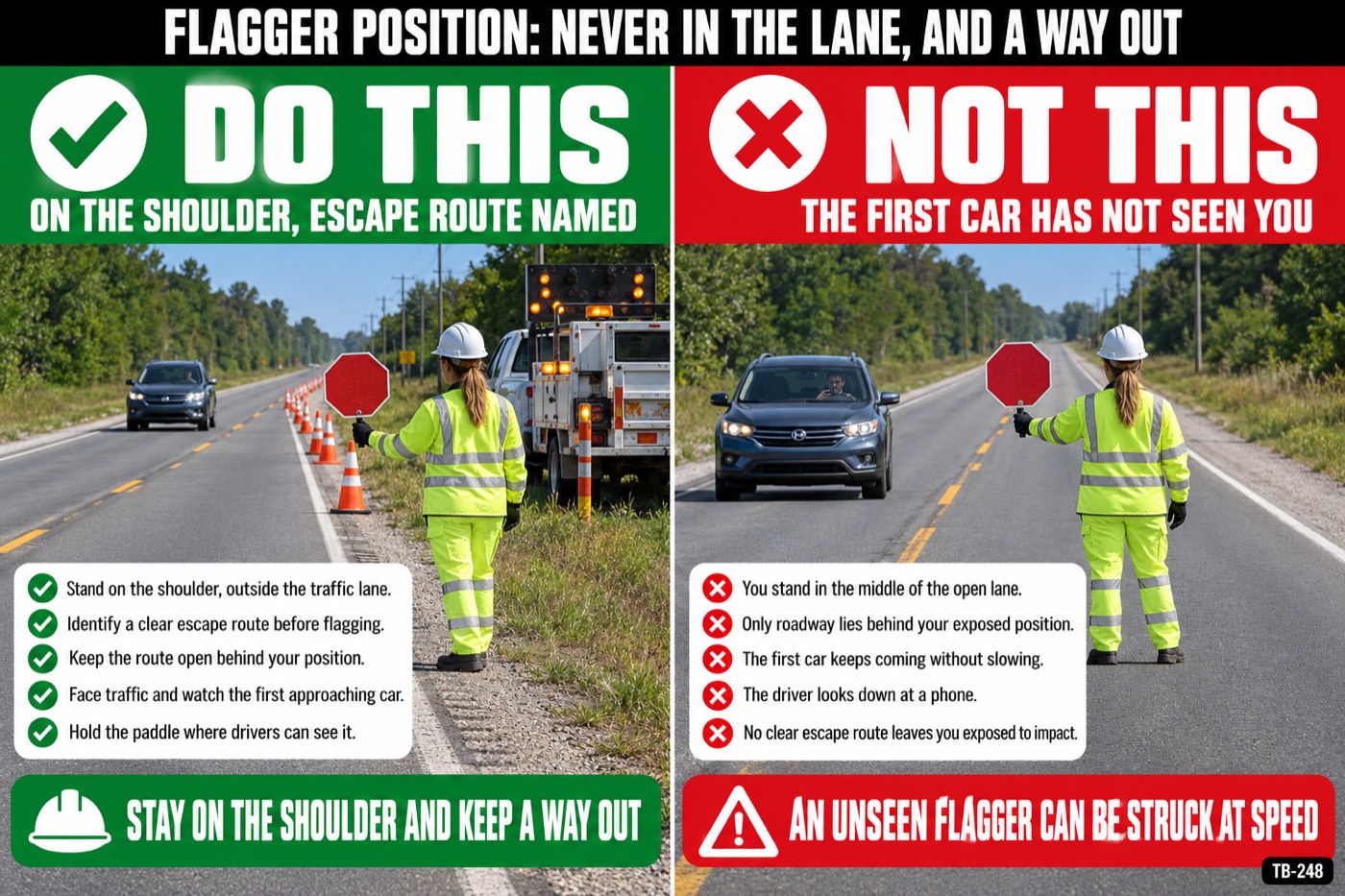
A car at 45 covers 66 feet every second. A driver who looks down at a text for three seconds drives 200 feet without seeing you, and 200 feet is about where you are standing.
The points
- Flaggers get killed by the first car in the line, not the tenth. The driver who has not slowed down is the one who has not seen you, and you find that out in the last second.
- You stand on the shoulder or in the closed lane, never in the open lane. You step into the lane only after traffic has stopped, and you are back out of it before you release them.
- Plan your escape route before the first car and say it out loud: behind the barrier, up the bank, behind the truck. If there is nowhere to go from that spot, that is the wrong spot.
- Your station sits far enough back that a driver can stop where you want them to. At 45 miles an hour that is 360 feet; at 55 it is 495. Those numbers are Table 6E-1 in MUTCD Part 6.
- Watch the driver, not the car. If the head is down or the phone is up, that driver has not seen you, and you move first, before you find out for sure.
Why it goes wrong
29 CFR 1926.201(a) says flagger signaling conforms to Part 6 of the MUTCD, and Chapter 6E is flagger control. Section 6E.08 puts the flagger station where an approaching driver has the full stopping sight distance to it: 155 feet at 25, 250 at 35, 360 at 45, 495 at 55, 645 at 65. If the curve or the crest gives you less than that, the station moves back or you add an advance flagger.
Section 6E.07 says the flagger stands on the shoulder next to the traffic being controlled or in the closed lane, and steps into the open lane only after the drivers have stopped. Standing in the open lane to be more visible is the mistake that gets people hit, because visible is not the same as seen.
The escape route is decided before the first car. It runs away from traffic, not across the open lane and not into the closed lane where the roller or the loader is moving. Nothing is stored in it, no truck is parked in it, and you are never standing between a parked truck and the open lane, because that is where you get pinned.
A car at 55 covers 80 feet a second. From the moment you decide a driver is not stopping you have one to two seconds, which is enough to take three steps if you already know which direction and if you were facing the car. It is not enough to turn around, look, and choose.
The phone in the driver's hand is the most common reason the head is down. A five-second glance at 55 is the length of a football field driven blind. Count the heads down in the next hour of windshields; the number will change how seriously you take your escape route.
The common mistakes: walking toward the work to talk to somebody, standing at the start of the taper next to the drums where an intruding car goes first, and stepping out early to wave the first car in. Every one of those puts you in the lane while it is moving.
Questions for the crew
- Where is your escape route from where you will stand this morning, and which way do you run?
- How far back from the work is your station on this road, and can the first driver see you at that distance?
- What do you do the moment you see a driver's head down and no brake lights?
To close
Before the first car this morning every flagger names their spot and their way out, and nobody stands in the open lane while it is moving.
To hold this talk with your crew
1
Read it aloud. Five minutes, before the work starts.
2
Ask the questions. A crew that talks is a crew that remembers.
3
Have them sign on their own phones, and the record is sealed.