Paddle and vest: seen at 500 feet or not at all
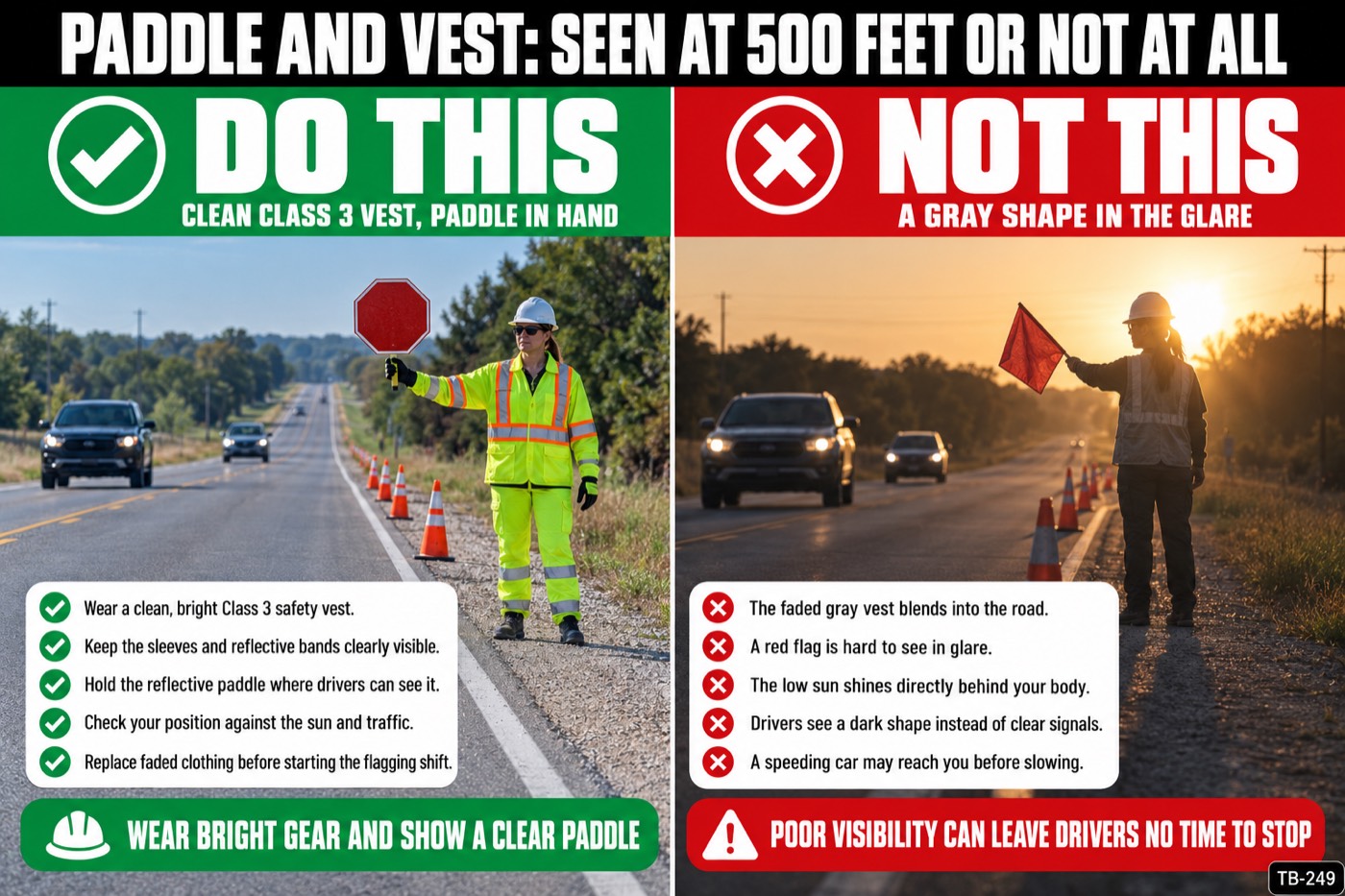
A driver at 55 needs about 500 feet to see you, decide, and stop. If your vest has gone gray and the sun is behind you, at 500 feet you are a shape, not a flagger.
The points
- Drivers do not hit flaggers they saw. They hit flaggers they never picked out from the trucks, the drums and the glare until there was no room left to stop.
- The vest is ANSI 107 Class 2 at minimum and Class 3 at night or on anything fast. Class 3 has sleeves, and the sleeves are what a driver sees when you are turned sideways.
- The paddle, not the flag. An 18-inch STOP/SLOW paddle on a rigid handle is the preferred hand signal; a flag is for emergencies only, and drivers read it wrong.
- At night your station is lit, your paddle is reflective or lit, and the lights on your vest are on. Headlights pick up retroreflective tape many times farther away than a dark vest.
- Know where the sun is. A low sun behind you puts you in silhouette to the driver; move the station or add a sign, or you are invisible at the worst hour of the day.
Why it goes wrong
29 CFR 1926.201(a) says the warning garments flaggers wear conform to MUTCD Part 6, and Section 6E.02 names the garment: high-visibility apparel meeting ANSI/ISEA 107 Performance Class 2 or 3, and Class 3 should be considered for night work. Federal-aid highways carry the same Class 2 or 3 requirement under the FHWA worker visibility rule, so there is no road where a plain orange T-shirt counts.
The classes are areas of material. Class 2 is at least 775 square inches of fluorescent background and 201 square inches of retroreflective tape. Class 3 is 1,240 and 310, and it has sleeves, which is the point: a driver recognizes a human shape by arms and legs, and a vest with no sleeves seen from the side is a rectangle.
Fluorescent color works by day, because it converts ultraviolet light into visible color, and it does nothing at night. Retroreflective tape works at night, because it bounces headlights straight back at the driver, and it does nothing by day. A faded, dirty vest has lost both, so wash it, and when the orange has gone pale, replace it.
MUTCD 6E.03 makes the STOP/SLOW paddle the primary hand-signaling device and limits flags to emergencies. The paddle is at least 18 inches wide with 6-inch letters on a rigid handle, and at night it is retroreflective or lit. A flag is 24 inches square in red or fluorescent orange-red, and a driver seeing a waved flag does not know if that means stop, slow, or go around.
A low sun behind the flagger, sunrise on an eastbound approach or sunset on a westbound one, means the driver is looking into the light and you are a dark cutout in it. The fix is to move the station out of the line of the sun, add advance signs, or put the flagger on the other side of the road where the geometry allows.
The common mistakes: the vest unzipped and flapping so the tape faces the ground, a jacket or rain shell over the vest instead of under it, a tool belt or radio harness covering the tape, a hood pulled up over the collar, and a paddle set down on the sign stand while the flagger waves with a hand.
Questions for the crew
- What class is the vest you have on right now, and when did it last get washed?
- Where will the sun be at 7 a.m. and 5 p.m. on this stretch, and which flagger has it behind them?
- If we are still flagging after dark tonight, what lights are on the station and on you?
To close
Everyone flagging today has a clean Class 2 or 3 vest zipped over everything else and a paddle in hand, not a flag.
To hold this talk with your crew
1
Read it aloud. Five minutes, before the work starts.
2
Ask the questions. A crew that talks is a crew that remembers.
3
Have them sign on their own phones, and the record is sealed.