Cones and signs: the setter is the exposed one
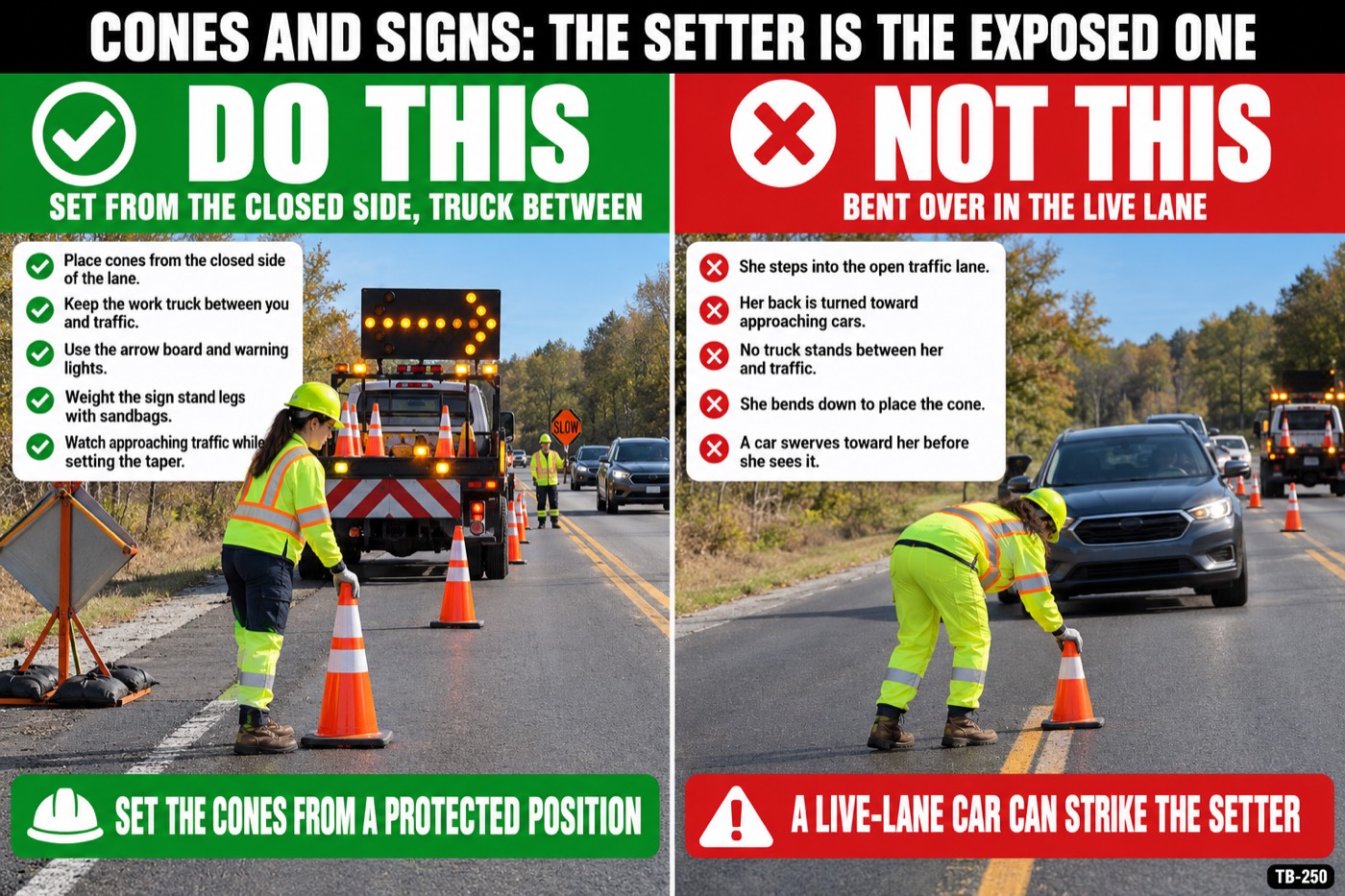
The closure that protects the crew does not exist yet while you are building it. The cone setter is on foot at the edge of a live lane, bent over, with a 7-pound cone in each hand and nothing behind them but the truck.
The points
- The closure does not protect you while you are setting it or picking it up. Those two windows are when traffic control crews get hit, and the setter on foot is the one who takes it.
- Set from the closed side, working with traffic, with the truck between you and the live lane and its lights and arrow board on. You never walk in the open lane to place a cone; you set it from the closed side and step back.
- Cones are 28 inches on anything fast and on every road at night, and 18 inches only on slow streets by day, and they come down in reverse, last one first, so the closure shrinks from the far end and you are always behind something.
- Sign stands get ballast on the legs, sandbags at the base, not hung on the sign. A 48-inch sign is a sail; a 30 mile-an-hour gust puts an unballasted stand in the lane, and a stand in the lane is a crash.
- Nobody rides the tailgate or the bumper while the truck rolls. Cones go on from a stopped truck or from the cone body with the setter secured, and the driver moves only on the setter's word.
Why it goes wrong
29 CFR 1926.200(g) says construction areas are posted with traffic control signs and protected by traffic control devices, and that the design and use of those devices conforms to MUTCD Part 6. Chapter 6F covers the devices: cones not less than 18 inches, 28 inches on freeways and other high-speed roads and on every road at night, with retroreflective bands for night; drums 36 inches; signs sized for the speed of the road.
Order matters because the driver has to see the warning before the device. Advance signs go up first, farthest from the work, then the taper, then the tangent along the work. Pickup is the exact reverse, from the far end back toward the signs, so the last thing to come down is the first thing a driver sees, and the setter is always downstream of something that is still standing.
The taper is the most dangerous stretch to set because drivers are still deciding what the cones mean. The setter's back is to traffic every time they bend, so the truck rides in the closed lane at walking pace with the setter on the far side of it, never between the truck and the open lane. If a cone gets knocked into the live lane, nobody chases it; the driver or the flagger watches for a gap and it is retrieved from the closed side.
A 48 by 48 inch sign is 16 square feet. At 30 miles an hour the wind pushes on it with roughly 35 pounds, five feet up on a stand that weighs 15, and that is why an unballasted stand goes over or slides. Ballast is what the manufacturer says, usually 20 to 40 pounds, on the legs at the base; a sandbag hung on the sign or the crossbar raises the center of gravity and makes it worse.
Dusk pickup is where the shift goes wrong. The crew is tired, the light is flat, the truck's lights are not on yet, and drivers coming into the sun cannot see a setter walking the drum line. Lights on before pickup starts, and the arrow board stays in caution mode until the last cone is on the truck.
The common mistakes: reaching across the open lane for a cone, the setter walking the line while the truck is 200 feet ahead, sandbags on the sign face, and riding the bumper to save five minutes. 29 CFR 1926.601 does not allow a person on the outside of a moving truck, and the ground at 10 miles an hour does not either.
Questions for the crew
- Where is the truck going to be while you set the taper, and which side of it are you on?
- How much ballast is on each sign stand today, and what did the wind do out here yesterday afternoon?
- If a cone gets knocked into the open lane at 2 p.m., who gets it and how?
To close
Today every cone and sign goes in and comes out from the closed side with the truck between the setter and traffic, and nobody chases a cone into a live lane.
To hold this talk with your crew
1
Read it aloud. Five minutes, before the work starts.
2
Ask the questions. A crew that talks is a crew that remembers.
3
Have them sign on their own phones, and the record is sealed.