TMA truck: the shield that rolls 100 feet when hit
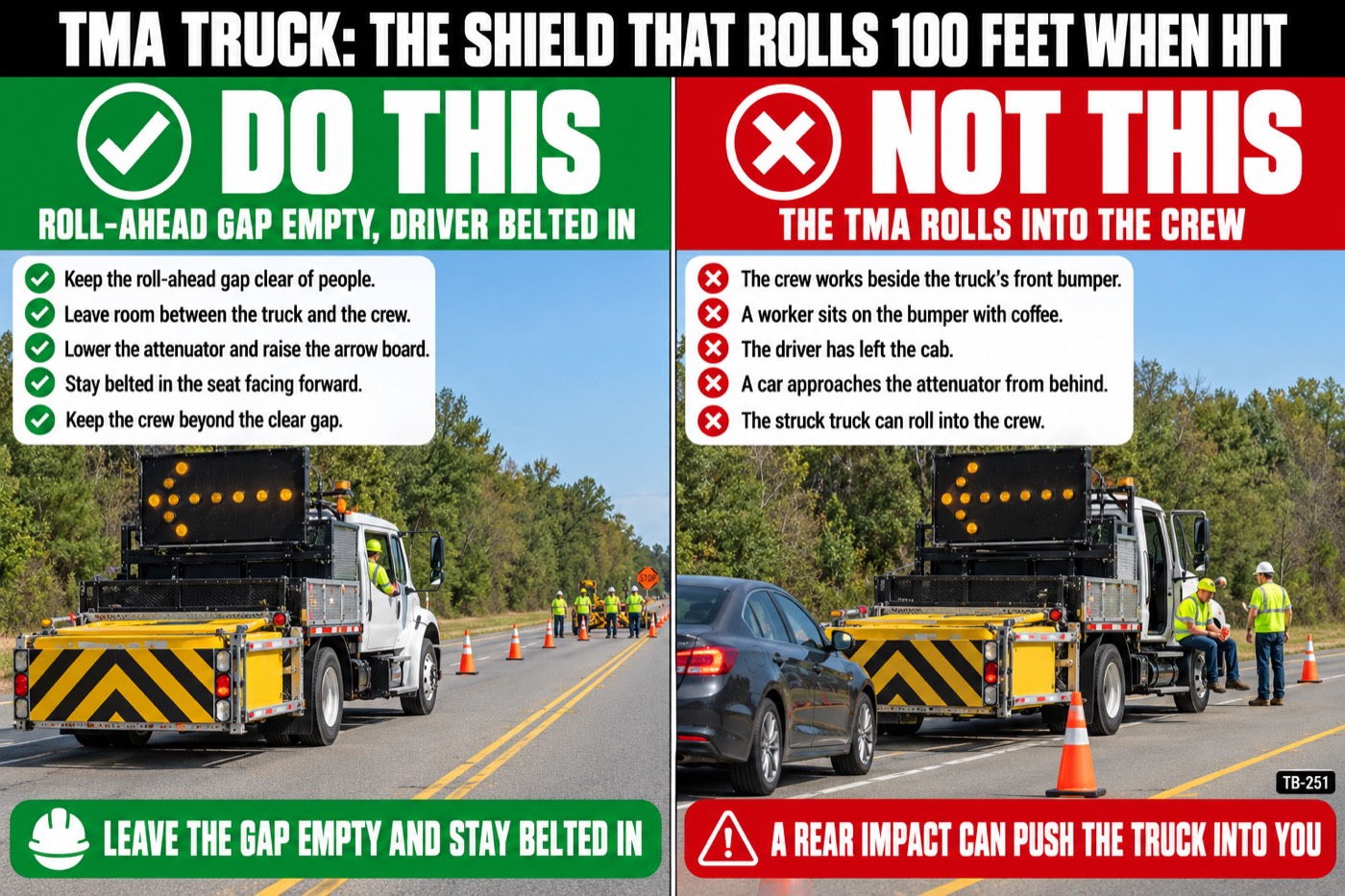
A TMA truck is built to be hit. When a 4,000-pound car does it at 60, the truck moves forward, and the only question is what was parked in its path.
The points
- The TMA does its job by taking the crash and rolling. A crew working right off its bumper gets hit by the truck that was supposed to save them.
- The gap between the back of the TMA and the first worker is the roll-ahead distance, and on a road over 55 mph that is 150 feet or more, and about 170 when the truck is light. Nobody works, parks or walks in that gap.
- The truck is heavy enough to be a shield, brake set, in gear, wheels straight or turned away from the crew, arrow board up. The host truck weight comes from the attenuator maker's rating, not from whatever was free in the yard.
- The driver stays in the seat, belted, facing forward, mirrors on traffic. The belt is what keeps the driver alive when 4,000 pounds arrives at 60; 29 CFR 1926.601(b)(9) requires it and the crash is why you wear it.
- Nobody stands between the TMA and the work, and nobody uses the TMA's bumper as a bench, a tool table or a step. The shadow vehicle's only job is to be hit.
Why it goes wrong
The crash cushion crushes over 6 to 12 feet to absorb the car's energy, and the truck it is bolted to still moves. How far it moves depends on the truck's weight, the speed of the hit and whether the brakes were set and the transmission in gear. Published tables put a parked, braked 10,000-pound truck hit by a 4,500-pound car at 60 at about 50 feet. Hit by a loaded truck, it can roll 200 feet. That is why spacing guidance on roads over 55 mph is 150 feet for a heavy truck and about 170 for a lighter one.
Attenuators carry a host vehicle weight range, commonly 10,000 to 24,000 pounds; outside that range the cushion does not perform as tested and the truck is not a shield, it is a heavy object in the way. The cushion itself is rated to MASH, and a cartridge that has been hit, bent or patched is not rated to anything until the maker says so. The walk-around covers the cushion, the lights, the arrow board and the tires before the truck goes to the lane.
The truck sits square in the closed lane so the impact is straight. A truck parked at an angle sends the car sideways, into the work or across into the open lane. Wheels straight, or turned away from the crew, so that if it rolls it goes where you decided and not where the impact decides.
The driver is in the seat with the belt on, head against the headrest, facing forward, for the whole time the truck is protecting the crew. A driver standing outside the truck to help is a worker in the gap. 29 CFR 1926.601(b)(7) says tools and material in the cab are secured, and in a TMA that matters twice: a thermos, a clipboard or a radio on the dash is a projectile at 60.
On a mobile operation the shadow vehicle keeps its gap while the work moves, and the work vehicle sets the pace. When the crew advances 200 feet on foot to the next patch and the TMA stays put, the gap is 300 feet and the crew is unprotected; when the TMA catches up and the crew stops, the gap is 20 feet and the crew is in the roll-ahead. Somebody owns that gap all day.
The common mistakes: the foreman's pickup parked in the gap, a worker walking back to the TMA cab for water, the driver getting out to stretch, tools laid on the cushion, and a truck that was hit last month and is still in the lane with a bent cartridge.
Questions for the crew
- How far is it from the back of the TMA to the first person working today, and did somebody pace it?
- Who is in the TMA seat this shift, and what happens to that gap when the work moves forward 200 feet?
- What is loose in that cab right now that becomes a projectile at 60?
To close
Today the TMA sits at its roll-ahead gap, the driver stays in it belted, and nothing and nobody sits in the space between it and the work.
To hold this talk with your crew
1
Read it aloud. Five minutes, before the work starts.
2
Ask the questions. A crew that talks is a crew that remembers.
3
Have them sign on their own phones, and the record is sealed.