Two-way flagging: the last car and the pilot car
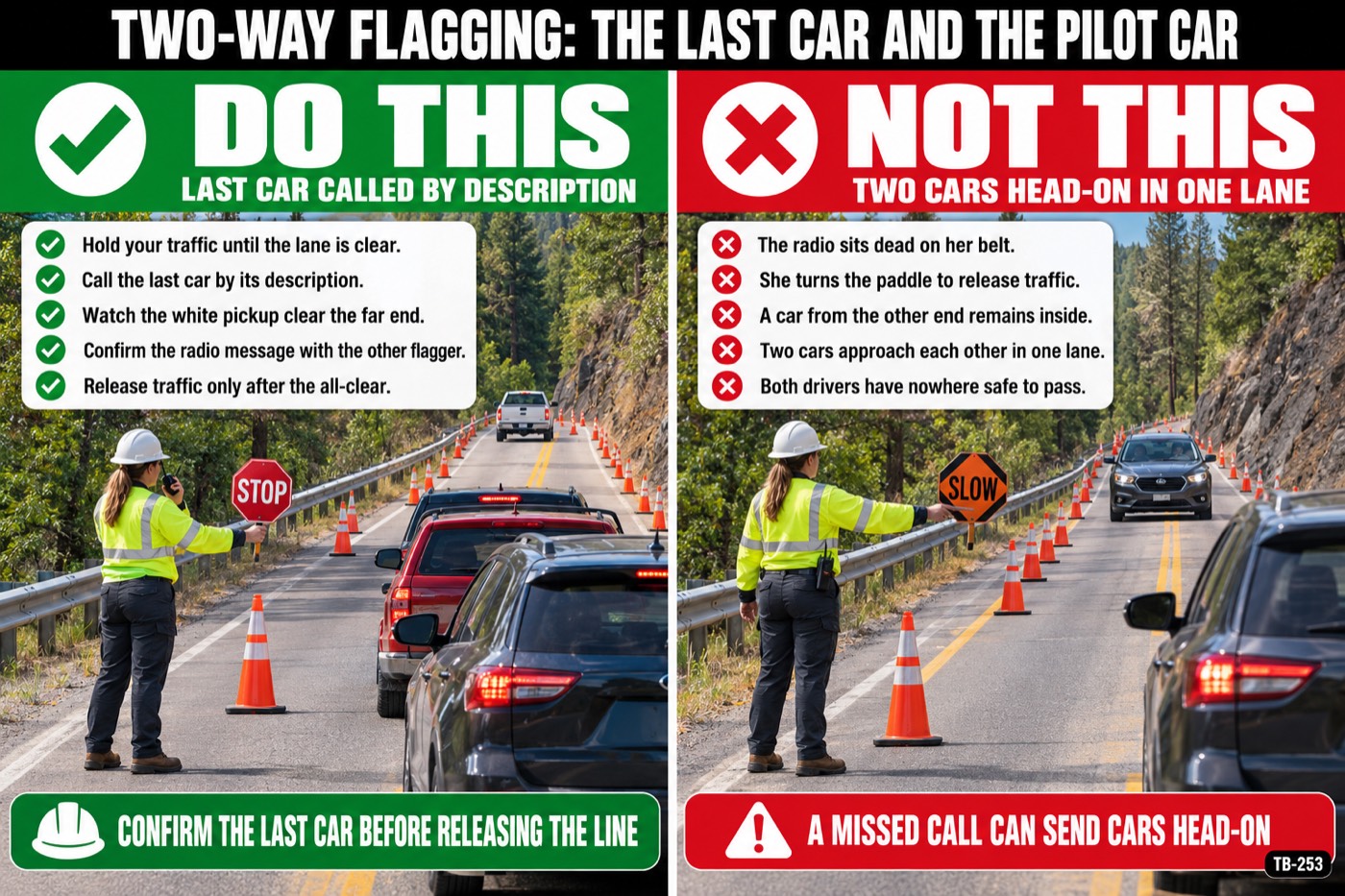
On a one-lane, two-way closure, two flaggers who lose the count send two cars at each other at 35 in a lane wide enough for one. The radio is the whole system.
The points
- A head-on inside a one-lane closure is caused by the flaggers, not the drivers. Two flaggers who each thought the other had stopped their end have put two cars in the same lane.
- Radios checked before the first car, both ends, spare battery in a pocket. If you lose contact, both ends go to STOP and stay there until you have voice again; nobody guesses.
- Count the cars through and call the last one by description: 'Last car is a white pickup, ten cars.' The far end releases only when the white pickup is out, not when it looks about right.
- A pilot car is used when the section is long, has a hill or a curve, or drivers get lost inside it. It carries the PILOT CAR FOLLOW ME sign on the back, the platoon follows only it, and the last car in the platoon is still called by radio.
- On a hill or a blind curve the flagger station sits where a driver has the full stopping distance to you, 250 feet at 35, 360 at 45, and if the road cannot give you that, you add an advance flagger or move the station.
Why it goes wrong
29 CFR 1926.201(a) sends flagger operations to MUTCD Part 6. Chapter 6E covers the flaggers, Section 6C.13 covers the pilot car with its PILOT CAR FOLLOW ME sign mounted on the rear, and the typical application for a lane closure on a two-lane road shows the two flagger stations with the one-lane section between them. Every method for running that section comes down to the same thing: the far end knows, for certain, that the last car is out before it releases.
The last car is called by description and not by number because the count goes wrong in ways nobody sees. A car pulls into a driveway inside the zone and never comes out the far end. A car joins from a side road and the far end counts eleven when ten were sent. If the far flagger is waiting for a white pickup, a driveway does not fool them; if they are waiting for ten, it does.
Radios fail in ordinary ways: a cold morning takes half the battery, a hill blocks the signal, somebody left the channel. So the rule is fixed before the shift: no contact means both ends are at STOP and stay there, and the section is empty before anyone releases. Hand signals between flaggers only work where the two stations can see each other the entire way, which on a hill or a curve is never.
A pilot car earns its place when the section is long enough that the last car is out of sight for a long time, or when a hill or a curve hides the platoon. The pilot car driver runs slow enough that the trucks keep up, keeps the platoon short, and talks on the same channel as the flaggers. On a hill the lead car crests while the last car is still climbing, so the far flagger holds until the pilot car arrives and the last car is confirmed, not until the pilot car is in view.
Drivers waiting in the line get restless after a few minutes, and the one who pulls out to pass the line is now driving into the section against the platoon. The flagger does not step into the lane to block that car. The flagger steps out, calls it on the radio so the far end and the pilot car hold everything, and the car is dealt with by the count, not by a body in the road.
The common mistakes: releasing on the number; turning the paddle to SLOW while the last car is still coming; the pilot car driver forgetting to call the last car; two flaggers chatting on the channel so the call that matters is stepped on; and a station on the near side of the crest where the driver sees the flagger with 150 feet left.
Questions for the crew
- Which channel, and what happens at each end if the radio goes dead at 2 p.m.?
- How long is the section today, and can the two flaggers see each other, or are you working blind?
- If a car turns into that driveway inside the zone, how does the far end know the count changed?
To close
Today the far end does not release until the last car, called by description, is out, and radio silence means both ends are at STOP.
To hold this talk with your crew
1
Read it aloud. Five minutes, before the work starts.
2
Ask the questions. A crew that talks is a crew that remembers.
3
Have them sign on their own phones, and the record is sealed.