The angry driver: do not engage, get the plate
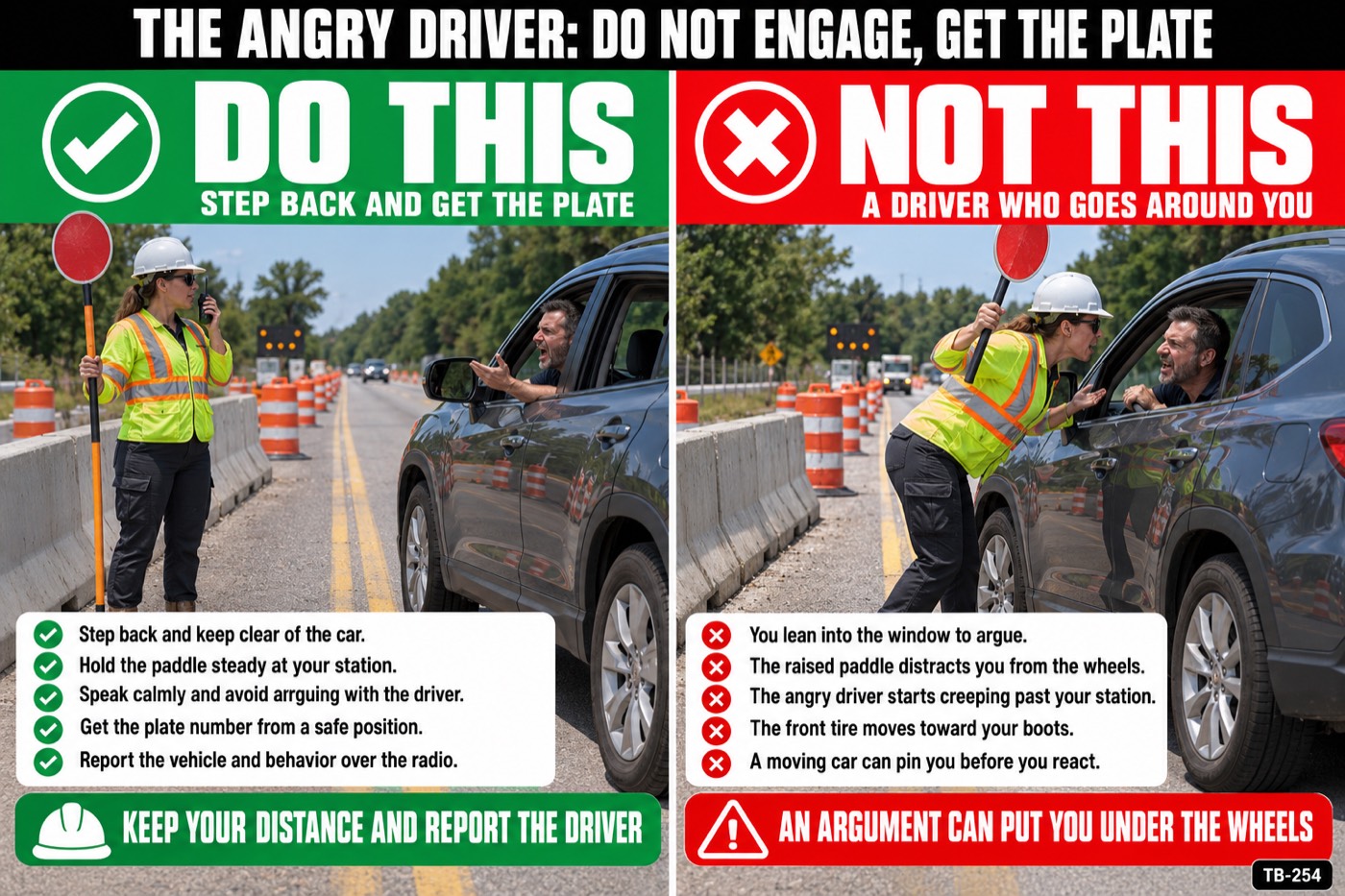
A flagger is not a cop and the paddle is not a badge. The driver screaming at you has 4,000 pounds and an accelerator, and you have a paddle and a vest.
The points
- The driver who argues with you is a nuisance; the driver who decides to go around you is the one who kills someone. You do not know which one you have, so both get the same thing: no engagement.
- You do not argue, explain, lecture or gesture. You hold the paddle, keep your voice flat, say 'a few minutes,' and step back to the edge of your station.
- A threat, a car creeping at you, a door opening: you get off the road and behind something, and you call the foreman on the radio right then, not after.
- Get the plate, the make, the color and the direction, and say it into the radio so somebody else has it too. That is what the police act on; your description of the driver's face is not.
- You never touch the car, hit it with the paddle, lean in the window or stand in front of it to stop it. A driver who goes through you was going through anyway; the paddle does not hold a car.
Why it goes wrong
29 CFR 1926.21(b)(2) says the employer instructs each employee in recognizing and avoiding the unsafe conditions of their work, and for a flagger the unsafe condition is a vehicle with an angry person in it. The training is distance and de-escalation, because nothing a flagger can carry stops a car, and the rule under 1926.201 and MUTCD Chapter 6E only works on drivers who are willing to be directed.
Not engaging is about your eyes as much as your temper. The argument pulls your attention off the approach, and the second car hits you while you are talking to the first. The driver is already at their worst; nothing you say improves that, and every sentence you add is time you are not watching the road.
The whole script is: 'Road's closed ahead, it'll be a few minutes.' Nothing about whose fault the delay is, nothing about the schedule, no detour advice beyond what you actually know. If the driver wants more, the answer is the same sentence again, and then you are looking at the road, not at them.
A threat is 'I'll run you over,' an engine revving, a car creeping into your space, a door opening. Any of those and you move to your escape route, behind the barrier or the truck, and radio the foreman with your location. The foreman calls 911. Nobody from the crew walks over to back you up; that leaves the work and the count unattended and turns a driver against a flagger into a driver against a crowd.
The plate is what the police need, with the time and the direction. Say it on the radio first so it is in two heads, then write it on the log or your hand within a minute, because plates leave memory fast. Most states double fines in a work zone and many treat assault on a highway worker as its own crime, but none of that happens without the plate.
The common mistakes: the flagger who steps in front of the car to make a point, the crew who gather around the window, swinging the paddle at the hood, and the foreman who does not call it in because nothing happened. A driver who threatened a flagger at 10 a.m. comes back through the zone at 4.
Questions for the crew
- What is the sentence you are going to say to the driver who has waited eight minutes and is yelling?
- If a driver creeps at you at 11 a.m., where do you go, and who do you call first?
- Who on this crew writes down the plate and calls it in, and where is that written?
To close
Today nobody on this crew argues with a driver; you step back, call the foreman, and get the plate.
To hold this talk with your crew
1
Read it aloud. Five minutes, before the work starts.
2
Ask the questions. A crew that talks is a crew that remembers.
3
Have them sign on their own phones, and the record is sealed.