Twelve hours on the paddle: the flagger who goes quiet
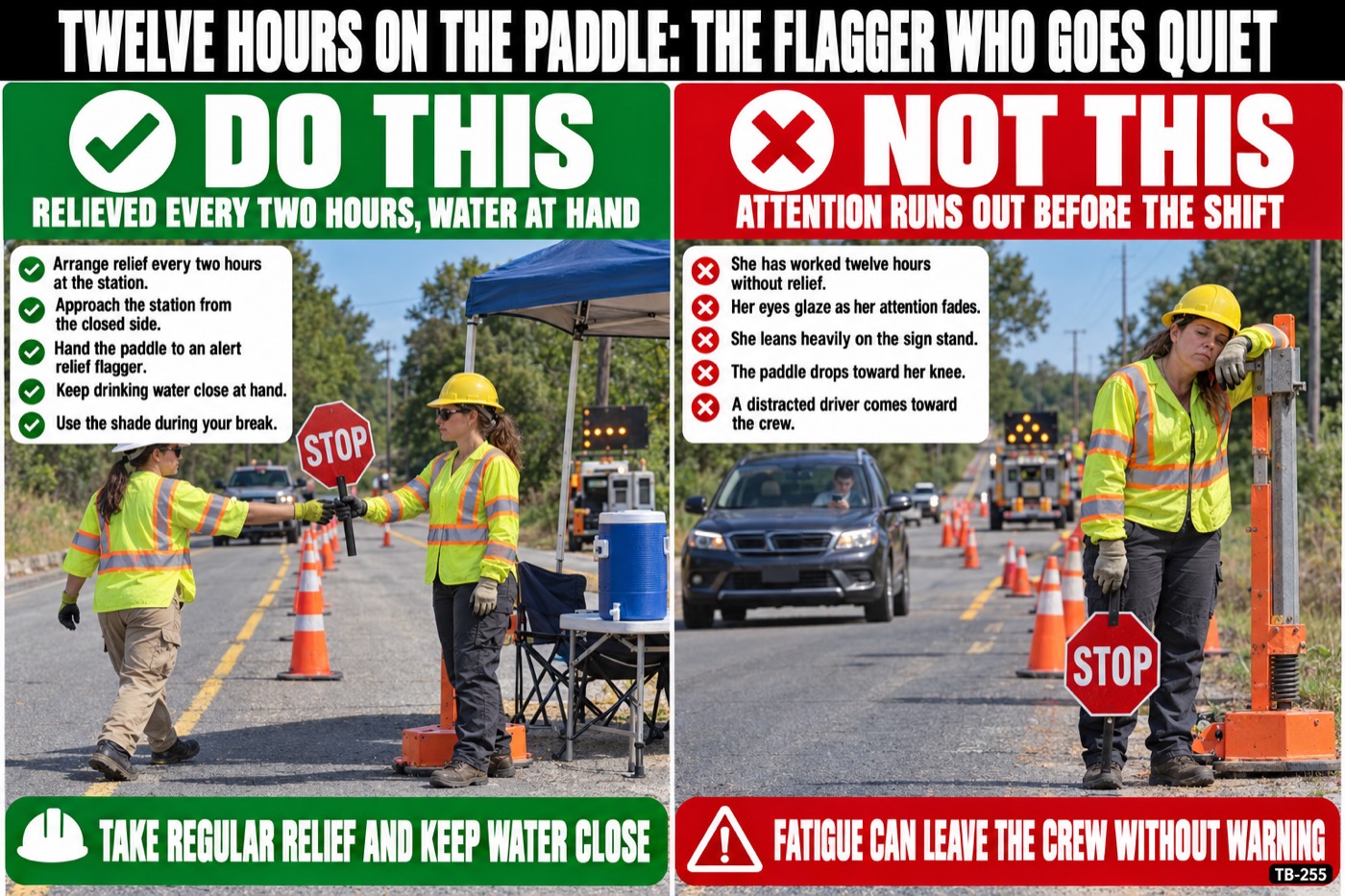
A flagger stands for 12 hours in the same 10 square feet, and the job is the same thing for every one of those 720 minutes: watch the next car. Attention is what runs out first, and you cannot see it go.
The points
- The tired flagger does not fall asleep standing up. They stop seeing the driver's head go down, they hold the paddle at SLOW when it should be at STOP, and the crash looks like the driver's fault.
- Rotation: nobody flags more than two hours without a break off the station, and on a hot or cold day it is shorter. The relief comes to the station; the flagger does not walk the lane to get it.
- Water: a cup every 15 to 20 minutes in heat, whether you feel like it or not, and there is shade or a truck cab at the station, not 300 feet back.
- Standing still on pavement for hours is its own load on the legs and the back. Shift your weight, take a few steps inside your station, and do not lock your knees; people who lock their knees faint.
- The flagger who goes quiet, answers the radio with nothing but 'yeah,' or starts leaning on the sign stand is done. Pull them, not because they are weak, but because the next car does not care.
Why it goes wrong
29 CFR 1926.20(b) makes the employer responsible for the program that keeps the crew fit for the job, and a flagger whose attention is gone is not fit for it, whatever their legs say. The flagging rule under 1926.201 and MUTCD Chapter 6E assumes an alert person at the station; it does not have a line for the eleventh hour, so the program has to.
Watching for one thing that rarely happens is the hardest task the human brain does for long. Attention on a monotonous watch drops measurably after about 30 minutes, which is why radar operators were rotated in the 1940s. A flagger is on that watch for 24 of those 30-minute blocks in a row, and the drowsy driving talk covers what the drive home looks like afterward. It applies.
Heat and cold both take the flagger harder than the rest of the crew because the flagger cannot move to deal with them. Asphalt in July is 140 °F at the surface and the flagger is standing on it with no shade; in January the flagger cannot walk to get warm. The heat talk and the cold talk apply, and the rotation gets shorter, not longer, when the weather is bad.
A break about every two hours is a common practice, and some state DOT flagger manuals recommend it. Treat it as a limit, not a target. Rotate flaggers with setters and spotters so the same person is not on the paddle all day. The relief walks to the station on the closed side with water, hands off face to face, and the flagger coming off sits down somewhere with shade before doing anything else.
Standing still lets blood pool in the legs, and a flagger who locks their knees in heat can faint into the lane. Shifting weight, a few steps within the station, and knees unlocked keep the blood moving. Boots with support matter more here than on any other job on the crew, and so does not sitting on the sign stand, because a sitting flagger cannot step out of the way.
The signs a flagger is done: gone quiet, slow to answer the radio, a fixed stare at the middle distance, the paddle drooping, leaning on something, short with drivers, and 'I'm fine' when asked. The foreman makes the call, and the flagger does not get a vote at hour ten. Nobody on this crew has ever been fired for saying they need to come off the station.
Questions for the crew
- Who relieves the flaggers today, at what times, and who is watching the clock?
- Where is the water and the shade for the station at the far end, and how far is it from where the flagger stands?
- What does each of you look like when you are done, and who on this crew will say it out loud?
To close
Today every flagger is off the station every two hours at most, with water at the station, and the first person who goes quiet gets pulled.
To hold this talk with your crew
1
Read it aloud. Five minutes, before the work starts.
2
Ask the questions. A crew that talks is a crew that remembers.
3
Have them sign on their own phones, and the record is sealed.