Bonding before the drop: the spark you never see
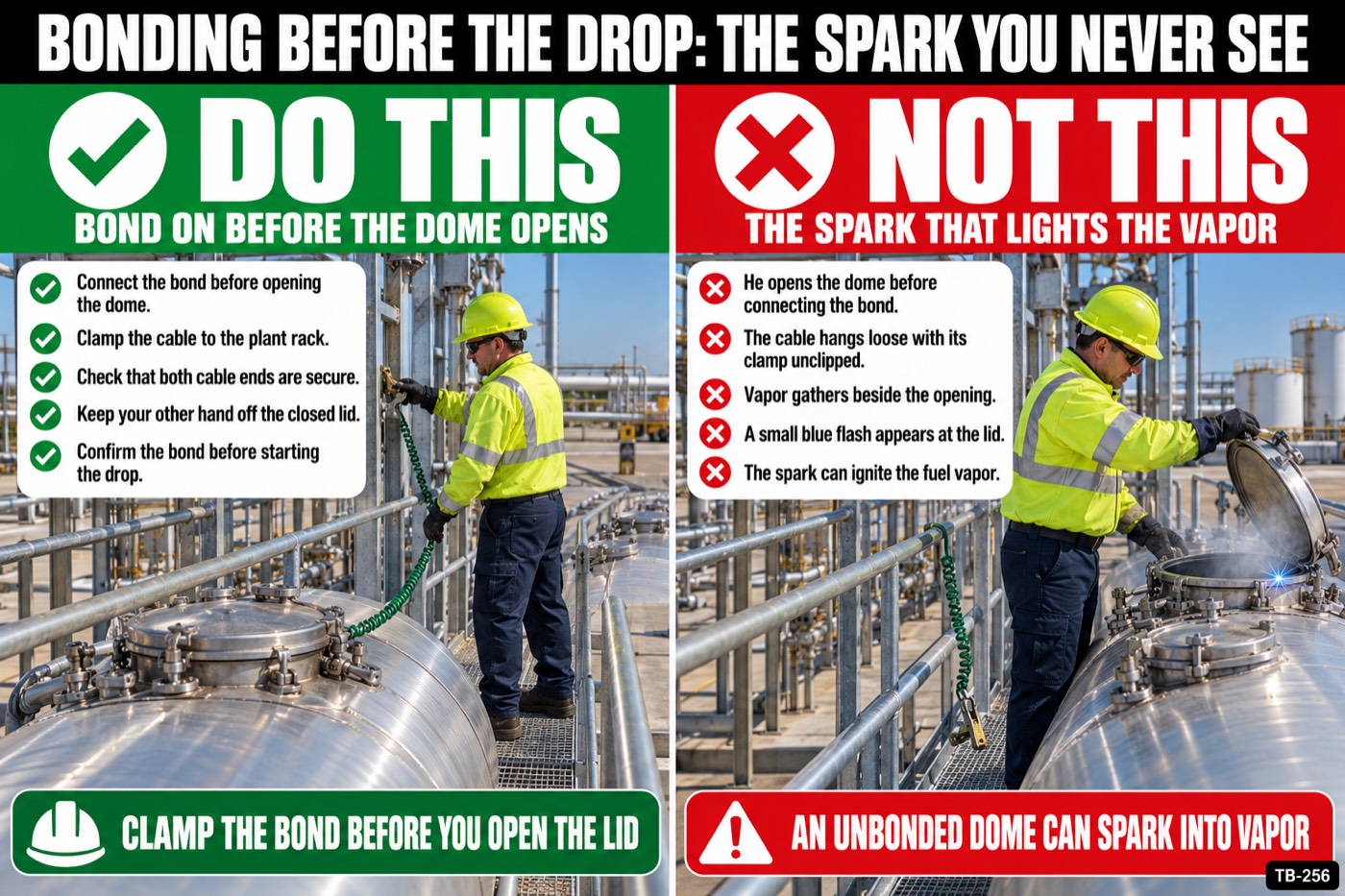
Fuel running through a hose builds a static charge the way your boots build one on a carpet. Gasoline vapor at an open dome can light from a spark too small for you to feel.
The points
- Flowing fuel strips charge off the hose and the tank wall. When that charge jumps to a nozzle or a dome lid inside a cloud of gasoline vapor, it is a flash fire before anyone sees a spark.
- When a cargo tank is loaded through an open dome, the bond wire goes on before any filling hole is opened and stays on until the last one is closed. That is the rule, not a suggestion.
- Between containers that are not touching metal to metal, the bond goes on the container being filled, then on the one the fuel comes from, at a point well away from the opening.
- On a drop into a stationary tank through a loose fill connection, the metal fill nozzle stays in contact with the fill hole the whole time. If the nozzle lifts off, the protection is gone.
- Check the clamp and the cable before you use them. A clamp sitting on paint, rust or a plastic cap is not a bond; it has to bite bare metal, and a broken strand inside the jacket can hide the break.
Why it goes wrong
Static builds any time a liquid flows past a surface, and refined fuels like gasoline and diesel hold that charge longer than water because they conduct so poorly. Fast flow, filters and splashing all add to it. The charge rides in the fuel into the tank and sits on the surface. Gasoline vapor can light from a spark of a fraction of a millijoule, which is less than the jolt you get off a truck door on a dry winter day.
49 CFR 177.837 is the cargo-tank rule for Class 3 flammable liquids. When a tank is loaded through an open filling hole, one end of the bond wire goes on the rack piping or connected steel framing and the other on the tank shell. The connection is made before any filling hole is opened and stays until the last one is closed. A vapor-tight top or bottom connection does not need a bond, because no vapor escapes where a spark could happen.
For containers that are not in metal contact with each other, the rule spells out the order. Connect the wire to the container being filled, then to the container the fuel comes from, and make that last connection at a point well removed from the opening. The reason is simple: the last connection is where a spark can jump, so you make it where there is no vapor. Taking the bond off goes in reverse, after the flow has stopped.
At the customer's tank, when you unload through a connection that is not vapor tight, the rule does not require a bond as long as the metal filling connection stays in contact with the fill hole. That is the part people miss. A nozzle propped on a lip, or held up an inch to watch the level, breaks that contact. If you unload by suction through an open dome, the rule says electrical continuity runs from the cargo tank to the receiving tank.
Switch loading is putting diesel into a compartment that last held gasoline. The leftover gasoline vapor sits in the range that burns, and diesel builds charge as it splashes in. API RP 2003 and NFPA 77 are industry practices, not law, and they call for slow starts and keeping the fill pipe down at the bottom of the compartment. The dome fires they describe at loading racks are real, and the risk is highest at the start, before the end of the fill pipe is covered.
A bond cable lives a hard life. It gets run over, coiled wet and slammed in a compartment door. Check the clamp spring, look for green corrosion at the lugs and pull on the cable at both ends. Clean the spot where the clamp bites, and if the jaw slides off a rounded edge, find a flat one. If the cable is cut or the clamp is weak, it gets replaced before the next load, not after.
Questions for the crew
- Which stops today take a drop through an open fill, and where does the bond clamp or the nozzle make contact?
- When did someone last check our bond cable and clamp for broken strands and a weak spring?
- Is any compartment going from gasoline to diesel today?
To close
Today the bond goes on before the dome opens, on bare metal, and the nozzle stays in the fill hole until the flow stops.
To hold this talk with your crew
1
Read it aloud. Five minutes, before the work starts.
2
Ask the questions. A crew that talks is a crew that remembers.
3
Have them sign on their own phones, and the record is sealed.