Overfill: know the room in the tank before you pump
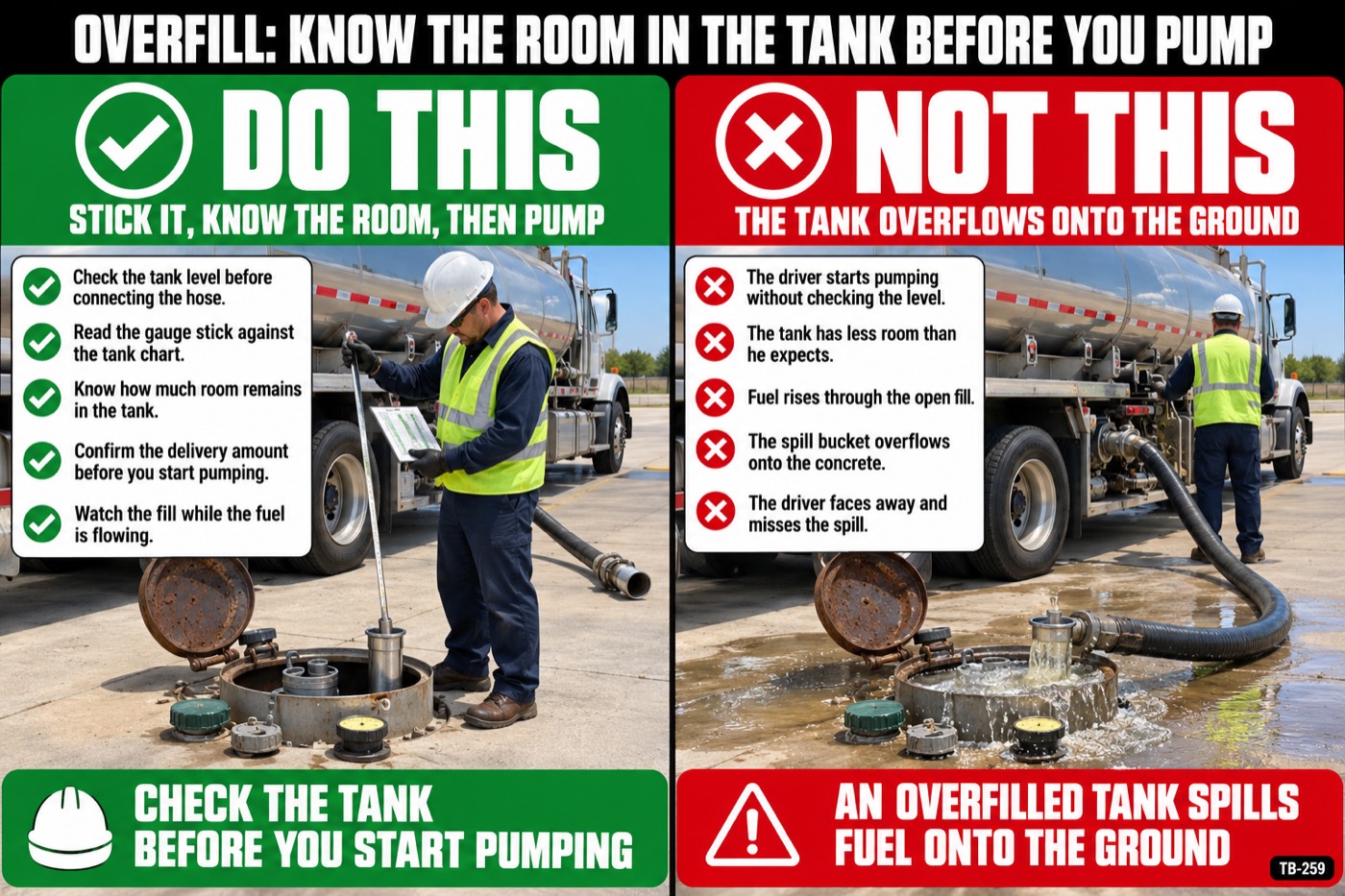
A 550-gallon tank with 300 gallons already in it has room for about 250, not 550. Pump 300 into it and the last 50 come out the vent and onto your boots.
The points
- For an underground storage tank, the rule says the room left in the tank must be greater than what you are about to put in it, checked before the transfer starts, and the transfer is watched the whole time.
- Stick the tank or read a gauge you trust, then check that number against the tank chart. A gauge stuck at half has caused more overfills than any bad pump.
- Match the product to the fill. Diesel in the gasoline tank, or gasoline in the diesel, is a cross-drop that ruins engines and can start fires. Read the fill cap, the tag and the paperwork, and ask when in doubt.
- An overfill alarm or a shutoff valve in the fill pipe is a backup, not a gauge. If the alarm sounds, you stop the flow right then - you do not finish the ticket and you do not silence it to keep going.
- The spill bucket around the fill is empty and dry before you start. Fuel or water left in it ends up in the ground or in the tank the next time someone pulls a hose.
Why it goes wrong
40 CFR 280.30 is the spill and overfill rule for underground storage tanks. The owner and operator must make sure the volume available in the tank is greater than the volume to be transferred, before the transfer is made, and that the transfer is monitored constantly. A note in the rule points to NFPA 385 and API RP 1007 as transfer procedures that can be used to comply. Those are industry documents, but the arithmetic in the rule is the law for those tanks.
Overfills follow a pattern. The gauge in the office reads wrong, or the tank chart is for a different tank. The order was written as a number of gallons instead of a fill. Someone else delivered yesterday. Two tanks sit side by side and the driver sticks one and fills the other. Every one of these is caught by the same habit: stick the tank you are about to fill, right before you fill it, and do the subtraction on paper.
Aboveground tanks at farms and job sites fall under other rules, but the arithmetic is the same. A 500-gallon skid tank does not hold 500 gallons of usable room; leave headroom for expansion and for the vent. When the fill is out of sight, have someone at the tank with a radio, or check the sight gauge more often than feels necessary near the end. The last few hundred gallons go in fastest when you are least ready for them.
Fuel grows as it warms. Gasoline expands roughly 1 percent for every 15 °F of warming, and diesel a little less. Cold fuel from an underground terminal tank pumped into an aboveground tank in July will swell in the sun. A tank filled to the top in the morning can be weeping out of the vent by afternoon, and that is still a spill. Leave the headroom the tank maker or the customer's procedure calls for.
Overfill devices - ball float vents, flapper valves in the drop tube, high-level alarms - are set to act before the tank is full, and they fail. Floats stick, alarms get unplugged, and a flapper that closes under a gravity drop can leave a full hose that has to be drained somewhere. Treat them as the last line, and never drop through a device that someone has removed or propped open.
When an overfill does happen at an underground tank, 40 CFR 280.53 says contain it and clean it up right away. A petroleum spill of more than 25 gallons, or one that causes a sheen on nearby surface water, is reported to the implementing agency within 24 hours, or another period that agency sets. Smaller spills still get cleaned up, and if that cannot be done within 24 hours the agency is notified.
Questions for the crew
- What is in each tank on today's list right now, and how do we know?
- Which stops have more than one tank or more than one product, and how is each fill marked?
- Who checks the stick reading against the tank chart before the hose goes on?
To close
Today every tank gets stuck or gauged and figured against its chart before a single gallon goes in.
To hold this talk with your crew
1
Read it aloud. Five minutes, before the work starts.
2
Ask the questions. A crew that talks is a crew that remembers.
3
Have them sign on their own phones, and the record is sealed.