Spill: stop it, contain it, call it
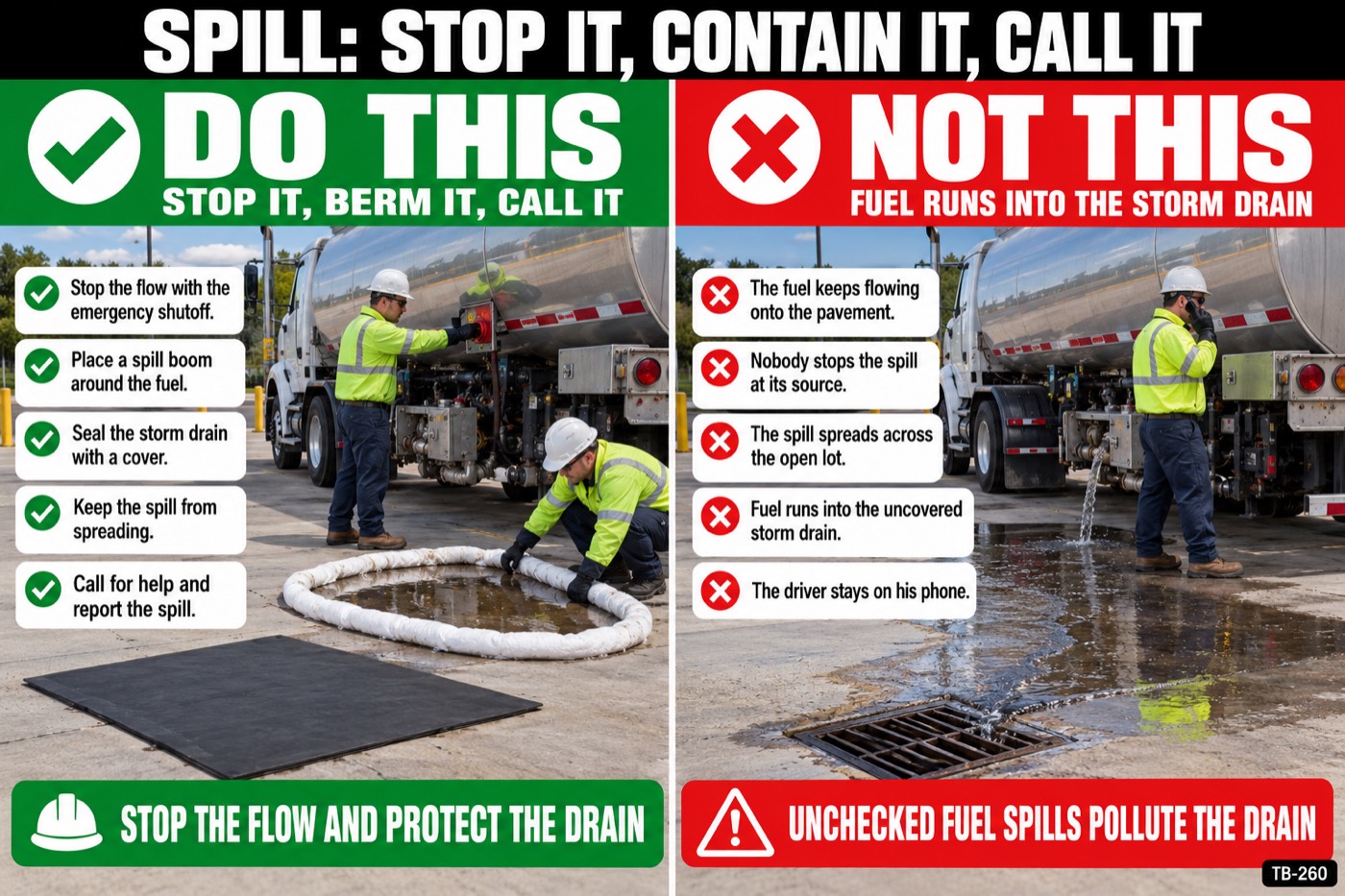
A few gallons of diesel that reach a creek spread into a rainbow sheen you can see from the road. Under the federal rule, that sheen alone makes it a spill that has to be reported.
The points
- Stop the source: close the internal valve with the emergency remote, shut down the pump, close the nozzle. A spill that stops at 20 gallons is a cleanup; one that runs for ten minutes is an incident.
- Contain it before it reaches a drain, ditch or creek. Socks and pads go downhill of the flow, and a drain cover goes over the nearest storm drain. Dirt works as a berm if the kit runs short.
- Oil that causes a film or sheen on water or the shoreline is a harmful discharge under the federal rule. The person in charge calls the National Response Center at 800-424-8802 as soon as they know.
- States and local agencies often add their own thresholds and phone numbers. Know your company's call list and who makes which call before the day you need it.
- The spill kit on the truck is only useful if it is full. Check pads, socks, drain cover, bags and gloves this morning, and restock whatever got used yesterday.
Why it goes wrong
40 CFR 110.3 defines what counts as a harmful oil discharge under the Clean Water Act: one that violates water quality standards, or causes a film or sheen on or discoloration of the water or adjoining shorelines, or leaves a sludge or emulsion beneath the surface or on the shore. There is no minimum gallon count in that test. If it makes a sheen on water, it counts. Gasoline and diesel are both oil for this rule.
40 CFR 110.6 says the person in charge of the vessel or facility notifies the National Response Center immediately on learning of such a discharge, at 800-424-8802. If that is not practicable, the report can go to the Coast Guard or the EPA on-scene coordinator for the area, and then on to the NRC. In practice, your company decides who makes the call. Your job is to make sure the call happens, quickly, with the location and what spilled.
The order matters. Stop the source before you grab pads, because every minute the valve is open adds gallons. On most fuel trucks that means the emergency remote that closes the internal valve, then the pump. Next, block the path to water. Storm drains on a street or a lot usually go straight to a creek with no treatment, so the drain cover goes down before the cleanup starts.
Do not hose a spill into the ditch or spray soap on a sheen to make it go away. 40 CFR 110.4 prohibits adding any chemical or other substance to oil to get around the rule. Dish soap breaks the sheen up and sends the fuel down into the water, where it does more harm and is harder to recover. Pads, socks and booms soak it up so it can be picked up and hauled away.
Gasoline on the ground is a fire waiting for a spark. Nobody starts an engine, turns a key or flips a switch near the pool. Move people upwind and uphill, and keep traffic away. Diesel is slower to light but makes everything slippery. Either way, do not walk through it and track it to the cab; the vapor follows you into a closed space. Wait for help with a big gasoline spill rather than wading in alone.
Used pads and socks are now waste soaked with fuel, not trash. Bag them, label them and bring them back the way your company handles them. Write down the time, the place, roughly how much spilled, what you did and who you called, while it is fresh. Then restock the kit, because the next spill does not wait for the order to come in. A kit with two pads left is not a kit.
Questions for the crew
- Where is the nearest storm drain, ditch or creek at each stop today?
- Is the spill kit on this truck full, and who used it last?
- Who do we call if fuel reaches water today, and is that number in your phone?
To close
Today the spill kit is checked full, and every driver knows the drain to cover and the number to call.
To hold this talk with your crew
1
Read it aloud. Five minutes, before the work starts.
2
Ask the questions. A crew that talks is a crew that remembers.
3
Have them sign on their own phones, and the record is sealed.