Hazmat training: what the three-year card covers
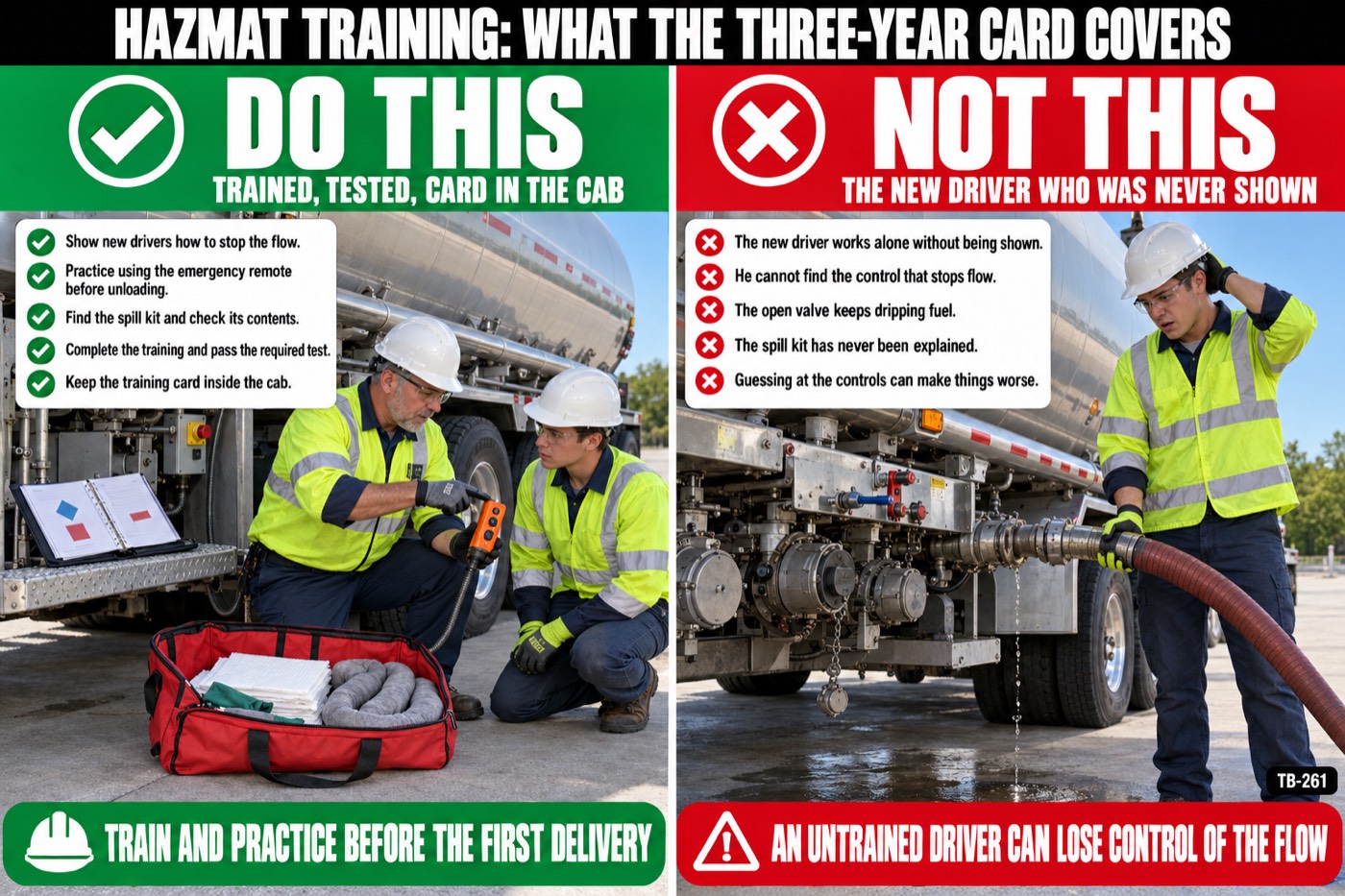
Your hazmat training is good for three years, and a big part of it is what you do in the five minutes after something goes wrong. If you cannot say what those minutes look like on your truck, the certificate is just paper.
The points
- Every hazmat employee gets general awareness, function-specific training for the job they do, safety training on emergency response and self-protection, and security awareness. New hires get the security part within 90 days.
- Training is repeated at least once every three years. A new driver may work before training only under direct supervision of a trained person, and the training is finished within 90 days.
- Your employer keeps a record of your current training covering the last three years, including a certification that you were trained and tested. When you sign a training sheet, you are saying you got it.
- Cargo tank drivers also need training on emergency controls, surge, partial loads, loading and unloading, and the hazards of what they haul. A CDL tank or hazmat endorsement can meet that driver part.
- If your training did not cover the truck you drive today, the valves you use or the product you haul, say so. Function-specific means your function.
Why it goes wrong
49 CFR 172.704 lists what hazmat training must include. General awareness teaches you to recognize and identify hazardous materials and the marks, labels and placards that go with them. Function-specific training covers the rules that apply to what you actually do: loading, unloading, preparing papers, placarding, driving. If you only do part of the job, the training covers that part; if your job changes, the training changes with it.
Safety training covers three things: the emergency response information that rides with the shipment, how to protect yourself from the materials you could be exposed to, including the specific measures your employer has put in place, and how to avoid accidents, such as the right way to handle what you haul. For a fuel driver that means the valves, the remote, the spill kit and the extinguisher on your truck, not a generic slideshow.
Security awareness training covers the risks of hazmat being stolen or misused and how to recognize and respond to possible threats. New employees get it within 90 days of hire. If your company is required to have a security plan, the people who handle the covered loads also get in-depth training on that plan, and they are retrained within 90 days if the plan is revised in the middle of the three-year cycle.
The timing rules are simple. Recurrent training happens at least once every three years. A new hire, or someone who changes jobs, can do hazmat work before training only under direct supervision of a properly trained employee, and the training must be done within 90 days. Training from a previous employer can count if a current record of it comes with you. The employer is responsible for compliance whether or not the training is done.
The employer keeps a record of each hazmat employee's current training covering the preceding three years, for as long as you work there and 90 days after. It shows your name, the completion date, the training materials, who gave it and a certification that you were trained and tested. A DOT official can ask to see it. A signature on a training sheet you did not sit through is a false record with your name on it.
49 CFR 177.816 adds driver training for cargo tanks: operating the emergency controls, high center of gravity, surge and its effect on braking, the difference between baffled, unbaffled and compartmented tanks, partial loads, loading and unloading, the hazards of the product, and retest and inspection rules. A CDL with a tank vehicle or hazmat endorsement can satisfy this part, but the endorsement test was years ago. Ask for what you do not remember.
Questions for the crew
- When does your hazmat training run out, and do you know where your record is kept?
- What is the first thing you do today if a hose lets go at a stop?
- Is there a valve, pump or product on today's truck that your training did not cover?
To close
Today each of us can name the first three moves at a spill or fire on our truck, and anyone who cannot says so.
To hold this talk with your crew
1
Read it aloud. Five minutes, before the work starts.
2
Ask the questions. A crew that talks is a crew that remembers.
3
Have them sign on their own phones, and the record is sealed.