Shipping papers and placards: what responders read
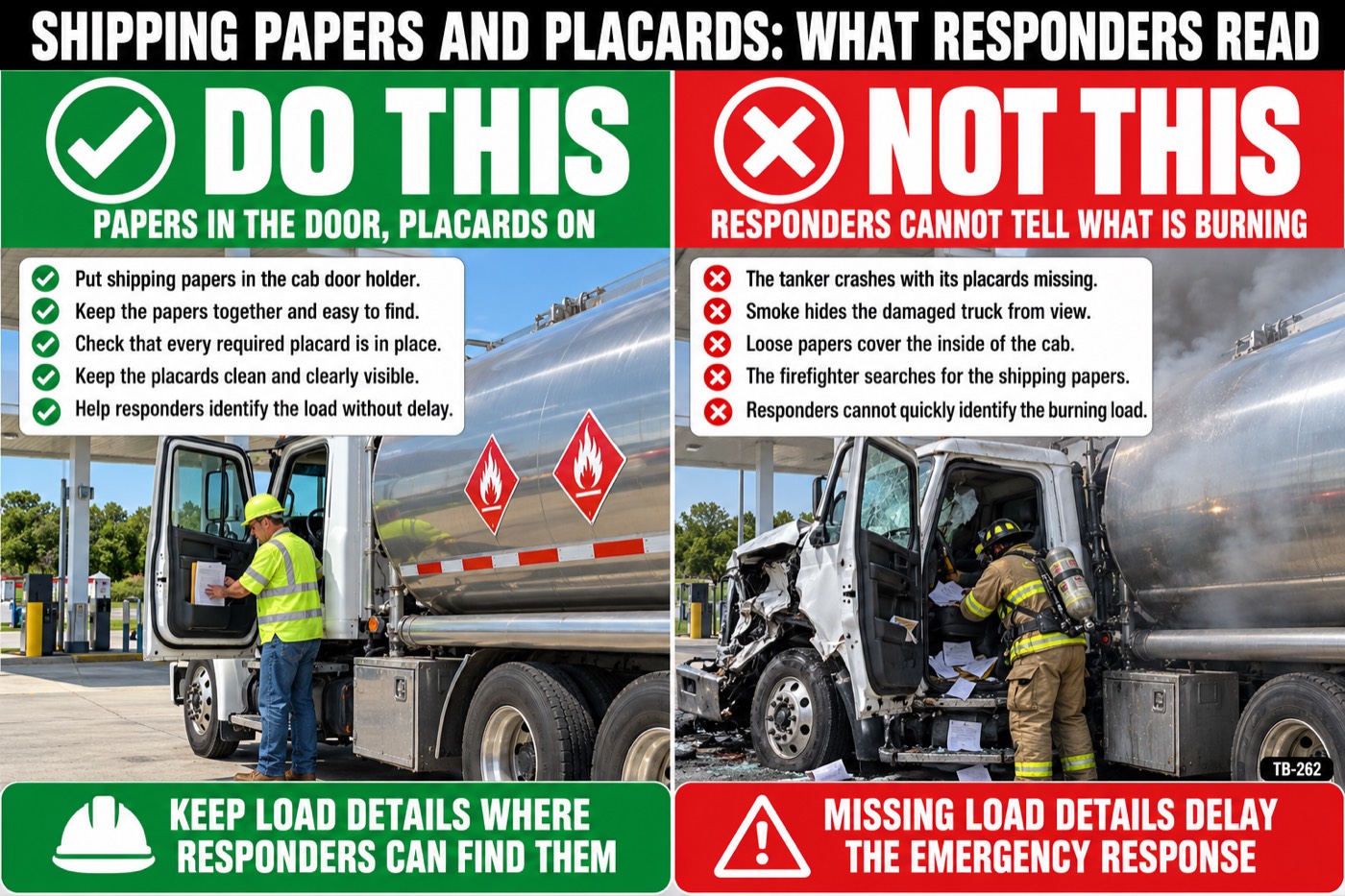
When a tanker is on its side and the driver is hurt, the firefighter's question is what is in it. The answer is a sheet of paper on the seat or in the door pocket, and the numbers on the placards.
The points
- While you are at the wheel, the shipping paper is within reach with your lap belt on, and either in plain sight from the door or in the holder on the inside of the driver's door.
- When you leave the controls, it goes in the driver's door holder or on the driver's seat. Not in the sleeper, not in a bag, not under the logbook on the dash.
- If it rides with other papers, it is tabbed or on top. A responder should find it in seconds, in the dark and in smoke, without knowing your filing system.
- The paper, or a document with it, carries emergency response information: health hazards, fire risk, what to do about a spill, first aid, and an emergency phone number monitored the whole time the load moves.
- A cargo tank of fuel is placarded on each side and each end in any quantity, and it stays placarded empty until it is cleaned and purged. Placards stay clean, readable and clear of ladders and pipes.
Why it goes wrong
49 CFR 177.817(e) puts the shipping paper where a stranger can find it. At the controls, it is within your immediate reach while you are restrained by the lap belt, and either readily visible to a person entering the driver's compartment or in a holder mounted inside the driver's door. Away from the controls, it is in that door holder or on the driver's seat. If it is with other papers, it is tabbed so it stands out, or it goes on top.
The reason is the first ten minutes of a wreck. The driver may be unconscious, trapped or gone to the hospital. The first engine company does not know whether that tank has gasoline, diesel or a mix of both in different compartments, and the right approach depends on it. The paper tells them the proper shipping name, the ID number, the hazard class and the quantity in each compartment.
49 CFR 172.602 says emergency response information goes with the shipment: the description, immediate health hazards, fire or explosion risks, immediate precautions, how to handle a fire, how to handle a spill with no fire, and first aid. It can be on the shipping paper or in a separate document like a safety data sheet or an emergency response guide that cross-references the paper. The carrier keeps it with the shipping paper, where the driver can reach it.
49 CFR 172.604 requires an emergency response telephone number on the paper, monitored at all times while the material is in transportation, by someone who knows the material or can reach someone who does. Look at today's paper and find that number. If it is a number that rings to an office that closes at five, that is a problem to raise with dispatch this morning.
49 CFR 172.504 says a bulk packaging like a cargo tank is placarded on each side and each end in any quantity. A FLAMMABLE placard may be used in place of COMBUSTIBLE on a cargo tank, so a truck that hauls both can stay flammable. 172.514 says the tank stays placarded when empty unless it has been cleaned of residue and purged of vapors. Under 172.516 placards stay visible, clear of ladders and pipes, and maintained so dirt or damage does not hide them.
Papers go stale fast on a multi-drop route. A compartment that was gasoline yesterday and diesel today needs today's paper, not yesterday's. When you finish a drop and a compartment is empty, the paper still describes the residue until the tank is cleaned. Keep a copy as your company requires; the rule calls for the carrier to keep one for a year after acceptance for fuel shipments.
Questions for the crew
- Where is the shipping paper right now in each truck going out today?
- Does today's paper match every compartment on the load, including any switch from yesterday?
- Are the placards on all four sides clean, readable and clear of ladders and hose trays?
To close
Today the shipping paper rides in the door pocket or on the seat, on top of everything else, and matches what is in the tank.
To hold this talk with your crew
1
Read it aloud. Five minutes, before the work starts.
2
Ask the questions. A crew that talks is a crew that remembers.
3
Have them sign on their own phones, and the record is sealed.