Wet-hosing equipment: engine off, fuel in the open
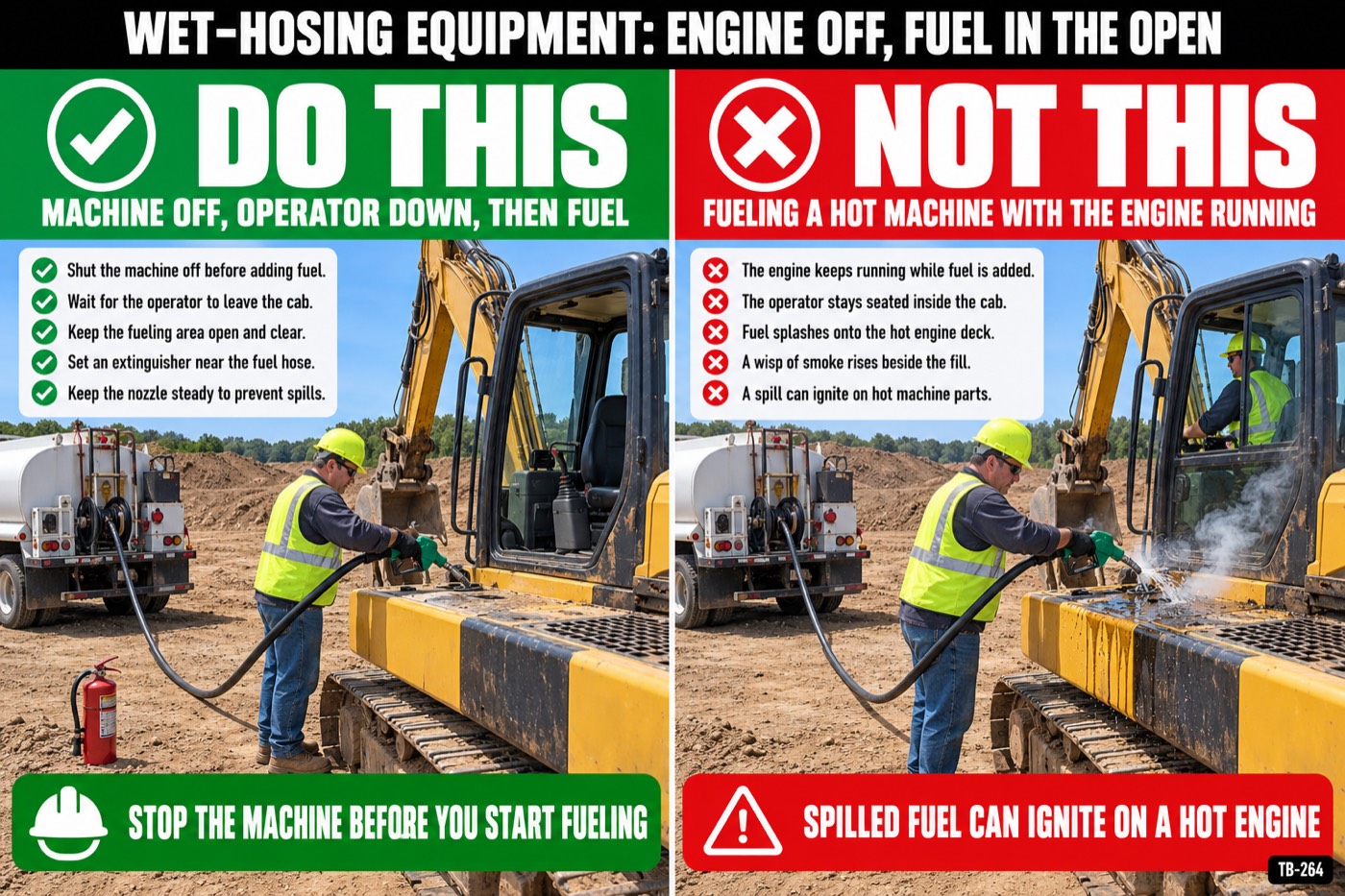
An excavator's exhaust and turbo stay hot enough to light diesel for a while after shutdown. Fuel splashed out of an overfilled tank onto that metal is how a fuel stop turns into a machine fire.
The points
- The motor of every piece of equipment being fueled is shut off during fueling. Not idling, not cooling down - off. Wait for the operator to climb down before the nozzle goes in.
- No smoking or open flames where fueling happens, and no-smoking signs are posted where people can see them. That includes the operator in the next machine over.
- Every truck dispensing flammable liquid carries at least one 20-B:C extinguisher, and a fueling area has one within 75 feet of each pump and dispenser. Know which side of your truck it is on.
- Pick the fueling spot: level, away from trenches, drains and creeks, out of the haul road, with room to pull away. Do not fuel a machine parked on the edge of a trench or a slope.
- Stop short of full. Fuel expands as it warms, and fuel pushed out of the fill or the vent onto a hot engine or into the dirt is a fire or a spill report.
Why it goes wrong
29 CFR 1926.152(g) covers service and refueling areas on construction sites. There is no smoking or open flame in areas used for fueling or dispensing flammable liquids. Conspicuous, legible no-smoking signs are posted. The motors of all equipment being fueled are shut off during fueling. Each fueling area has at least one extinguisher rated at least 20-B:C, placed so one is within 75 feet of each pump, dispenser, underground fill pipe and service area.
The same rule requires at least one portable extinguisher rated 20-B:C or more on every tank truck or other vehicle used to transport or dispense flammable liquids. Check the gauge, the pin and the hose this morning, and make sure it is mounted where you can grab it without climbing past the fire. An extinguisher behind the hose reel on the side where the fuel is burning does not help.
The DOT rule on unloading in transit, 49 CFR 177.834(h), says plainly that it does not prohibit fueling machinery or vehicles used in road construction or maintenance. That is why wet-hosing exists as a trade. It does not mean the other rules go away. The bonding, the nozzle contact, the no-smoking distance and the attendance habits all still apply at the side of a dozer, a loader or a generator.
Hot surfaces are the ignition source on a job site. Exhaust manifolds, turbos and aftertreatment run far above the temperature at which diesel can light on its own, which is roughly 410 to 500 °F depending on the fuel and the test. Shutting the engine off stops new heat; it does not cool the metal right away. Fill slowly near the top, keep the nozzle in the fill neck, and wipe up drips before the operator starts the machine.
Know what goes where. Many machines now have a diesel fill and a DEF fill side by side. DEF in the fuel tank or diesel in the DEF tank can wreck the system and park the machine for days. Read the cap color and the label every time, and if a cap is missing or the wrong color, stop and ask. On farms, add dry grass, hay and grain dust to the list of things that catch fire.
Night fueling on a job site means moving a truck among parked machines in poor light. Walk the route before you drive it, use your lights and a spotter if backing, and set up where the operator coming back to the machine can see you. Operators climb down with three points of contact, not by jumping off a track onto a hose. If the machine is on a grade or near a trench edge, it gets moved before it gets fuel.
Questions for the crew
- Which machines get fuel today, and where will each one be parked when we get there?
- Where is the extinguisher on the fuel truck, and what does its gauge read this morning?
- Do any of today's machines have DEF and diesel fills side by side, and how are the caps marked?
To close
Today every machine is shut off and the operator is on the ground before the nozzle goes in.
To hold this talk with your crew
1
Read it aloud. Five minutes, before the work starts.
2
Ask the questions. A crew that talks is a crew that remembers.
3
Have them sign on their own phones, and the record is sealed.