Surge and rollover: the load that keeps moving
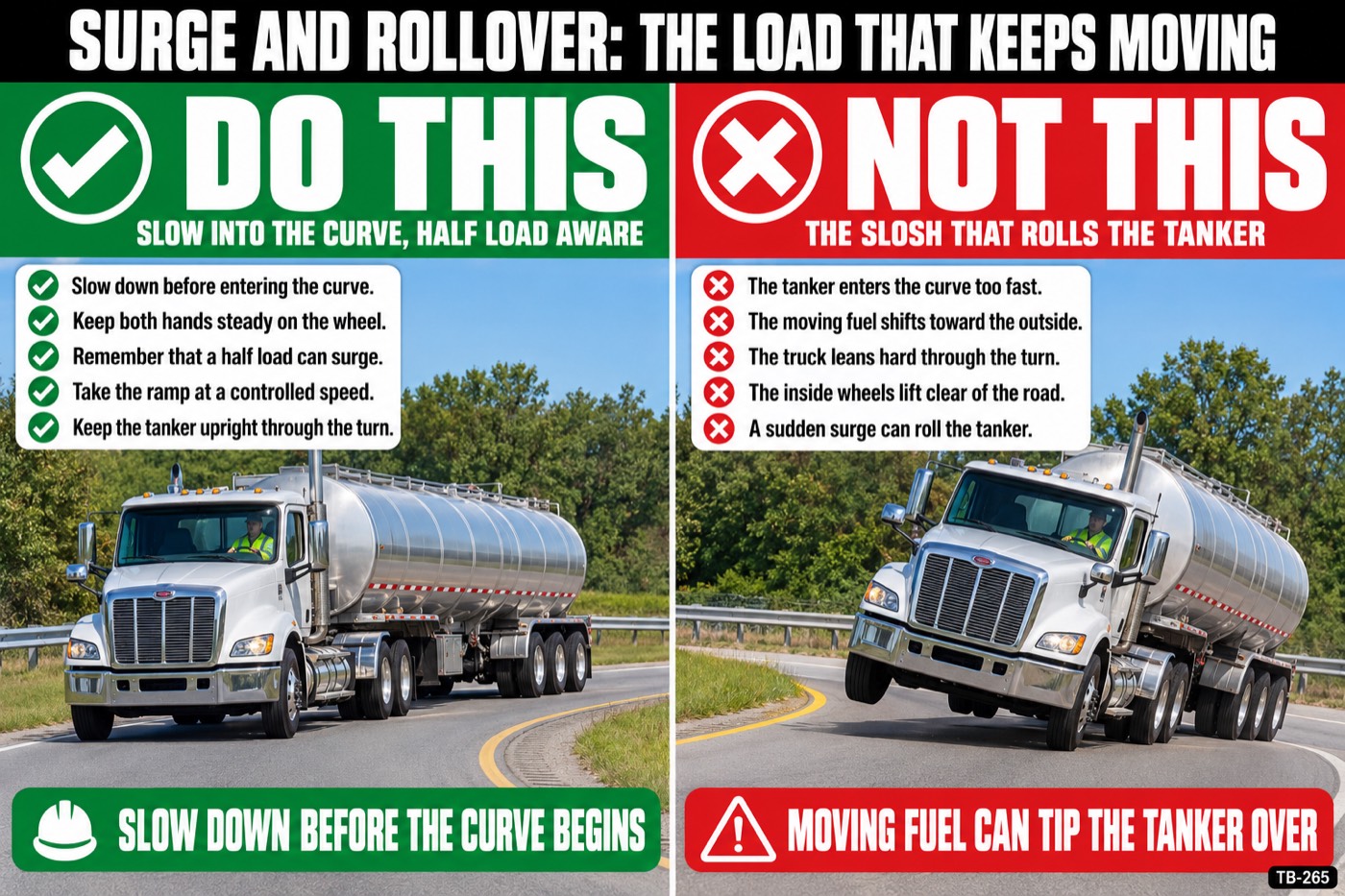
Brake hard with a half-full tank and the fuel keeps going, slams into the front head and shoves the truck forward. Take a ramp a little fast and the same fuel piles against the outside wall.
The points
- A partly loaded tank is a load that moves on its own. The liquid surges forward when you brake, back when you accelerate and to the outside in a curve, and each wave hits after you made the move.
- Gasoline weighs about 6 pounds a gallon and diesel about 7. A 3,000-gallon tank wagon full of diesel carries roughly 21,000 pounds of liquid, sitting high on the frame.
- Smooth beats quick. Brake early and steady, ease off before the curve, and hold the brake until the wave settles at a stop. Letting off too soon is when the surge shoves the truck into the intersection.
- The advisory speed on a ramp is set with cars in mind. A tanker with a high center of gravity can roll below it. Slow down before the ramp, not on it.
- Smooth-bore tanks with no baffles surge the hardest. Know which kind of tank you have and how full each compartment is after every stop on a multi-drop route.
Why it goes wrong
49 CFR 177.816(b) lists what a cargo tank driver must be trained on beyond general driving: operating the emergency controls, and the special handling of a tank: high center of gravity, fluid load subject to surge, the effect of surge on braking, the differences in stability among baffled, unbaffled and multi-compartment tanks, and the effect of partial loads on stability. The rule lists those because they are what put tankers on their side.
A full compartment has little room for the liquid to move. An empty one has nothing to move. The partly full one is the problem, and on a delivery route nearly every compartment is partly full by mid-morning. The load is heaviest and highest early in the day, and it moves the most later. Plan which compartments you empty in which order so the weight stays balanced over the axles.
Baffles are walls inside the tank with openings that slow the fore-and-aft wave. Compartments split the load into separate tanks. A smooth-bore tank, used for some products and for easy cleaning, lets the whole load run end to end. None of them stop the side-to-side slosh in a curve. Know which you are driving before you need to stop short. The tank's spec plate and your company can tell you.
In a curve or on a ramp, the liquid climbs the outside wall and raises the center of gravity just as the truck is leaning. A tanker can reach the point of no return before the driver feels anything wrong, and many tanker rollovers involve no other vehicle. The fix is speed, set before the curve: slow on the straight, steady through the turn, and gentle on the throttle coming out.
At a stop, the wave comes back. You brake, the liquid runs forward, hits the front head and rebounds, and if you release the brake as the truck settles the next push can roll you forward several feet. Leave extra room at lights and behind cars, keep the brake on until the truck is still, and expect the same push when you start off. Wet or icy roads make all of it worse.
Job sites and farms bring their own risks: soft shoulders, side slopes, ruts and field lanes that a full truck never sees on the highway. A partial load on a side slope can tip a truck that would sit fine on the level. Stop before rough ground and walk it. If the only way to the tank is across a slope, ask for the tank to be moved or for a smaller delivery, not for your luck to hold.
Questions for the crew
- How full will each compartment be after each stop on today's route?
- Which ramps, curves or farm lanes today need a slower speed with a partial load?
- Is today's tank baffled, compartmented or smooth bore?
To close
Today we take every ramp and curve slower than the sign and brake early with the partial loads.
To hold this talk with your crew
1
Read it aloud. Five minutes, before the work starts.
2
Ask the questions. A crew that talks is a crew that remembers.
3
Have them sign on their own phones, and the record is sealed.