The internal valve and the remote: test the shutoff
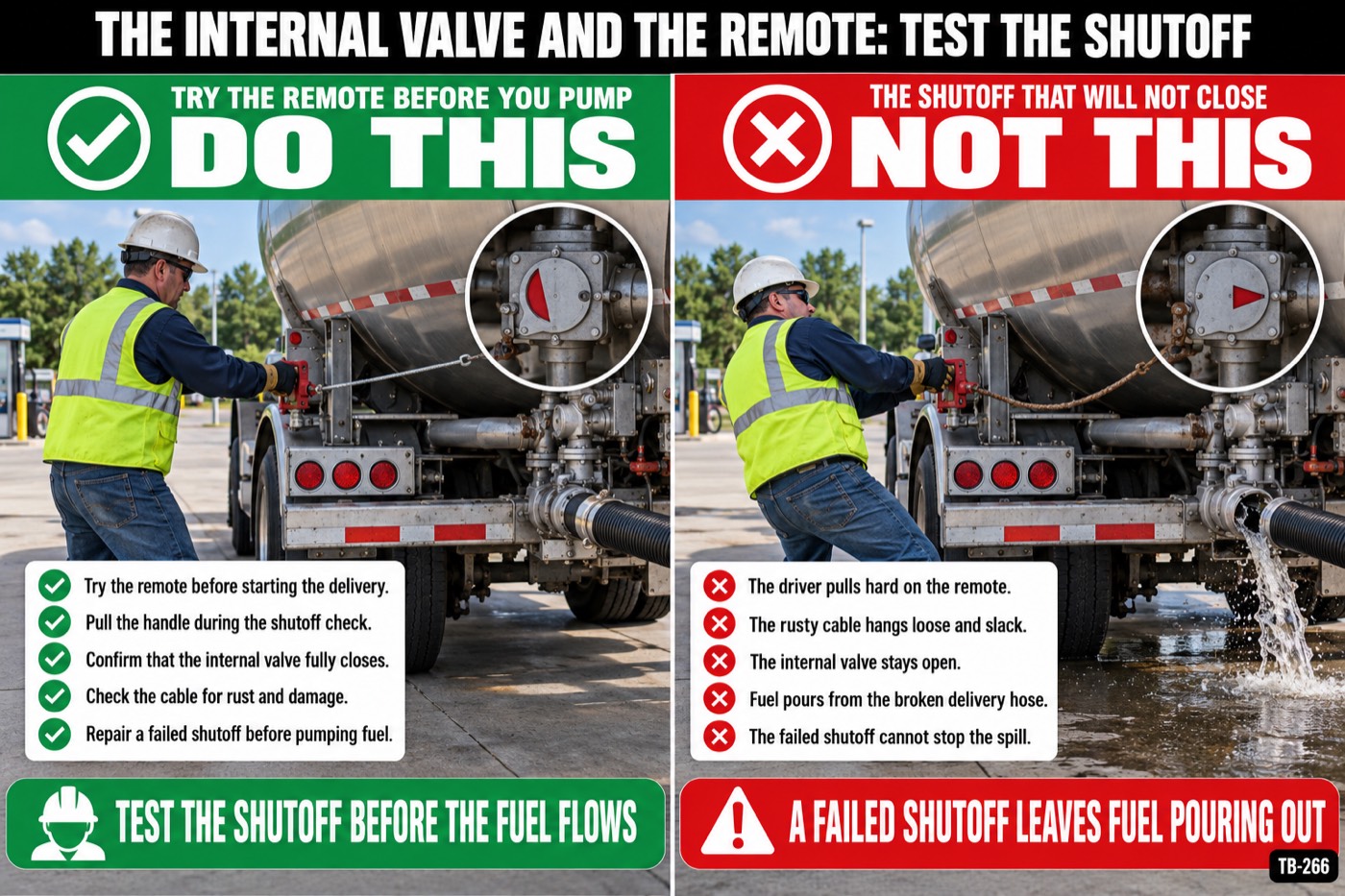
If a hose separates at the outlet, what stands between the tank and the ground is the internal valve. You find out whether its remote works now, in the yard, or later, standing in fuel.
The points
- Each loading and unloading outlet on a DOT 400-series cargo tank has an internal self-closing stop valve or an external one close to the tank wall, with a self-closing system that can shut every outlet within 30 seconds.
- The remote closure sits more than 10 feet from the outlet where the truck is long enough, or at the far end of the tank. For flammable loads it also closes on heat, at no more than 250 °F.
- Daily check: trip the remote and confirm each valve closes, look for drips at the outlets, and make sure the cable or air line is not kinked, frozen or tied off.
- Walk the hose before each drop: no exposed reinforcement, no soft spots or bulges, couplings tight and not slipping, gaskets in place. A hose that fails the look does not get used.
- Nozzles, dry-break couplers and caps get the same look. A cap left off an outlet or a nozzle latch that sticks open is a spill waiting for the first bump.
Why it goes wrong
49 CFR 178.345-11 is the construction rule for outlets on DOT 400-series cargo tanks. Each loading and unloading outlet has an internal self-closing stop valve, or an external stop valve as close to the tank wall as practicable. A self-closing system can close all of them in an emergency within 30 seconds of actuation, and if the actuating system is sheared off in a wreck, the outlets stay closed and hold the load.
The remote means of closure is located more than 10 feet from the outlet where the vehicle's length allows, or at the end of the tank farthest from the outlet, so you can reach it without standing in the spill. For flammable loads, the system also closes by heat, with the heat-activated part near the main connection, set at no more than 250 °F. Find yours on each truck you drive; they are not all in the same place.
The rule also says any piping that sticks out beyond the internal valve gets another stop valve or a leak-tight closure at its end. That is the cap or the adapter valve on the outlet. It is your second barrier. A cap hanging on its chain while you drive means the only thing holding fuel is a valve you cannot see, and a weeping internal valve becomes a drip on the highway.
49 CFR 180.407 sets periodic tests. For most fuel tanks, the external visual inspection and the leakage test come every year, and the leakage test includes checking every internal and external self-closing valve for tightness. The internal visual and the pressure test come every five years. Those dates are on the tank. If one is past due, the truck does not haul until it is done.
Between those tests, the daily check is yours. Under 49 CFR 396.13, before you drive you have to be satisfied the vehicle is in safe operating condition. Trip the remote and watch or listen for each valve to close. In winter, air lines freeze and cables stick. A remote that someone tied open to save time, or a heat link that was replaced with a bolt, is a defect to write up, not a shortcut to keep.
The hose takes the most abuse. The liquefied-gas hose rule lists rejection signs that make a good checklist for fuel hoses too, as practice rather than law: cover worn through to the reinforcement, wire braid kinked or flattened, soft spots or bulging, damaged or slipping couplings, and loose bolts on bolted couplings. Drain it, cap both ends, and hang or reel it so it is not run over or folded sharp.
Questions for the crew
- Where is the emergency remote on each truck going out today, and has it been tripped this morning?
- When are this tank's annual leakage test and external inspection due again?
- Is there any hose or coupling on board that you would not trust at full flow?
To close
Today every driver trips the remote and watches the valves close before the truck leaves the yard.
To hold this talk with your crew
1
Read it aloud. Five minutes, before the work starts.
2
Ask the questions. A crew that talks is a crew that remembers.
3
Have them sign on their own phones, and the record is sealed.