Gas cans: fill them on the ground, not in the truck bed
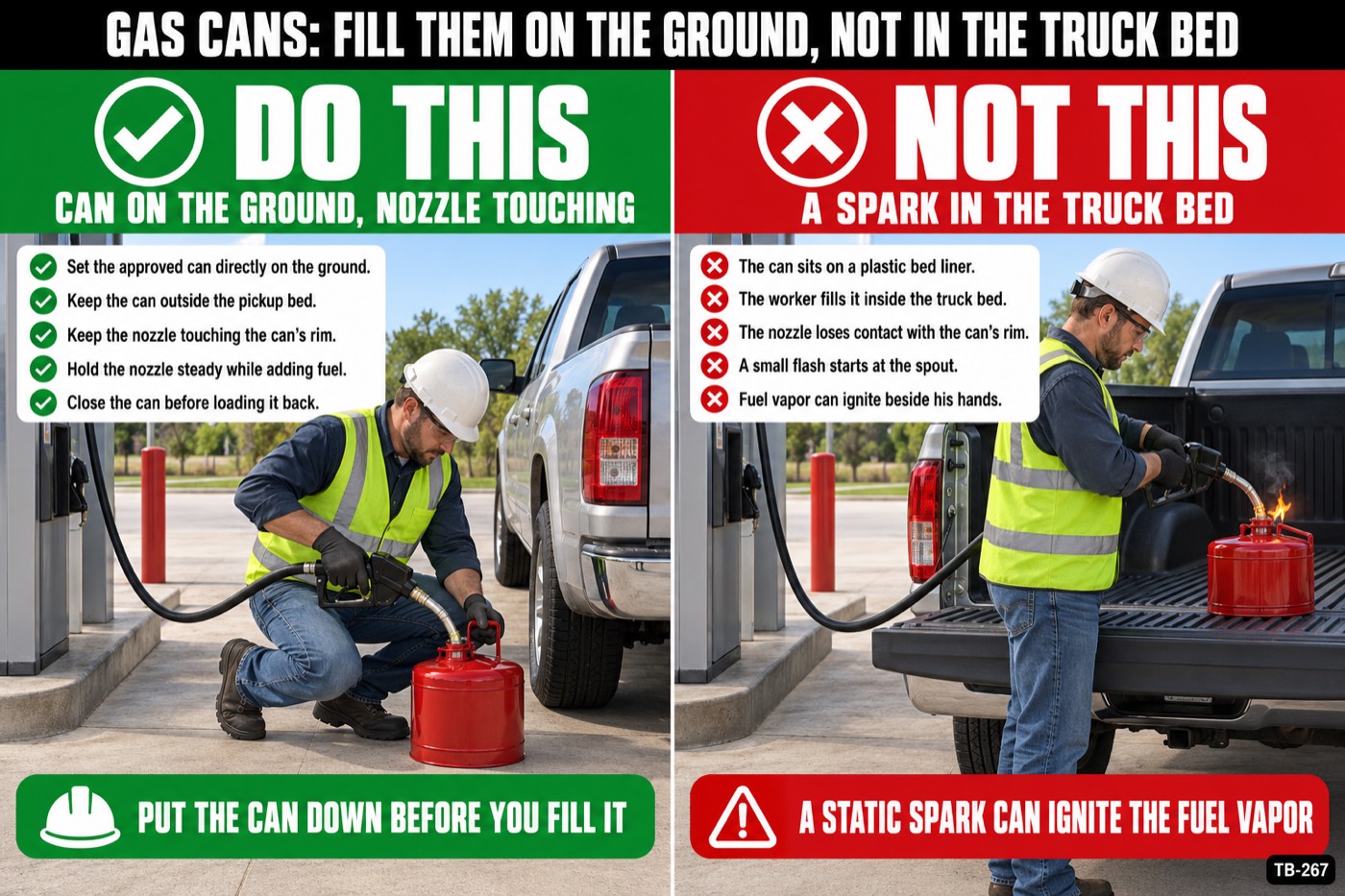
A plastic can sitting on a bed liner is insulated from everything around it. Fuel rushing in charges it up, and the spark jumps to the nozzle right where the vapor is thickest.
The points
- Take the can out of the truck and set it on the ground before you fill it. The ground drains the charge; a bed liner, carpet or plastic trailer deck holds it.
- Keep the nozzle in contact with the can's opening the whole fill. Metal touching the can is your connection; a nozzle hovering an inch above the opening is a spark gap.
- Leave room at the top so the fuel can expand, and close the cap tight before the can goes back in the truck. Never fill a can past its fill line.
- Use approved cans. The rule defines a safety can as no more than 5 gallons, with a spring-closing lid and spout cover, built to relieve pressure in a fire. By common practice gasoline goes in red and diesel in yellow, labeled.
- Cans ride upright and strapped in the open bed, never loose in the cab or a closed trunk. Vapor in a closed space is waiting for a dome light or a cigarette.
Why it goes wrong
Static builds on a can the same way it builds on a tank: fuel flowing fast through a nozzle and splashing into the can separates charge. A metal can on bare ground bleeds that charge away. A can on a plastic bed liner or a carpeted trunk floor has nowhere to send it, so it builds until it jumps, often to the nozzle as you pull it out. Fires started this way are common enough that many pumps carry a warning sticker about it.
29 CFR 1910.106 is OSHA's flammable liquids rule for general industry. It defines a safety can as an approved container of not more than 5 gallons capacity, with a spring-closing lid and spout cover, designed to safely relieve internal pressure when exposed to fire. On construction sites, 29 CFR 1926.152 requires approved safety cans or DOT-approved containers for handling flammable liquids in amounts of 5 gallons or less.
The same rule lists static sparks among the ignition sources that must be controlled where flammable vapor may be present. NFPA 30A, the motor fuel dispensing code adopted by many fire departments, does not allow portable containers to be filled while inside a vehicle or truck bed. That code is good practice, not federal law, but the reason behind it is the physics in the first paragraph.
Filling equipment from a can brings its own risks. Shut off the engine and let a hot muffler or exhaust cool before pouring. Use the can's spout or a funnel, not a cut-off bottle. On construction sites, the rule says transfers of flammable liquids from one container to another are done only when the containers are bonded, and flammable liquids are used only where there are no open flames or other ignition sources within 50 feet.
Old cans are a hazard of their own. A cap that does not seal, a spout with a cracked gasket, a vent that stays open, or a can with no label leads to spills, vapor in the truck and the wrong fuel in the wrong engine. Throw out cans that are cracked, swollen or rusted through, and do not use milk jugs, water jugs or buckets for fuel, ever. A can that looks like a water jug gets drunk from or poured into the wrong tank.
Storage matters as much as filling. Keep cans closed when not in use, out of the sun, and out of exits, stairways and walkways. On a construction site, no more than 25 gallons of flammable liquid are stored in a room outside an approved storage cabinet. At the end of the day, the cans go back to their spot, capped and upright, not left next to a running generator.
Questions for the crew
- How many fuel cans go out today, and is each one approved, labeled and capped?
- Where will we fill them today - on the ground at the pump, or from the fuel truck?
- Which gas engines on site get refueled today, and who makes sure they cool first?
To close
Today every can comes out of the truck and sits on the ground with the nozzle touching it before the fuel flows.
To hold this talk with your crew
1
Read it aloud. Five minutes, before the work starts.
2
Ask the questions. A crew that talks is a crew that remembers.
3
Have them sign on their own phones, and the record is sealed.