Testing tank air: oxygen first, then fuel vapor, then toxics
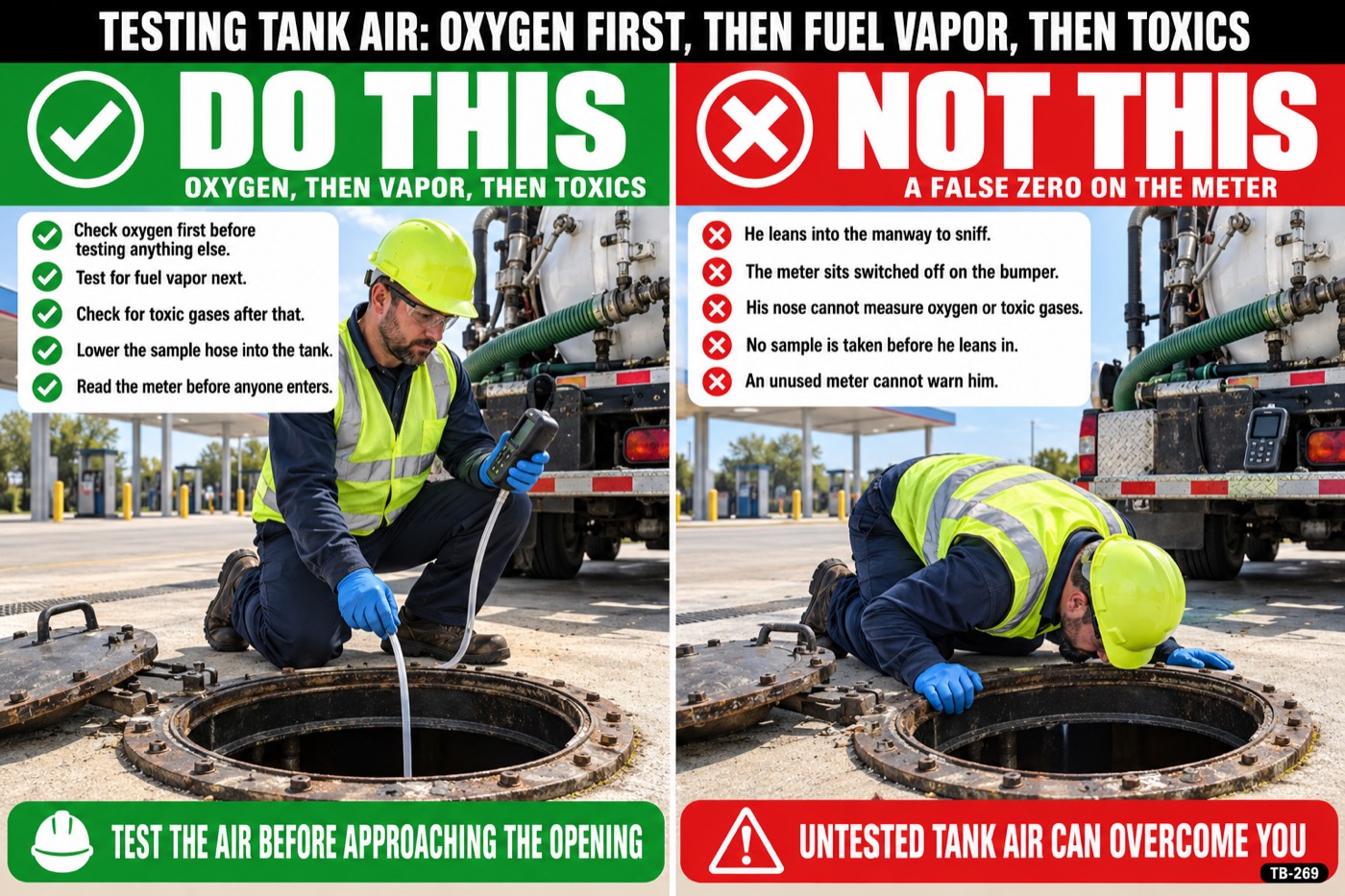
The meter at the manway reads 20.9 percent oxygen and zero LEL, and everyone relaxes. Then the entrant kneels down and pushes a squeegee into a crust of sludge that has been holding fuel for twenty years.
The points
- The rule sets the order: test first for oxygen, then for combustible gases and vapors, then for toxic gases and vapors. The combustible sensor on most meters needs oxygen to read right, so a low-oxygen tank can show a falsely low vapor number.
- Acceptable means oxygen between 19.5 and 23.5 percent and flammable vapor below 10 percent of the lower flammable limit. Many crews set their own entry limit lower than 10 percent for fuel tanks, and the permit should say what that number is.
- Fuel vapor is heavier than air and pools low. Test the top, the middle and the bottom of the tank with a sample hose before anyone enters, and give the pump time to pull the sample all the way up the tube.
- The LEL screen does not protect you from benzene. A reading of 1 percent of LEL on gasoline can mean well over a hundred ppm of hydrocarbon vapor. Toxics need their own sensor, such as a PID or detector tubes.
- One reading at the start is not enough. Air changes the moment someone stirs the sludge, so the entrant wears a running meter in the breathing zone and the attendant watches it until the last person is out.
Why it goes wrong
The order is written into 1910.146: oxygen, then combustibles, then toxics. The reason is the sensors. A catalytic bead combustible sensor works by burning a tiny bit of the sample on a hot wire. With too little oxygen, nothing burns and the reading drops even when the tank is full of fuel vapor. If oxygen is low, you already have your answer - nobody enters on that reading - and every number after it has to be read with suspicion.
Before the meter goes near the tank, it gets a bump test with known gas so you know every sensor responds and every alarm sounds. A meter that has not been bumped is a guess. Calibration follows the maker's schedule. Know what your combustible sensor is calibrated to. Most are set to methane or pentane, and gasoline or diesel vapor reads differently, so the maker's correction chart matters more than the decimal on the screen.
Test from outside, through the manway or fill opening, with a pump and a sample hose. Fuel vapor is heavier than air and settles on the bottom and in low corners, right where the entrant will kneel. Take readings at the top, the middle and near the sludge, and wait long enough at each level for the pump to draw the sample through the full length of hose. The entrant has the right to watch the testing. Watch it.
A combustible reading near zero does not mean clean air for your lungs. Ten percent of the lower flammable limit for gasoline is still well over a thousand ppm of vapor, and 1 percent on the screen can be more than a hundred ppm. Benzene's exposure limit is counted in single ppm. That is why fuel tank work needs a toxic sensor that sees hydrocarbons at low levels, like a photoionization detector, or benzene detector tubes.
The first reading is a snapshot of an undisturbed tank. The moment a squeegee or a pressure washer breaks the crust on the sludge, trapped vapor comes off and the numbers climb, sometimes fast. The rule requires testing or monitoring as necessary to make sure conditions stay acceptable during the entry. For a fuel tank that means a running four-gas meter on the entrant, clipped near the face, not left at the manway.
The attendant watches that meter or a second one at the opening, and the permit says what happens at each alarm. A low alarm on combustibles means stop agitating and let ventilation catch up. A high alarm, any oxygen alarm, or any symptom means everyone out, no discussion. Readings get written on the permit with the time and initials. If the numbers trend up over an hour, that trend is information, not noise.
Questions for the crew
- When was our meter last bump tested, and what is its combustible sensor calibrated to?
- What readings did we get at the top, middle and bottom of this tank, and what is our entry limit today?
- What sensor are we using for benzene on this tank, and who watches it while we work the sludge?
To close
Today we bump the meter, test oxygen then vapor then toxics at three levels, and keep a meter running on the entrant until the last person is out.
To hold this talk with your crew
1
Read it aloud. Five minutes, before the work starts.
2
Ask the questions. A crew that talks is a crew that remembers.
3
Have them sign on their own phones, and the record is sealed.