Vapor-freeing: "empty for years" is not a reading
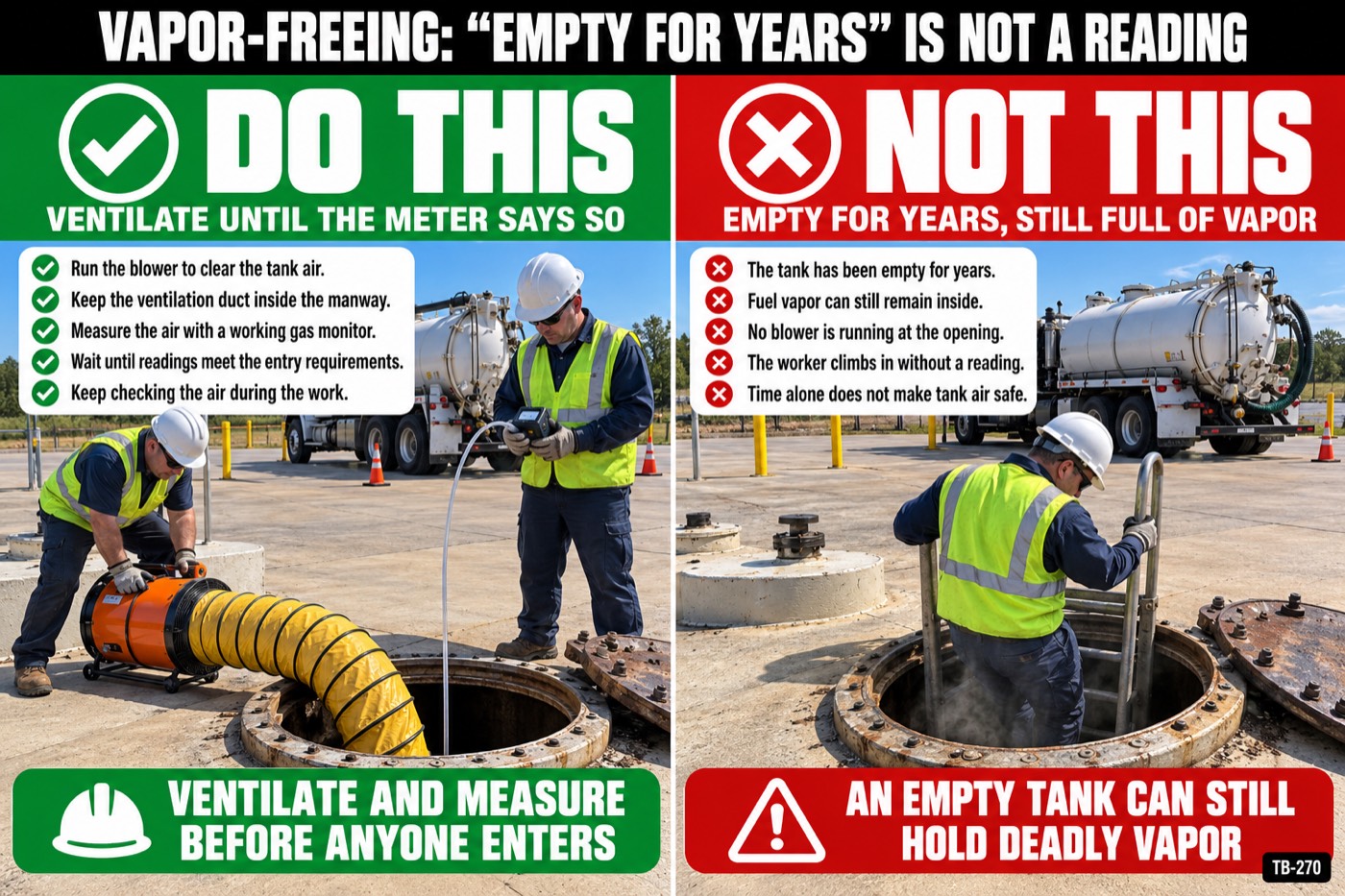
The owner says the tank has been empty since before he bought the place. The fill cap comes off, a hot afternoon has been cooking the sludge on the bottom, and the meter goes to alarm before the hose is halfway down.
The points
- The rule requires purging, inerting, flushing or ventilating the space as needed to remove or control the atmospheric hazard. In a fuel tank that means moving air until the meter says it is done, not until the clock says it should be.
- A tank that has sat empty for years still has fuel in the sludge, in the rust scale and in the seams. Close the lids and the vapor builds back up. The owner's word, the paperwork and the smell are not readings.
- Blow or pull air from a clean source, away from the vac truck exhaust and any running engine. Send the vapor-laden discharge high and downwind, away from people, drains and anything that sparks. Bond the air mover to the tank.
- Inerting with nitrogen or dry ice keeps the tank from burning but leaves air nobody can breathe. An inerted tank is an IDLH oxygen-deficient atmosphere, and it stays that way until it is ventilated and tested again.
- Keep the air moving the whole time someone is inside, and retest after any break. A tank that was clear at noon and sat closed through lunch is not clear at one o'clock until the meter says so.
Why it goes wrong
Vapor-freeing is the step that turns a fuel tank from a bomb into a workplace. Under 1910.146 the employer has to purge, inert, flush or ventilate the space as needed to eliminate or control the atmospheric hazard before and during entry. There is no fixed number of air changes or hours in that rule. The finish line is the meter, read at the top, the middle and the bottom, with numbers inside the limits written on the permit.
The most dangerous sentence on a tank job is "that thing has been empty for years." Product soaks into the sludge on the bottom, into flaking rust, under old coatings and into the seams and fittings. Warm the tank in afternoon sun or disturb that sludge and it gives the vapor back. Tanks that sat closed for a long time have also been known to hold layers of water with fuel floating on top. Every tank is tested as if it held fuel last week.
Ventilation works by dilution, so where the air comes from and where it goes matter. The supply has to be clean. A blower set beside the vac truck exhaust or a generator pushes carbon monoxide into the tank. The discharge carries fuel vapor that is heavier than air and will roll along the ground into storm drains, basements and the nearest pilot light. Duct the exhaust up and away, downwind, and keep ignition sources and the public out of that path.
Air movers and eductors can build static just like a vac hose. Use units rated for the job, bond them to the tank before starting, and keep the bond on until they are shut down. Good practice documents from API on tank cleaning and tank closure describe ventilation and inerting methods in detail. They are not law, but they are what experienced tank crews and regulators expect you to know, and they are a good place to settle an argument about method.
Inerting is the other way to make a tank safe to cut or pull: push out the air with nitrogen or carbon dioxide from dry ice so there is not enough oxygen to burn. The rule's own note on inerting says it produces an IDLH oxygen-deficient atmosphere. An inerted tank is safe from fire and lethal to breathe. Nobody puts a head in that manway to look. If entry follows inerting, the tank is ventilated back to normal oxygen and tested again from the start.
Ventilation is not a one-time job. Keep the air moving the whole time someone is inside, aimed where the entrant is working, and watch the meter while the sludge is worked because that is when vapor comes off. When the blower stops for lunch, a fuel delivery, a dead generator or the end of the day, the clock resets. Before anyone goes back in, the tank is tested again in order, and the new numbers go on the permit.
Questions for the crew
- Where is the blower drawing its air from today, and where is the discharge going?
- What did the meter read after ventilation, at what levels, and who wrote it down?
- If the blower stops while someone is inside, what is the call?
To close
Today the tank is ventilated from a clean source, tested at three levels before entry, and retested after every stop of the blower.
To hold this talk with your crew
1
Read it aloud. Five minutes, before the work starts.
2
Ask the questions. A crew that talks is a crew that remembers.
3
Have them sign on their own phones, and the record is sealed.