Isolating the tank: pump, lines, dispensers and the next delivery
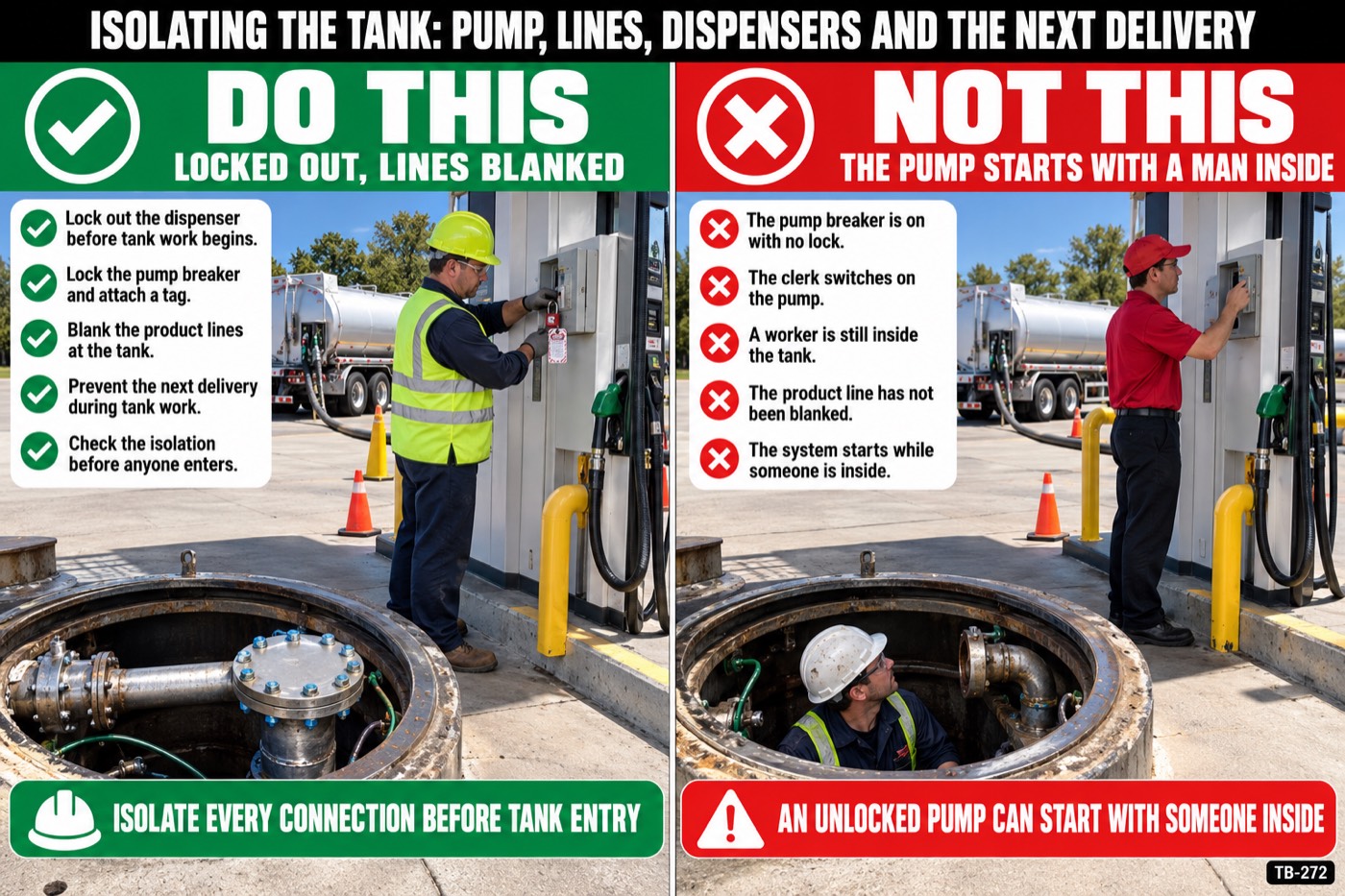
The crew locks out the pump and goes in. Across the lot, a clerk resets the dispenser stop for a customer, and a fuel truck that nobody called pulls up to the fill box with a load for that same tank.
The points
- Before entry the tank is removed from service and protected against any energy or product coming in. The rule names the ways: blanking or blinding, removing sections of line, double block and bleed, lockout, and disconnecting linkages.
- The submersible pump breaker gets your lock and tag, every entrant's lock, not one lock for the crew. The dispenser emergency stop is not a lockout. Somebody resets it, and the pump can start again with the crew in the tank.
- A closed valve is not isolation for a person inside. Product lines, vent lines and any siphon line to the next tank get disconnected or blinded at the tank, so a leaking valve or a careless restart cannot flood the space.
- Opening a fuel line is line breaking. Expect product and vapor to come out under pressure. Drain it to a container, bond the container, keep the meter close, and wear face and hand protection.
- The fill pipe is a door into the tank. Lock or cap the fill, tell the site manager and the fuel supplier in writing that no delivery comes today, and put a sign on the fill box where a driver will see it.
Why it goes wrong
The isolation definition in 1910.146 is specific: the space is removed from service and completely protected against the release of energy and material into it. Blanking or blinding, misaligning or removing sections of line, double block and bleed, lockout or tagout of energy, and blocking or disconnecting mechanical linkages are the methods it lists. A single closed valve is not on that list, and for a person inside a tank it is not enough.
Start with the energy. The submersible turbine pump that pushes fuel to the dispensers is fed from a breaker in the building, often in a panel full of unlabeled breakers. Find it, prove it by trying to run a dispenser, then lock and tag it. Every person who enters puts on a personal lock. The dispenser emergency stop button and the console shut-off are for customers in a fire. They are reset with a key or a button, and they are not lockout.
Then the product. Fuel lines run from the pump at the top of the tank to every island. Check valves, line leak detectors and old valves leak, and a line full of fuel will drain back downhill. Disconnect the product piping at the tank or install a blind, and plug or cap the open end. Do the same with vent lines and any vapor recovery line that could carry vapor from another tank. Write each point on the permit.
Watch for manifolded tanks. Some stations join two tanks with a siphon bar so they draw down together. If the tank next door is full and the siphon is intact, product can move into the tank you are cleaning. Find every line that ties the tanks together and break or blind it. Cathodic protection systems with a rectifier are another energy source on some sites; know whether there is one and how it is shut off for the job.
Opening a fuel line is what the rule calls line breaking: intentionally opening a pipe that is or has been carrying flammable or toxic material. Assume it is full and under some pressure. Set a bonded container under the joint, crack it slowly, keep the meter nearby, and wear a face shield and fuel-rated gloves. Drips on hot pavement or into the pit add to the vapor the crew is breathing.
The last way in is the fill pipe. A fuel driver who was never told can back up to the spill bucket, hook up and drop thousands of gallons into a tank with a person inside. Lock the fill cap or block the fill with a locking cap, tag it, tell the station manager and the fuel supplier in writing that the tank is out of service, and put a cone and sign over the fill box. Remove them only when the entry is closed out.
Questions for the crew
- Which breaker feeds the pump on this tank, and how did we prove it is dead?
- What lines tie this tank to the dispensers, the vents and any other tank, and how is each one blinded or disconnected?
- Who told the fuel supplier there is no delivery today, and what is on the fill box?
To close
Today every entrant's lock is on the pump breaker, every line is blinded or disconnected at the tank, and the fill is locked and signed.
To hold this talk with your crew
1
Read it aloud. Five minutes, before the work starts.
2
Ask the questions. A crew that talks is a crew that remembers.
3
Have them sign on their own phones, and the record is sealed.