Tank rescue: the tripod goes up before anyone goes in
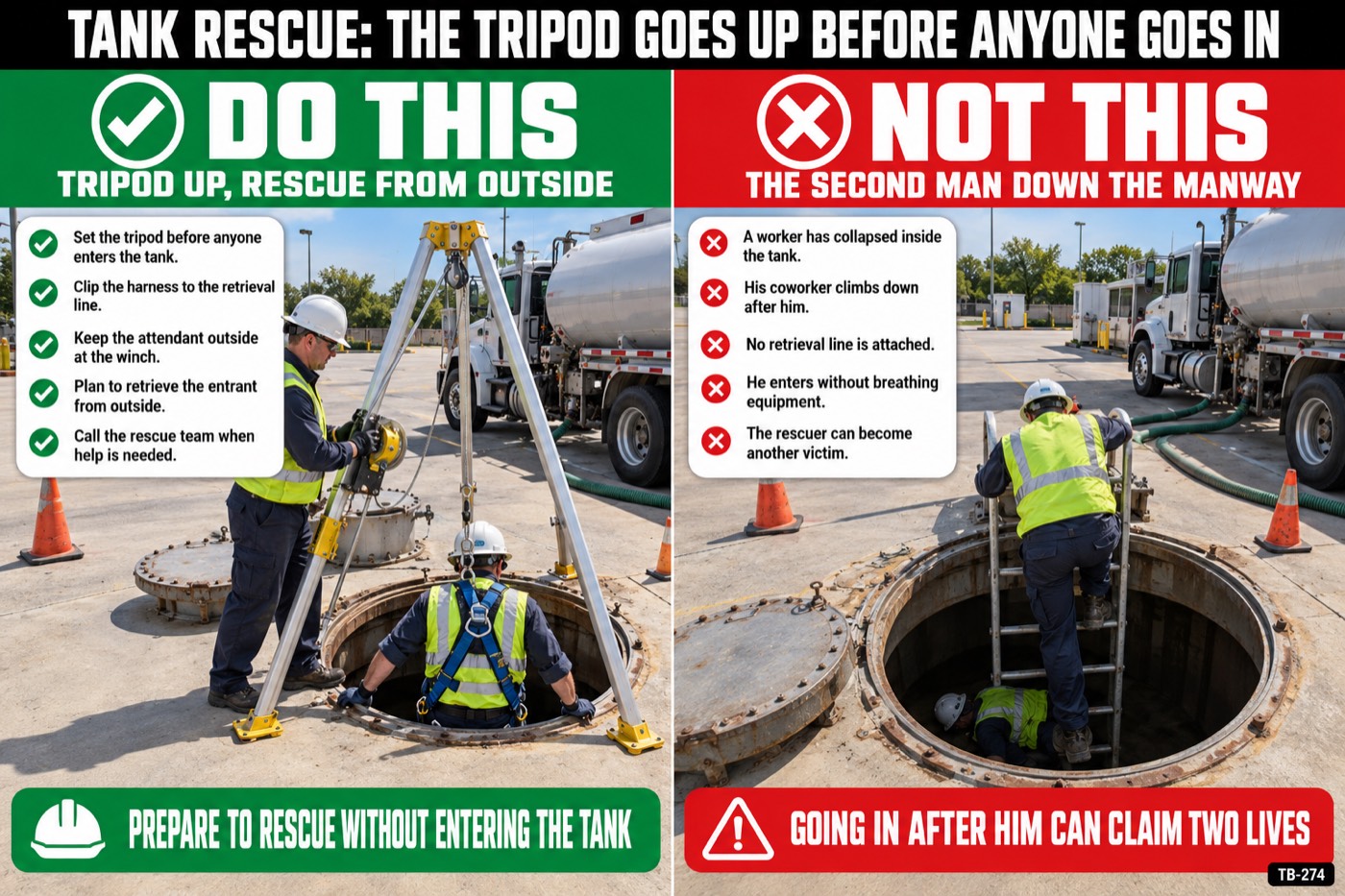
The entrant slumps against the inside of the tank. The attendant can see him through the manway, eight feet down, and every instinct says climb in and grab him.
The points
- A 1986 NIOSH alert found that more than 60 percent of confined space deaths were would-be rescuers. The person who goes down the manway after a coworker without air usually becomes the second body.
- Each entrant wears a chest or full body harness with a retrieval line, and the other end is tied to a mechanical device or fixed point outside, so rescue can start the second it is needed. For a vertical entry more than 5 feet deep, a mechanical device has to be there.
- Set the tripod or davit and winch over the manway before entry, rig the line, and test it. A retrieval system that is still in the truck when someone goes down is not a retrieval system.
- Calling 911 is not a rescue plan by itself. The rescue service has to be evaluated for how fast it can get there and whether it can do this kind of rescue, and the permit lists who they are and how to reach them.
- The attendant summons rescue as soon as an entrant may need help, and starts cranking from outside. The attendant does not enter unless trained and equipped for rescue and relieved by another attendant first.
Why it goes wrong
The pattern in confined space deaths is painfully consistent. One worker goes into a tank and collapses. A coworker sees it, climbs in to help without air, and collapses too. Sometimes a third follows. NIOSH reported in a 1986 alert that more than 60 percent of confined space fatalities were among would-be rescuers. The instinct to go after a friend is human. In a tank full of fuel vapor or low oxygen, acting on it without air and a line adds a second victim.
The rule's answer is to plan rescue before entry and make it possible from outside. Under 1910.146(k)(3), each entrant uses a chest or full body harness with a retrieval line attached, and the other end goes to a mechanical device or fixed point outside so rescue can begin as soon as the rescuer knows it is needed. A mechanical device must be available for vertical spaces more than 5 feet deep, which describes the manway of most underground tanks.
Set the retrieval system up first. Place the tripod or davit square over the manway on solid ground, not on a cracked slab edge or soft fill at the pit. Rig the winch, attach the line to the entrant's back D-ring, and test the winch and the brake before anyone climbs in. Know how the line will act once the entrant moves horizontally along the inside of the tank. A line that snags on a baffle, a fill tube or a ladder can stop a rescue halfway.
If rescue depends on an outside service, the employer has to evaluate that service for how fast it can respond and how well it can do a permit space rescue, and give it access to practice. Many fire departments are not equipped for a confined space rescue in a fuel tank. Call ahead, ask, and write the number and the plan on the permit. If your own crew is the rescue team, they are trained, equipped, and practice a permit space rescue at least once every 12 months.
The attendant's job in an emergency is to call for rescue as soon as an entrant may need help, order everyone else out, and start the retrieval from outside. The rule lets an attendant enter only if the program allows it, the attendant is trained and equipped for rescue, and another attendant has taken over outside first. In practice that means a supplied-air respirator, a harness and a second person on the line. Without those, the attendant stays out and keeps cranking.
At least one member of the rescue team or service holds current first aid and CPR certification. Have the safety data sheet for the fuel ready to hand the ambulance crew, because the rule requires it to go to the medical facility treating the entrant. Practice a retrieval with a real person in a harness on a cleaned tank. Five minutes of practice tells you more about the plan than an hour of talking about it.
Questions for the crew
- Where is the tripod or davit going on this manway, and who tested the winch today?
- Who is our rescue service for this tank, how long will they take to get here, and who checked?
- If the entrant stops answering, what does the attendant do first, second and third?
To close
Today the tripod and winch are set and tested over the manway, every entrant is on a line, and the attendant knows the rescue call and stays out.
To hold this talk with your crew
1
Read it aloud. Five minutes, before the work starts.
2
Ask the questions. A crew that talks is a crew that remembers.
3
Have them sign on their own phones, and the record is sealed.