Bonding the truck, the hose and the tank
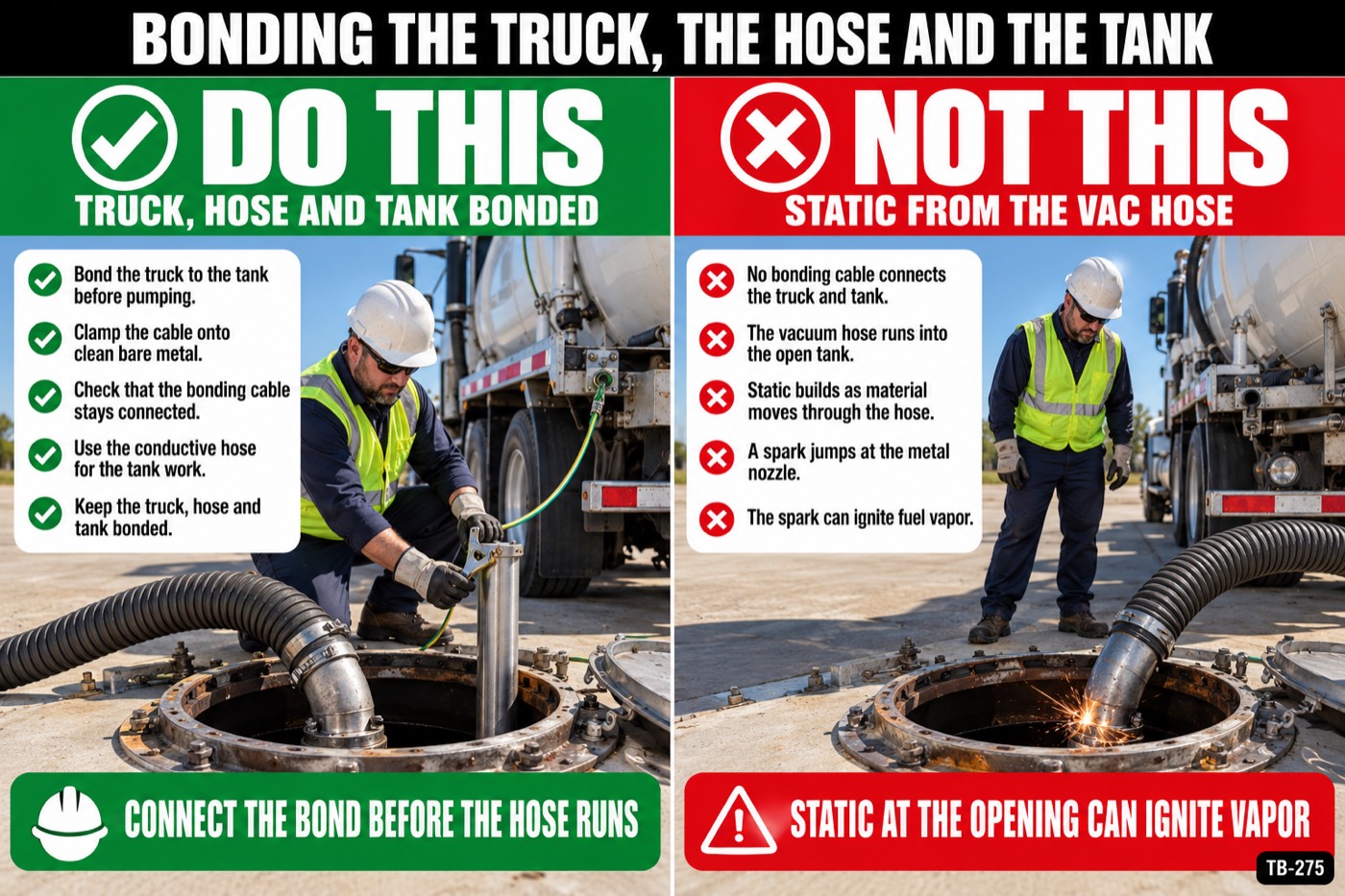
The vac hose goes into a gasoline tank before anyone clips the bond cable. Fuel and air roar through a hose with a broken static wire, and the charge has nowhere to go but across the gap at the fill riser.
The points
- Fuel and fuel-laden air rushing through a vacuum hose build static charge. If the truck, the hose and the tank are not tied together with metal, that charge jumps as a spark, and a tank opening is full of vapor.
- OSHA's flammable liquids rule requires a bond wire made fast to a tank vehicle before the dome is opened and kept on until filling is done and all dome covers are closed and secured. That paragraph is written for bulk plant loading racks, but the physics on a tank job are the same.
- The bond goes on first and comes off last: clamp to bare metal on the tank, then the truck, before any lid opens or the hose goes in. Paint, rust and grease are insulators. Scrape to bright metal or use a clamp that bites through.
- The vacuum hose has to be made for flammable service and conduct static from end to end. Check its continuity with a meter before the job. A hose that looks fine can have a broken wire inside a fitting.
- A pressure washer spraying into a tank can charge the mist and the wand. Bond the wand and the pump, do not spray into a tank that still has flammable vapor, and stop the job if anyone feels a shock.
Why it goes wrong
Static is made whenever two materials rub and separate. Liquid fuel flowing fast through a hose, droplets and mist moving through a vacuum hose, and air moving through a duct all build charge. On a conductive system that charge drains away quietly. On a system broken by a rubber gasket, a painted flange or a plastic fitting, it piles up until it jumps the gap. A static spark is small, but fuel vapor near the lower flammable limit needs very little energy to light.
The OSHA flammable liquids rule, at 1910.106(f)(3)(iv), requires bonding for protection against static sparks when tank vehicles are loaded through open domes at bulk plants. The bond wire is connected to the vehicle or tank before the dome covers are raised and stays until filling is done and all dome covers are closed and secured. A vac truck loading tank bottoms at a gas station is not a bulk plant rack, so treat that paragraph as the model, not as a citation for your job. The order it sets is the order to follow.
The bonding chain runs tank to hose to truck. Put the bond cable on before the hatch, the manway cover or the fill cap comes off, and before the hose goes in. Clamp to bare metal on the tank or its fill riser, and to the truck's bonding point. Clamps on paint, rust or a greasy flange may look connected and carry nothing. Leave the bond on until the hose is out, the hatch is closed and the truck is sealed.
The hose is the weak link. Hoses for flammable service have a static wire or conductive rubber that must connect to metal fittings at both ends. Crushing, kinking and repairs break that path without any outside sign. Check continuity end to end with a meter at the start of the job, and do not join sections with plastic couplings. Your crew's talk on vacuuming flammables covers the truck's rating; this one is about the wire that ties it all together.
Fiberglass tanks do not conduct. You cannot bond the tank shell, so bond every metal part you touch, such as the fill riser, the manway ring and the hose fitting, and keep flow rates moderate at the start of transfer when the hose and the tank are full of vapor. People carry charge too. Synthetic jackets and walking across a dry lot build it. Touch the truck or the bonded tank with a bare hand away from the opening before reaching toward the vapor.
Pressure washing and steam cleaning inside a tank make charged mist. The water jet breaking into droplets separates charge, and a wand or nozzle that is not bonded can collect it and spark to the tank wall. Bond the pump and wand, ventilate first so the tank is below its flammable range before washing starts, and keep the meter running. Good practice guides from API on tank cleaning describe these hazards in more detail and are worth reading.
Questions for the crew
- Where does our bond clamp go on this tank, and is it on bare metal?
- When was the vacuum hose last checked for continuity, and what did it read?
- Is this tank steel or fiberglass, and what changes in our bonding if it is fiberglass?
To close
Today the bond goes on bare metal before any lid opens, the hose is checked end to end, and the bond comes off last.
To hold this talk with your crew
1
Read it aloud. Five minutes, before the work starts.
2
Ask the questions. A crew that talks is a crew that remembers.
3
Have them sign on their own phones, and the record is sealed.