Tank sludge and rinse water: hazardous until tested
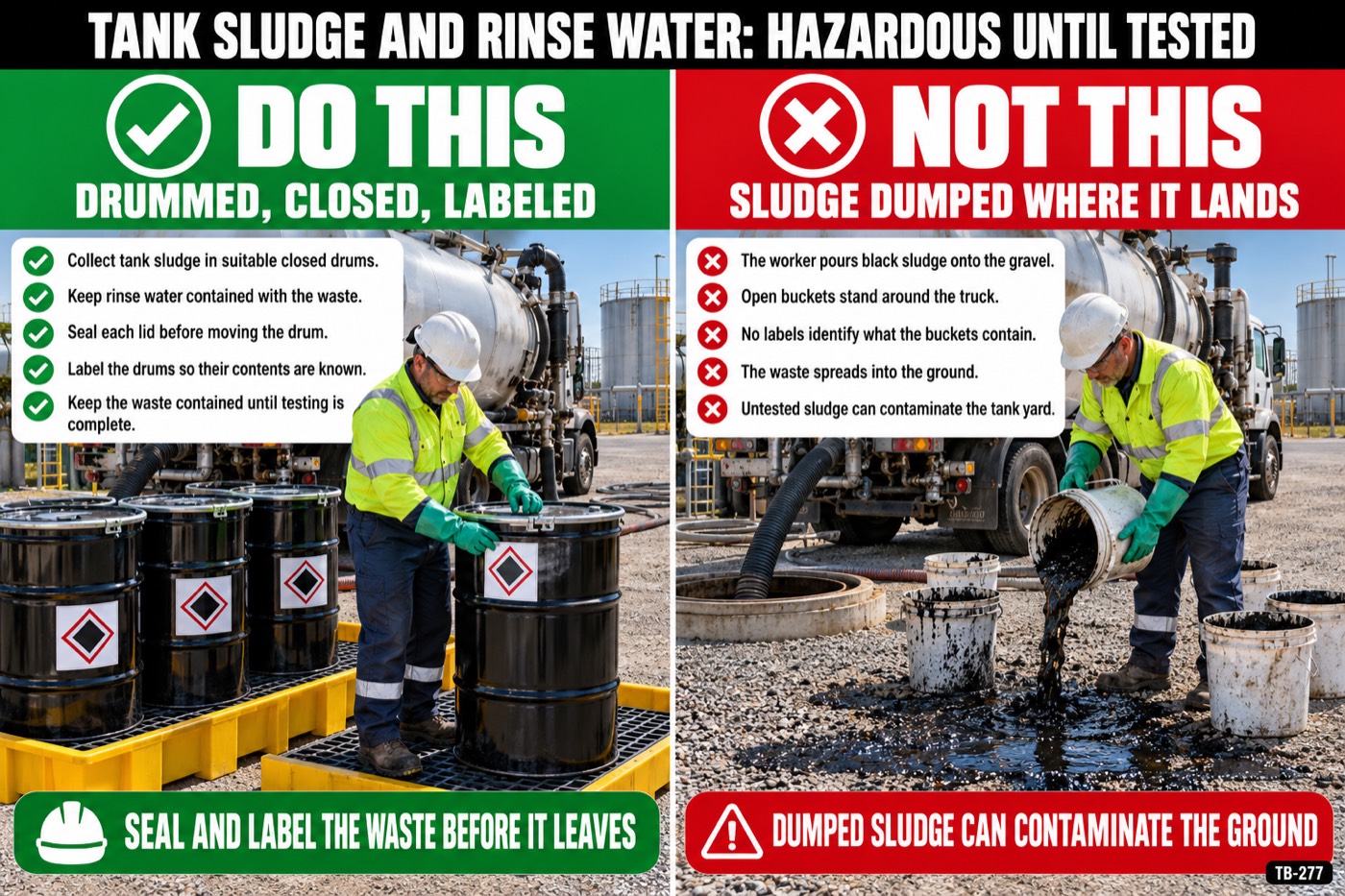
The truck pulls fifty gallons of black gasoline sludge, then four hundred gallons of rinse water, then the dirty water from three spill buckets. Now it is all one load, and nobody knows what any of it tested at.
The points
- Whoever generates a waste has to decide whether it is hazardous, at the point it is made and before any dilution or mixing. Tank sludge, rinse water and fuel-soaked rags all count. Until that call is made, handle them as hazardous.
- Gasoline sludge often fails two ways. Liquid waste with a flash point under 140 degrees F is ignitable, code D001. Waste whose TCLP extract has 0.5 mg/L benzene or more is toxic, code D018. Old tanks can also carry lead, D008.
- Do not mix rinse water into sludge, or sludge into a clean load, to make it pass. The determination is made before dilution, and mixing a hazardous waste into a bigger load just makes a bigger hazardous waste.
- Drums stay closed except when adding or removing waste. Hazardous waste containers are marked with the words Hazardous Waste, the hazards of the contents, and the date accumulation started. Bond the drum when filling with anything flammable.
- Contaminated soil from a cleanup under the tank rules has a narrow exclusion for some toxicity codes. Sludge pulled from inside a tank is not soil. Ask before you assume, and keep loads separate until someone with the test results decides.
Why it goes wrong
Everything that comes out of a fuel tank is a solid waste, and under 40 CFR 262.11 the generator has to make an accurate determination of whether it is hazardous. That decision is made at the point of generation, before any dilution, mixing or other change. It can be based on knowledge of the waste, or on testing when knowledge is not enough. On a tank job the owner and the cleaning contractor both have a stake, so settle before the job who signs as generator.
Two characteristics catch most fuel tank waste. A liquid waste with a flash point below 60 degrees C, which is 140 degrees F, is ignitable and carries code D001; gasoline and many gasoline-water mixtures are far below that. A waste is toxic if its extract from the TCLP test contains contaminants at or above the listed levels. For benzene that level is 0.5 mg/L, code D018. Sludge from tanks that once held leaded gasoline can also fail for lead at 5.0 mg/L, code D008.
Dilution is the trap. A vac truck that pulls sludge, then rinse water, then the water from the spill buckets and sumps ends up with one big mixed load. If the sludge was hazardous before it went into the truck, adding water does not change that, because the determination belongs to the point of generation. Plan the order of work so sludge and rinse water from each tank can be kept separate or at least characterized before they are combined.
Containers on site follow the generator rules. A container holding hazardous waste stays closed except when waste is being added or removed, so no open bungs with a funnel left in. For larger generators the rule requires marking with the words Hazardous Waste, an indication of the hazards, such as ignitable or toxic, and the date accumulation began, and limits on-site storage time. Use drums that are compatible with fuel, bond them during filling, and keep them out of traffic.
There is a real exclusion people misuse. Petroleum-contaminated media and debris that fail the toxicity test for codes D018 through D043 only, and are subject to the corrective action rules for tanks, are excluded from the hazardous waste definition. That covers soil and debris from a release cleanup. It does not turn tank bottoms into soil, it does not cover ignitability, and it does not cover lead. When in doubt, the load waits for a determination.
Rags, gloves, suits, absorbent pads and used cartridges soaked with fuel are waste too, and fuel-soaked rags in a closed bag in the sun can heat up. Put them in a closed metal container, not in the customer's dumpster. The paperwork follows the waste to a facility that is allowed to take it, and the crew's job is to make sure what is in each drum or truck matches what is written on its label and its papers.
Questions for the crew
- What wastes will this job make, and has anyone made the hazardous waste call on each one?
- How are we keeping the sludge separate from the rinse water on this tank?
- Where do the drums go, who labels them, and what is written on them?
To close
Today every waste from this tank is handled as hazardous until it is determined, kept separate where we can, and put in closed, labeled containers.
To hold this talk with your crew
1
Read it aloud. Five minutes, before the work starts.
2
Ask the questions. A crew that talks is a crew that remembers.
3
Have them sign on their own phones, and the record is sealed.