Respirators in a fuel tank: cartridge, airline or SCBA
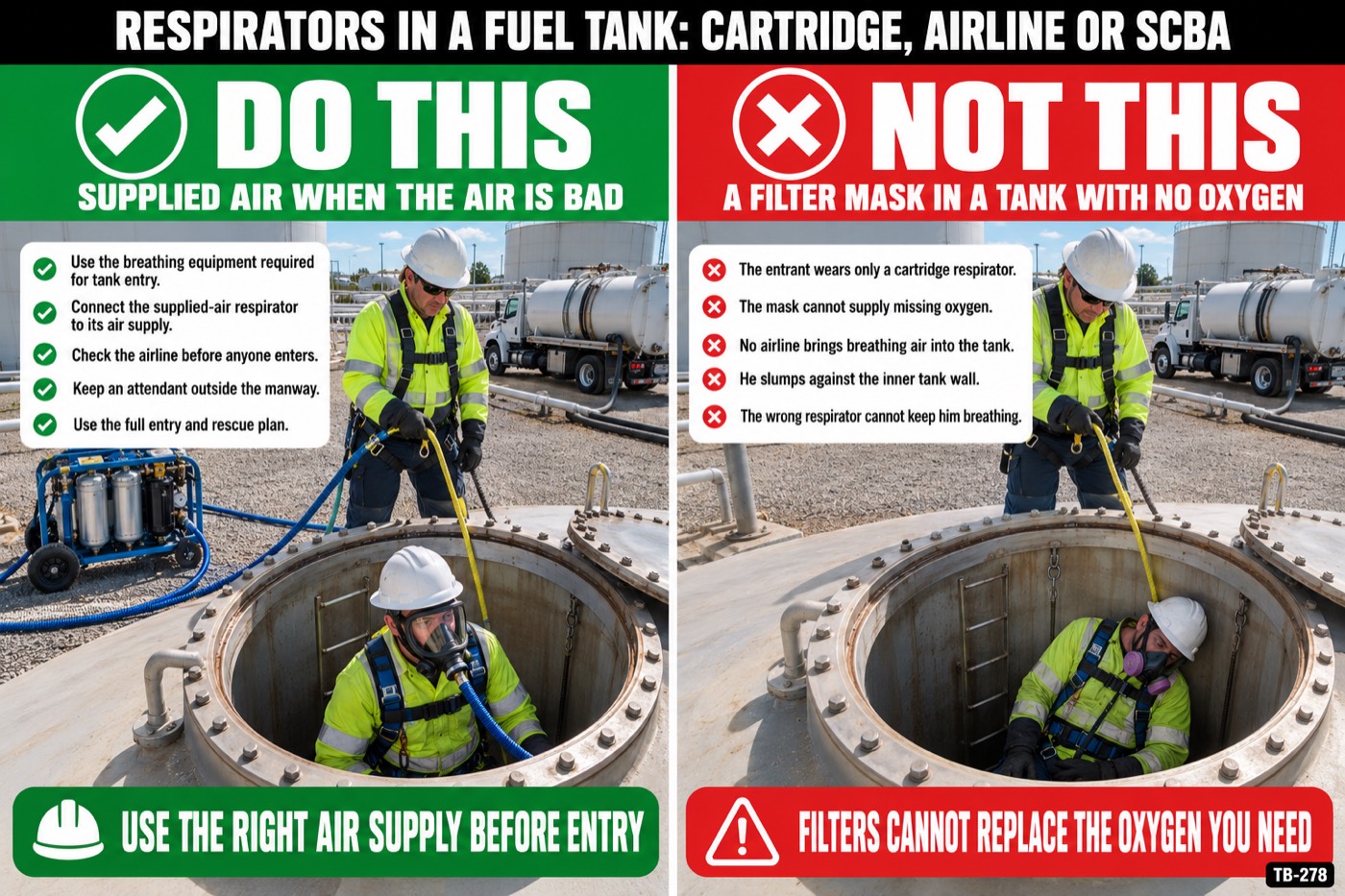
The entrant has a half-mask with organic vapor cartridges and the meter shows fuel vapor, so he feels covered. The oxygen sensor is reading 17 percent, and no cartridge in the world can fix that.
The points
- An air-purifying respirator cleans the air you have. It does not add oxygen, and it does not protect you in an atmosphere that is immediately dangerous to life or health. A fuel tank can be both low on oxygen and high in vapor.
- For IDLH air the rule allows only a full facepiece pressure demand SCBA rated for at least 30 minutes, or a full facepiece pressure demand airline with an auxiliary escape bottle. All oxygen-deficient air is treated as IDLH.
- Cartridges have a life. Unless the cartridge has an end-of-service-life indicator, the employer sets a change schedule based on data, and the cartridges are changed on that schedule, not when you start to smell fuel.
- Before you wear a tight-fitting respirator you get a medical evaluation, then a fit test on that exact make, model and size, repeated at least once a year. A different mask means a new fit test, and facial hair under the seal is not allowed.
- When someone works in IDLH air, at least one standby person stays outside, in contact, trained and equipped to rescue. The airline compressor or air source is placed so it never pulls in truck exhaust or tank vapor.
Why it goes wrong
Respirator choice in a fuel tank starts with one question: could this air be immediately dangerous to life or health? The rule defines IDLH as air that poses an immediate threat to life, would cause irreversible health effects, or would impair a person's ability to escape. A tank that has not been vapor-freed, an inerted tank, and any tank where oxygen is low or the readings cannot be trusted all fall on the IDLH side until the meter proves otherwise.
For IDLH air, 1910.134(d)(2) allows two choices: a full facepiece pressure demand SCBA certified by NIOSH for at least 30 minutes, or a combination full facepiece pressure demand supplied-air respirator with an auxiliary self-contained air supply. The rule treats all oxygen-deficient atmospheres as IDLH unless the employer shows oxygen stays within its altitude limits. An air-purifying cartridge respirator is not on that list. It filters vapor; it cannot make oxygen.
In a tank, an SCBA bottle is bulky in a small manway and runs out. That is why many crews use airline respirators with a small escape bottle on the belt. The airline comes from a breathing air compressor or cylinders placed upwind, with the intake away from the vac truck, the generator and the tank vents. Route the hose so it cannot kink, be driven over or snag on the manway ring, and assign someone to watch the air source.
Once the tank is vapor-freed, tested and stable, an air-purifying respirator with organic vapor cartridges may be the right choice for benzene and fuel vapor, if the measured exposure is within what that respirator is rated for. The rule requires a cartridge change schedule based on objective data unless the cartridge has an end-of-service-life indicator. Smell is not the signal; by the time you smell fuel through a cartridge it is already passing vapor.
Fit comes before use. The rule requires a medical evaluation before fit testing, a fit test before you first wear a tight-fitting facepiece, a new test whenever you change to a different size, style, model or make, and a retest at least once a year. Facial hair that lies between the seal and the face is not allowed. Do a user seal check every time you put it on. Your crew's talk on the P100 and the seal covers the check; this one is about picking the right kind.
When work goes on in IDLH air, the rule requires at least one standby person outside, staying in visual, voice or signal line contact, trained and equipped for rescue. On a tank job that is the attendant, with a harness and retrieval line on the entrant and a second set of supplied air ready. If the airline stops, the entrant switches to the escape bottle and comes out. Nobody stays inside to finish a last few feet of sludge.
Questions for the crew
- Is the air in this tank IDLH right now, and what reading says so?
- What respirator is each entrant wearing today, and when was each person last fit tested on that model?
- Where is the air source, what is upwind of it, and who is watching it?
To close
Today the meter decides whether the tank is IDLH, IDLH means SCBA or airline with an escape bottle, and every mask on site has a current fit test.
To hold this talk with your crew
1
Read it aloud. Five minutes, before the work starts.
2
Ask the questions. A crew that talks is a crew that remembers.
3
Have them sign on their own phones, and the record is sealed.