Spill buckets, sumps and leak detection: close every lid
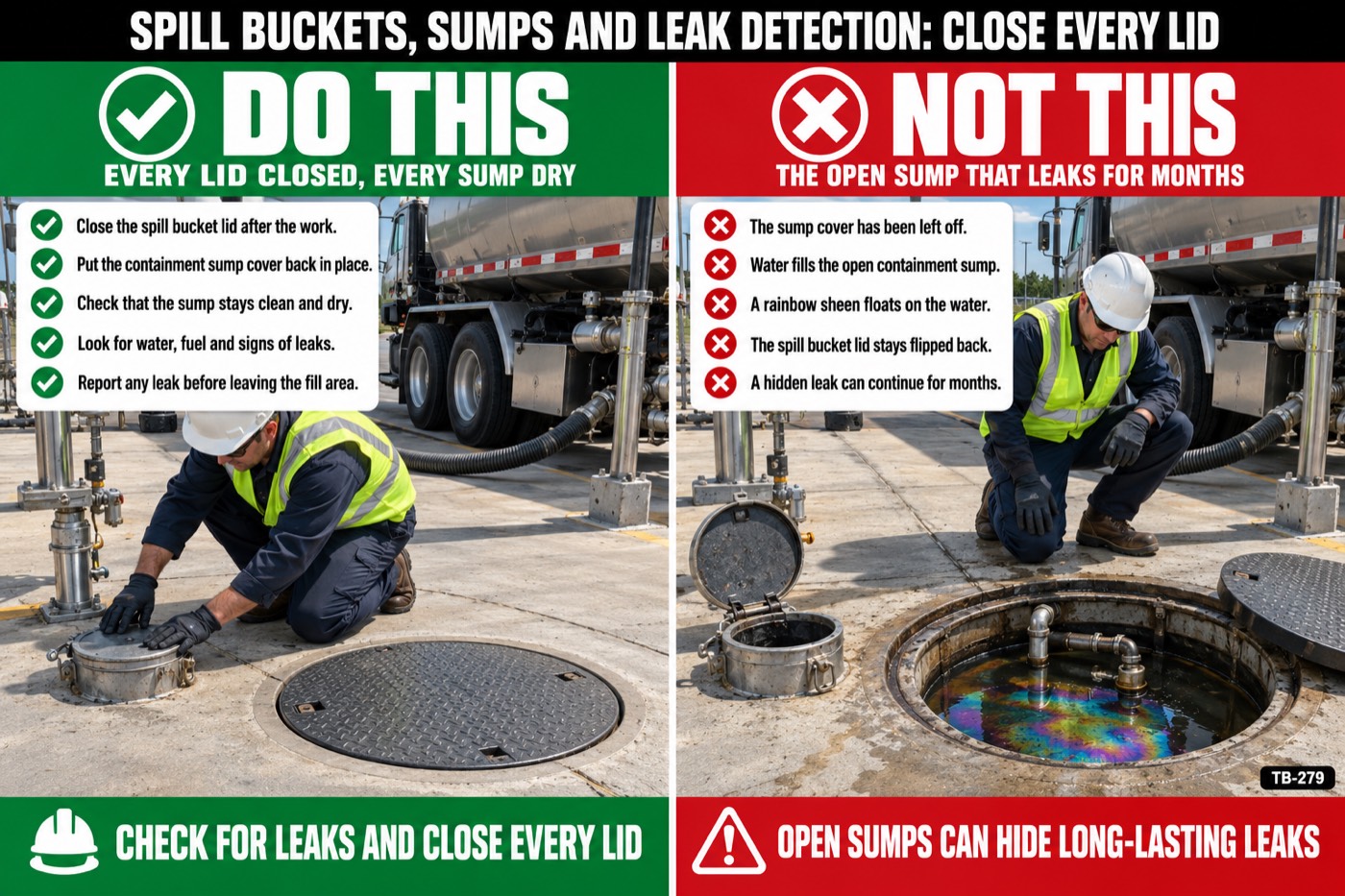
A crew vacuums three spill buckets, rinses them clean and rolls out by lunch. One fill cap is lying in the bottom of a bucket, and the afternoon rain fills the box and runs straight into the tank.
The points
- Spill buckets and containment sumps used for piping leak detection are tested at least once every three years to show they are liquid tight, by vacuum, pressure or liquid testing. Overfill equipment is inspected on the same cycle.
- Every 30 days the owner checks spill buckets for damage, removes liquid and debris, clears the fill pipe and makes sure the fill cap is secure. When you vacuum a spill bucket, that liquid is fuel-contaminated waste, not rinse water.
- Release detection catches small leaks. A tank tightness test has to find 0.1 gallon per hour, an automatic tank gauge 0.2 gallon per hour, and a line leak detector 3 gallons per hour at 10 psi within an hour.
- If you see a cracked bucket, fuel or water standing in a sump, a sensor out of its sump, or an alarm on the tank monitor, tell the owner and write it down. A crew is often the only set of eyes in those boxes for months.
- Before the truck leaves, every fill cap, spill bucket lid, sump lid, monitoring well cap and manway cover is back on and seated. An open lid lets rain and traffic in, and an open fill cap is a leak waiting for the next delivery.
Why it goes wrong
Many fuel leaks at a station start at the top, not in the tank shell: a cracked spill bucket, a loose fitting in a sump, a fill cap left off. The federal rules at 40 CFR 280.35 require spill prevention equipment and containment sumps used for interstitial monitoring of piping to be tested at least every three years for liquid tightness by vacuum, pressure or liquid testing. Overfill prevention equipment is inspected at least every three years to make sure it activates at the right level.
Between tests, 280.36 requires a walkthrough at least every 30 days. For spill prevention equipment that means a visual check for damage, removing liquid or debris, checking for and removing obstructions in the fill pipe, and checking that the fill cap is securely on the fill pipe. Release detection equipment is checked for alarms and unusual conditions. Containment sumps and hand-held release detection equipment get an annual check. Your crew often does the cleaning part of that work.
The liquid you vacuum from a spill bucket or a sump is fuel mixed with rain water and dirt. It goes in the truck as contaminated waste, not down a storm drain or back into the tank. Many spill buckets have a drain valve into the tank; water drained that way ends up in the customer's fuel. While the bucket is empty, look at it. Cracks, a split seam, a loose fill adapter or a gap at the riser are reasons to stop and tell the owner.
Release detection is how a leak gets caught while it is small. The federal limits show how small. A tank tightness test has to detect a leak of 0.1 gallon per hour, and an automatic tank gauge 0.2 gallon per hour. Automatic line leak detectors must catch 3 gallons per hour at 10 psi within an hour and be tested yearly, and a line tightness test must catch 0.1 gallon per hour at one and a half times operating pressure. A sensor lifted out of its sump or zip-tied up catches nothing.
When a tank tester is on site, the crew may be asked to pump water out of a tank, clean a sump so a sensor can be tested, or bring a tank to a set product level. Do exactly what the tester asks and nothing extra, and do not move probes, floats or sensors without them. If the tester finds a problem, the owner has reporting duties. Your part is to describe accurately what you saw and did, with times, and not to fix the evidence before anyone looks.
The last job of the day is a walk around every box on the site. Fill caps on and latched, spill bucket lids seated, sump lids closed and sealed, monitoring well caps on, manway covers down, and any locks back on. A lid left off lets rain flood a sump and set off an alarm, or lets a tire drop into a box. A fill cap left off lets water and dirt into the fuel. Check it, and have a second person check it.
Questions for the crew
- Which spill buckets and sumps are we opening today, and what condition are they in?
- Where does the liquid from those buckets go, and how is it labeled?
- Who does the final walk to check every cap, lid and cover before we leave?
To close
Today we report any crack, liquid or alarm we see, and two people check every cap, lid and cover on the site before the truck leaves.
To hold this talk with your crew
1
Read it aloud. Five minutes, before the work starts.
2
Ask the questions. A crew that talks is a crew that remembers.
3
Have them sign on their own phones, and the record is sealed.