Compressed gas cylinders
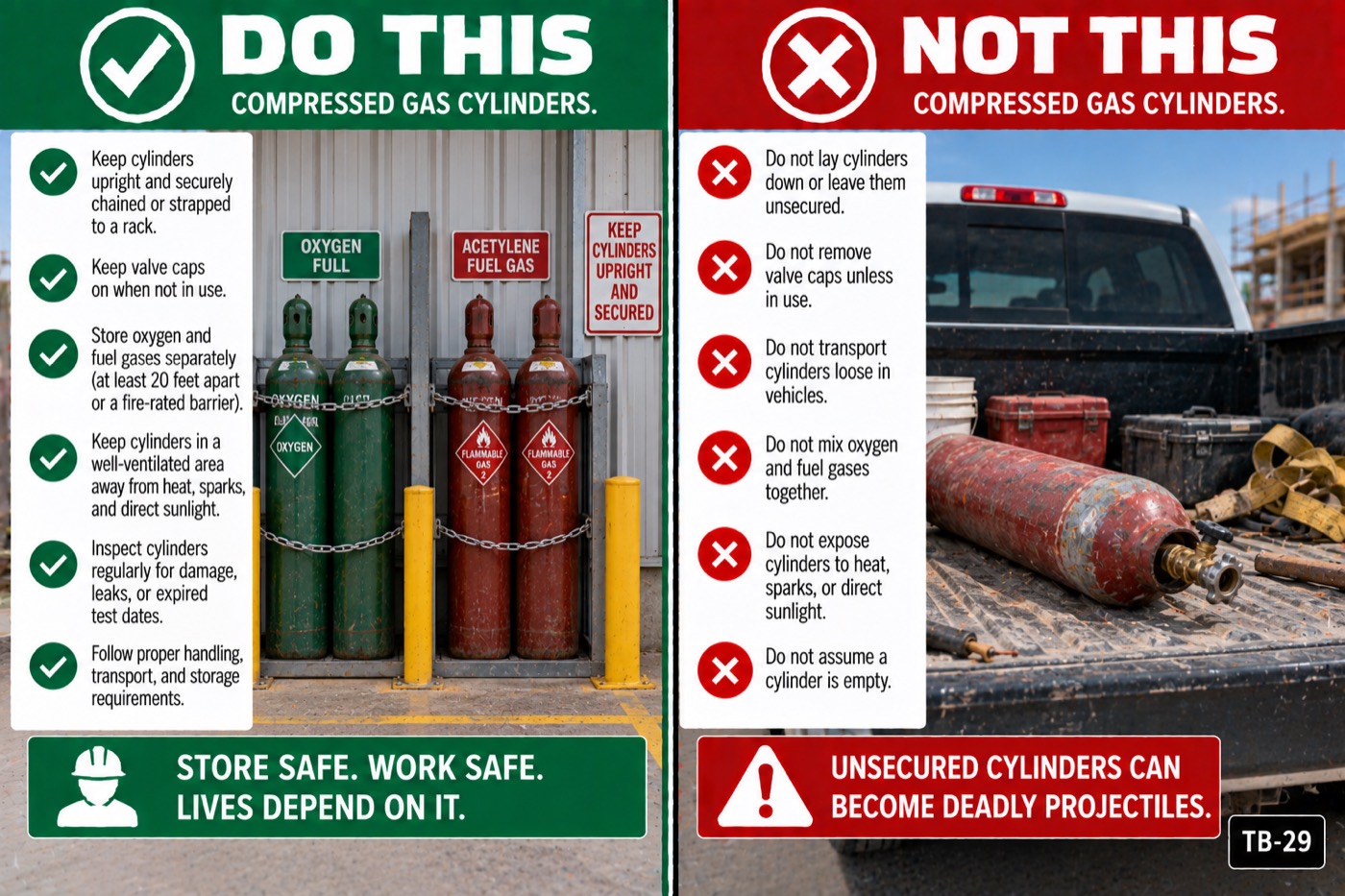
A cylinder that falls and snaps its valve off does not fall over. It leaves, through whatever is in the way.
The points
- Cylinders stand upright and secured, valve end up, chained or in a rack. A cylinder that falls and snaps its valve leaves through a block wall.
- Valve protection caps go on any time the cylinder is not connected and in use, including for a short move across the site.
- Store oxygen at least twenty feet from fuel gas, or separate them with a five-foot barrier rated for half an hour.
- No oil, no grease, no oily gloves near oxygen fittings. Oxygen and oil ignite on contact under pressure.
- A cylinder is never a roller, a support, or something to strike an arc against.
Why it goes wrong
A full cylinder holds gas at around two thousand pounds per square inch. The steel is built for it; the valve sticking out of the top is the weak point. Break that off and the cylinder becomes a rocket with enough energy to go through a block wall, and it does not travel in a predictable direction.
That is the whole reason for the rules that feel fussy. Upright so it cannot roll. Secured so it cannot fall. Valve cap on whenever it is not connected, including for a short move across the yard, because that short move is when they get knocked over.
Oxygen is its own hazard and it is not obvious. Oxygen is not flammable, but it makes everything else violently so. Oil or grease on a fitting, under pressure and in a pure oxygen stream, can ignite on contact with no spark at all. That is why oxygen is stored twenty feet from fuel gas or behind a rated barrier, and why oily gloves stay away from the regulator.
Questions for the crew
- Where are our cylinders right now, and is every one of them secured upright?
- Who has seen a cylinder go over? What stopped it, or what did not?
- Is there any oil or grease near where we handle the oxygen fittings?
To close
Upright, chained, caps on anything not in use. Check that before you leave the trailer today.
To hold this talk with your crew
1
Read it aloud. Five minutes, before the work starts.
2
Ask the questions. A crew that talks is a crew that remembers.
3
Have them sign on their own phones, and the record is sealed.