Backing up: the accident that happens in your own yard
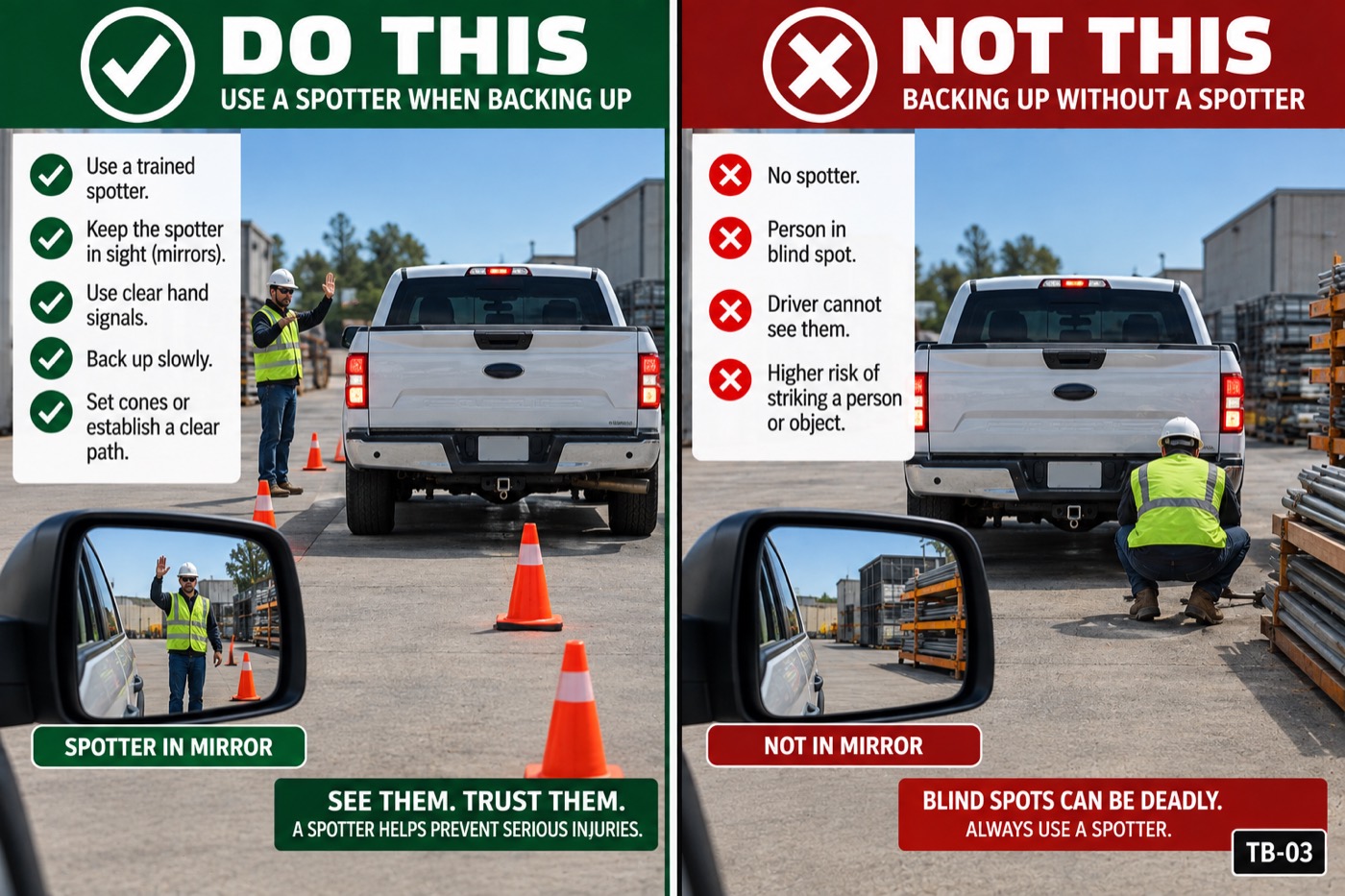
The truck that hurts somebody on a job like ours is often creeping along in reverse, close to where it parked.
The points
- Many struck-by incidents on small jobs happen at low speed, in reverse, close to where the truck parked.
- Walk the path behind the vehicle before you get in. Mirrors and cameras do not show a crouching person or a stack of material.
- If a spotter is guiding you and you lose sight of them, stop. Every time.
- Agree on hand signals before the truck moves, not while it is rolling.
- Nobody stands between a backing vehicle and a fixed object. Ever.
Why it goes wrong
Backing incidents seldom happen at speed or out on the road. Many happen in yards and on sites, at walking pace, within sight of where the vehicle parked, and often to somebody the driver had been talking to two minutes earlier. Familiarity is the hazard here; nobody clears a path they have driven a hundred times.
Mirrors and cameras do not solve it. Both give you a flat image of a space you cannot judge depth in, and neither one shows a person crouched at bumper height, a stack of material, or somebody who walked into the zone after you checked. The walk-around works because it puts you in the space itself, and because it takes long enough that anybody in it hears you.
The spotter rule is one sentence and it is absolute: if you lose sight of the spotter, you stop. Not slow down, not carry on and look for them. The whole value of a spotter is that they are in the place you cannot see, which means the moment you cannot see them, you have no information about that place at all.
Signals get agreed before the vehicle moves, because a signal invented mid-maneuver gets misread. And the spotter stands where they can be seen and where they cannot be pinned - never between the vehicle and a wall, a trailer, a stack, or another machine. Many of the deaths in this category are people crushed against something fixed, not run over.
Questions for the crew
- Where do vehicles back up on this site, and who walks through there?
- Who is spotting today, and what signal means stop?
- Is there a way to lay this out so nothing has to reverse at all?
To close
Walk behind your vehicle before you get in it. Every time, even in our own yard.
To hold this talk with your crew
1
Read it aloud. Five minutes, before the work starts.
2
Ask the questions. A crew that talks is a crew that remembers.
3
Have them sign on their own phones, and the record is sealed.